Rhinoceros Auklet (Cerorhinca monocerata)
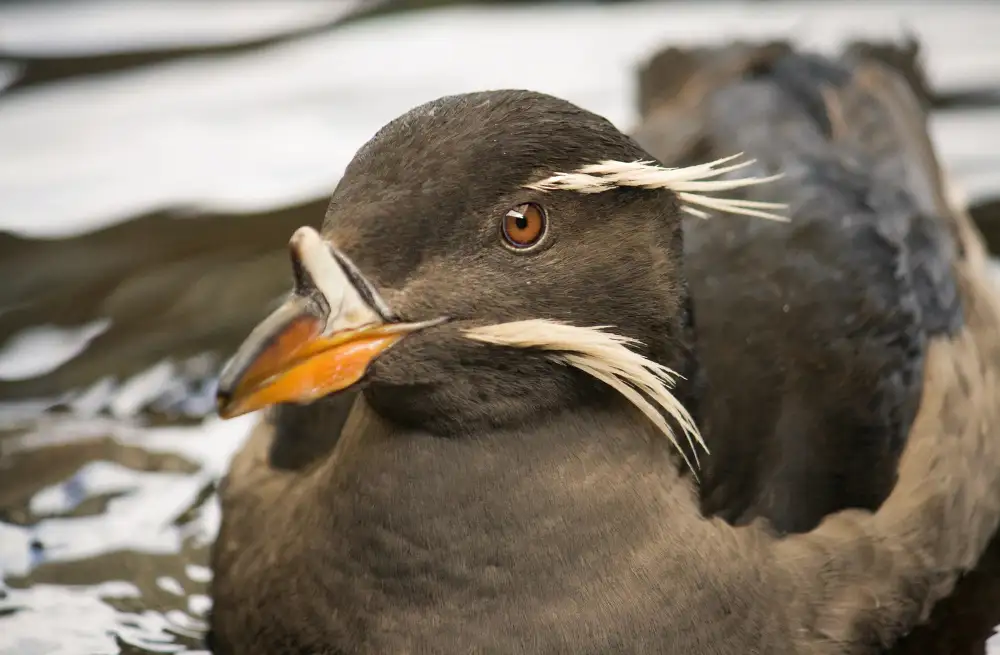
Despite its name, the Rhinoceros Auklet is actually more closely related to puffins than true auklets, and some ornithologists have even proposed renaming it.

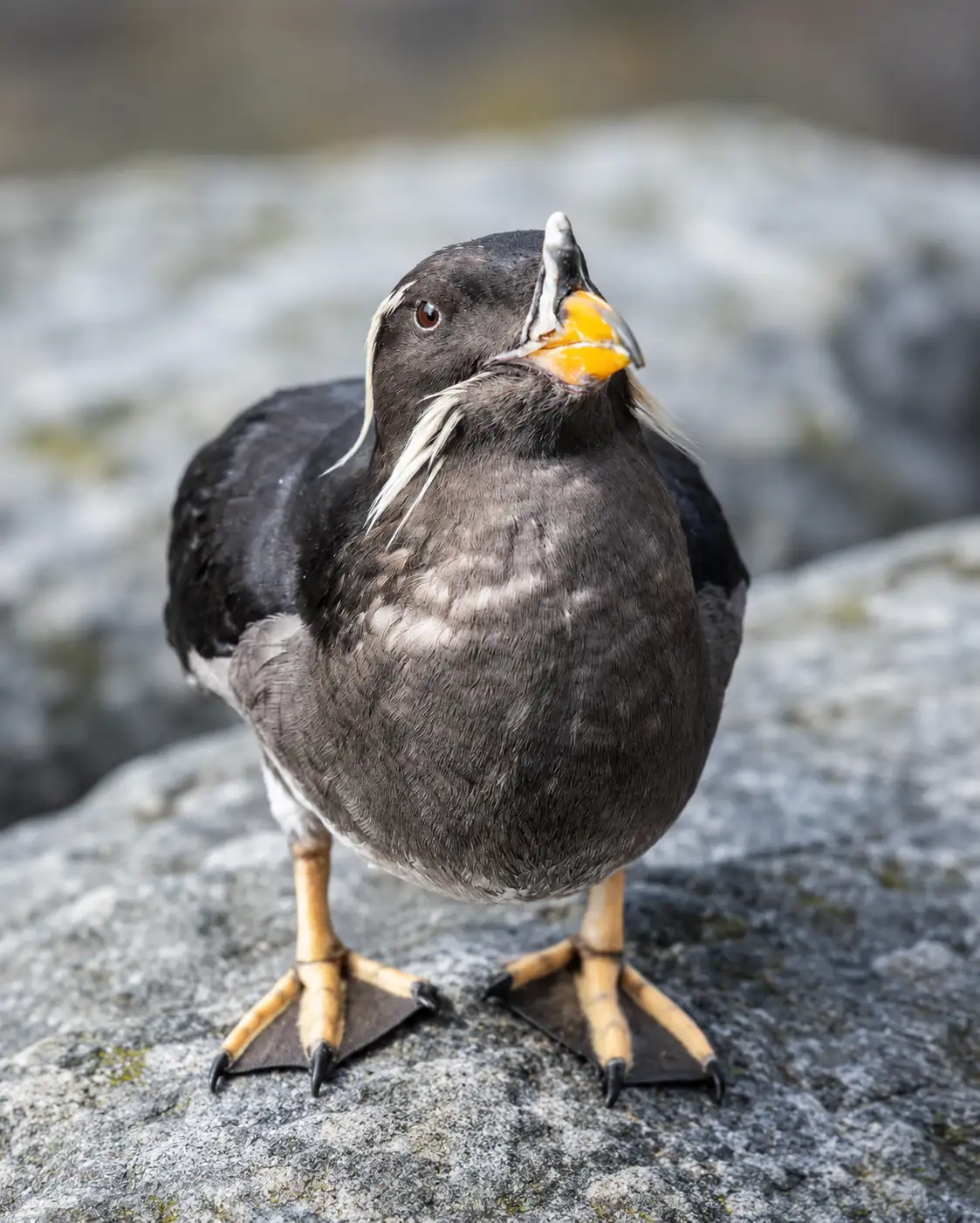
Each spring it develops a distinctive horn on its bill that is shed after the breeding season, glows under ultraviolet light, and, unlike other puffins, it returns to its nesting burrow only after dark, often carrying a row of fish across its bill.
IUCN status Least Concern (Pop. ~2.5 Million)
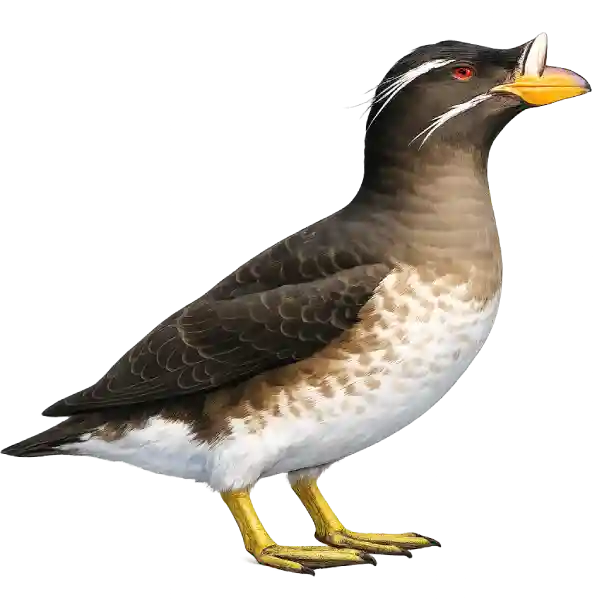
Rhinoceros Auklet showing its characteristic breeding horn

Rhinoceros Auklet

Cerorhinca monocerata
A nocturnal, burrow-nesting North Pacific seabird closely related to puffins, famous for its seasonal bill horn.

Species Profile

Length 14–15.5 in 35–39 cm
Wingspan 22–26 in 56–66 cm
Weight 15–21 oz 440–600 g
Subspecies Monotypic No subspecies
Clutch size 1 egg Only one brood per year
First breeding 3–5 years
Range North Pacific Coasts & open ocean
Population ~ 2.5 Million Widespread
Key Feature Bill Horn During breeding season
Nest Deep Burrow Excavated in soil
Diet Small Fish Anchovies, sand lance
Incubation 39–45 days By both parents

Scientific Classification

Kingdom Animalia
Phylum Chordata
Class Aves
Order Charadriiformes
Family Alcidae
Genus Cerorhinca
Species C. monocerata
Described Pallas, 1811 Originally Alca monocerata

1. Naming & Taxonomy

Peter Simon Pallas described the species in 1811. It is the only living member of the genus Cerorhinca.

The Name Is Wrong

This is the central fact about the bird, and it is not a minor quibble.

Despite being called an auklet, Cerorhinca monocerata is a close relative of the puffins. Molecular work by Friesen and colleagues in 1996 placed it in the tribe Fraterculini, alongside the three Fratercula puffins, and not with the true auklets at all.

The mismatch has been recognised formally. A proposal to the American Ornithologists' Union's classification committee in 2008 suggested renaming the species the rhinoceros puffin. Other names already in circulation include horn-billed puffin and unicorn puffin, along with the informal rhino auklet.

The name has not changed, but any source describing this bird as a true auklet is out of date.

A Genus That Once Spanned Two Oceans

Cerorhinca evolved in the North Pacific, apparently in the mid to late Miocene. It was once far more diverse than the single surviving species suggests, with fossils found as far south as Baja California.

  • Cerorhinca dubia L. H. Miller, 1925 — Late Miocene, Santa Barbara County, USA
  • Cerorhinca minor Howard, 1971 — Late Miocene or Early Pliocene, Cedros Island, Mexico
  • Cerorhinca reai Chandler, 1990 — Late Pliocene, San Diego
  • Cerorhinca sp. — Early Pliocene, southeastern United States

That last entry matters. Smith, Olson and Clarke reported the first Atlantic record of the clade in 2007, from the Pliocene of North Carolina. A genus assumed to be purely Pacific turns out to have had a more complicated history than anyone expected.

2. Identification & Appearance
Cerorhinca monocerata  ·  Identification & Appearance

Least Concern
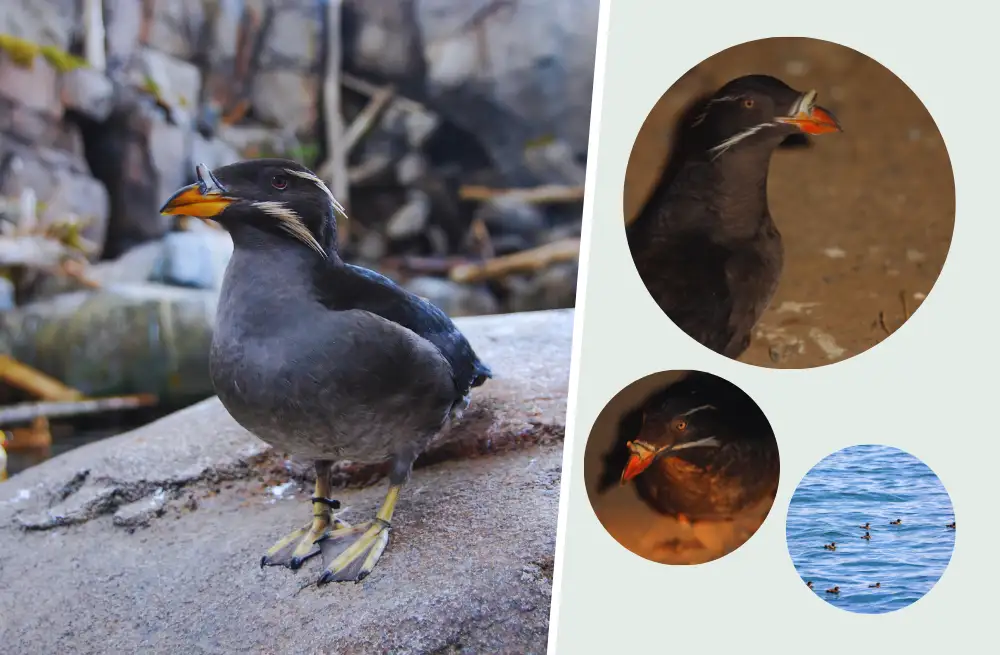
Billed as Unique The "Rhino" Horn Adults possess a fleshy, upright horn at the base of the upper mandible during the breeding season.
Breeding Bill Dull & Two-Tone The large, heavy bill is mostly brownish-black, with a yellowish tip and a pale yellow or greenish-yellow cere (base).
Body Length Approx. 15 in 38 cm Similar in size to a Rhinoceros Auklet's close relative, the Tufted Puffin.
Breeding Plumage (Head) Dark Hood & Plumes Head and upperparts are dark sooty-brown. Faint white plumes extend backward above and behind the eye.
Underparts Pale Grey & White The breast is brownish-grey, fading to whitish on the belly and under the wings.
Legs and Feet Pale Yellow Like many alcids, they have webbed feet set far back on the body, adapted for swimming but awkward on land.
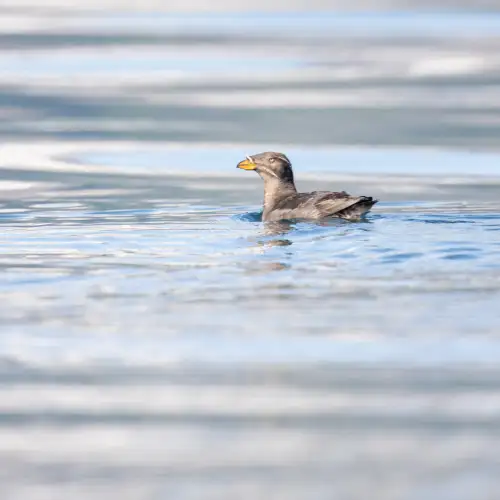
Winter Plumage Horn & Plumes Lost In non-breeding plumage, the horn is shed, the facial plumes disappear, and the bill becomes duller.
Confusing Critter No Tuft, Just Plumes Often mistaken for a Tufted Puffin, but lacks the prominent yellow head plumes. Males and females look alike.
A note on measurements: Reported size varies depending on the source. Since no official measurements are listed in the original species description on Wikipedia, and other references place the bird anywhere from 30–38 cm (12–15 in) long, the figures above should be considered approximate.
A note on male and female differences: There is no clear agreement on size differences between males and females. Some sources suggest males may be slightly heavier, while others note that distinctive features such as the horn are the same size in both sexes. For now, any reported difference in body size should be considered tentative.

Plumage

Dark above, paler below, and altogether plainer than a puffin. Breeding adults of both sexes carry two white plumes on each side of the head, one running back above the eye and one back from the base of the bill.

The bill itself is large, strong and orange-brown.

The Horn

The feature the bird is named for is a vertical extension of the rhamphotheca, the horny sheath of the bill, projecting upward from the upper mandible.

It appears only in breeding adults. It grows in early spring and is shed in late summer, exactly as puffins shed the bright outer plates of their bills, which is one more piece of evidence for where this species actually belongs.

Its function is unknown. It is the same size in males and females, which rules out the simplest explanations.

The Horn Glows

Research published in 2019 found that the bill is fluorescent under ultraviolet light, and that the effect is strongest in the horn itself.

This is likely to matter. Birds can see into the ultraviolet, and several species are known to use UV cues, so a fluorescent ornament on a bird that chooses a lifetime mate is a reasonable candidate for a signal. There is no difference in fluorescence between the sexes, but the amount varies noticeably between individuals, which is exactly what you would expect from something being assessed by a potential partner.

3. Range & Habitat

Cerorhinca monocerata  ·  Distribution at a glance

Least Concern
Range North Pacific Basin Breeds across temperate and subarctic coastal zones from California and Alaska across to Japan and the Kuril Islands
Core Stronghold British Columbia & Alaska The North American Pacific coast supports the vast majority of the global population, notably on secure offshore islands
Largest Colonies Triangle Island & Apex Reserves Major colonies house hundreds of thousands of breeding pairs, heavily concentrated on protected, predator-free islands
Southern Limit Central California & Honshu Breeding reaches as far south as the Channel Islands off California in the east and central Japan in the west
Winter Range Pelagic Waters Dispersive at sea; birds migrate south along the continental shelf and out into open northern Pacific deep waters
Foraging Range Up to 80 km from colonies During chick-rearing, adults fly far out to continental shelves and upwellings to harvest schooling fish like sand lance
Colony Requirements Forested & Grassy Slopes Requires stable subterranean soil or dense root matrices for deep burrowing, combined with steep slopes to provide lift for flight
Time Ashore Strictly Nocturnal Adults visit land exclusively under the cover of darkness to evade daytime aerial predators such as gulls and eagles
Favorite Habitats
  • Open Ocean primary habitat view Open Ocean
  • Rocky Offshore Islands habitat Offshore Islands
  • Grassy Coastal Slopes habitat Grassy Coastal Slopes
  • Nearshore Marine Waters habitat Nearshore Marine Waters

Breeding requires soil that can be dug, so colonies sit on islands with workable ground rather than bare rock. The birds prefer slight inclines, which help with take-off, because this is not a strong flier.

Migration is partial and regionally variable. Between October and April large numbers pass through pelagic Californian waters, most of them from colonies north of California. Birds that already live off the California coast simply stay put.

Within the family, the Rhinoceros Auklet generally occupies waters south of the Fratercula puffins.

4. Diet & Diving
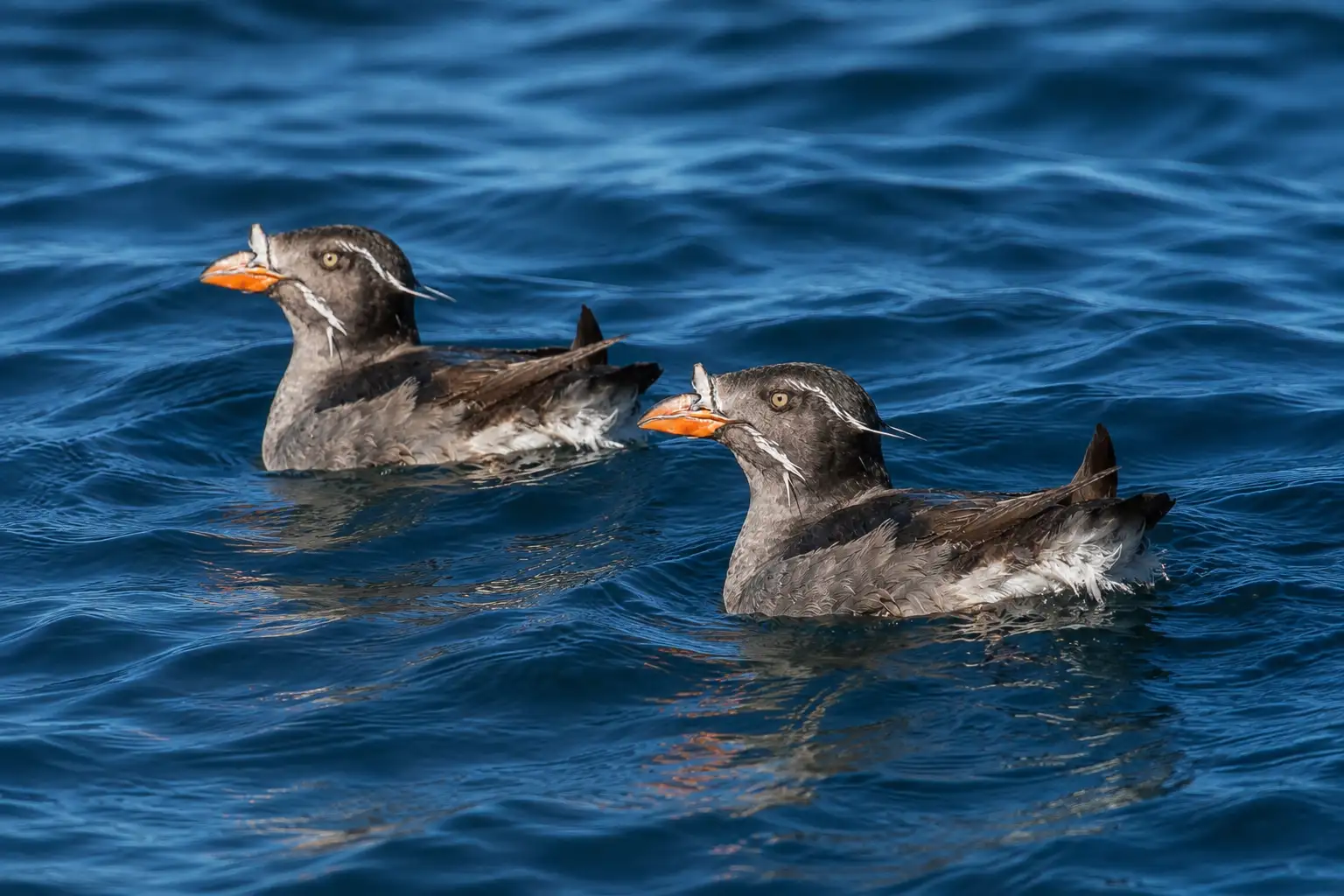
Mainly fish, with some krill and squid. During the breeding season it feeds inshore, in midwater rather than on the bottom.

Dive performance is considerable. Recorded to 57 m (187 ft), and submerged for as long as 148 seconds.

Diet composition depends heavily on where a colony sits, and the contrast can be sharp over short distances. At one island in the Salish Sea off Washington, the birds feed mainly on sand lance. At another island off the same coast, the diet is anchovy and smelt.

5. Breeding & Nesting
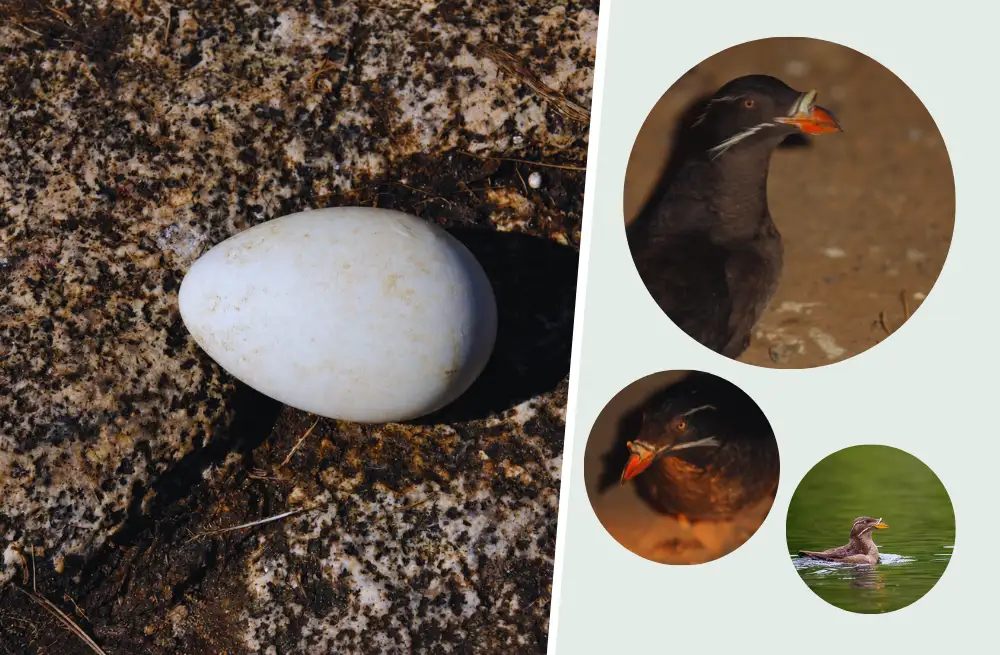
Cerorhinca monocerata  ·  Breeding & Nesting

Nocturnal Nester
Season May to June Timing of egg-laying varies slightly by latitude, but generally peaks in late spring
Pair Bond Monogamous Pairs winter separately at sea but synchronize to return to the exact same burrow each year
Nest Dug Burrow Excavated in the soil on sloping island terrain, or occasionally placed in natural rock cavities
Burrow Depth 1 to 5 m 3.3 to 16 ft Deep, winding tunnels help protect the chick from surface predators and harsh weather
Clutch Size A single egg Like most alcids, they invest heavy parental effort into raising just one chick per season
Incubation 39 to 45 days Incubation duties are shared equally by both parents (Note: corrected from 30-35 days to reflect actual biological data)
Chick Period 35 to 45 days The semi-precocial chick remains hidden in the burrow while parents forage
Feeding Visits Strictly at Night Parents return only in darkness, carrying fish crosswise in their bills to avoid kleptoparasitic gulls

It Comes Home in the Dark

This is what separates the Rhinoceros Auklet from the puffins it is related to.

Adults visit the colony at night. Cornell notes two things that follow from it: this is the largest auk to attend its breeding colony after dark, and it is the only nocturnal auk that carries fish externally. Every other night-visiting auk brings food back in a gular pouch, if it brings food at all.

The reason is thought to be gulls. Arriving in daylight with a visible beakful of fish invites both predation and theft, and darkness removes the problem. The trade-off is that the bird has to find its own burrow entrance, among thousands of others, in the dark.

The chick is semi-precocial and is fed each night with a bill full of fish, in the manner of a puffin, for 35 to 45 days.

Pairs Migrate Apart, Then Sync Up

A 2018 study produced one of the more surprising findings about this species. Pair-mates are monogamous and migrate across broadly similar areas, but they do so separately, not together.

Then, once they return to the colony in the pre-laying period, they synchronise their foraging activity. Whatever holds the pair together, it is not proximity through the winter.

6. Conservation

The IUCN lists the Rhinoceros Auklet as Least Concern.

Introduced rodents are the clearest historical threat. Populations at some former colonies crashed after rats and rabbits reached the islands, which is a familiar pattern for any seabird that nests in a burrow at ground level.

The recovery story is equally clear. Active removal of rats and rabbits from affected islands has led to successful recolonisation of former nesting sites. As with the Pigeon Guillemot and introduced foxes, the intervention that works is the removal of the mammal.

Similar Species

Swipe

Iconic seabird famous for its vibrant, multi-colored beak.

Read More
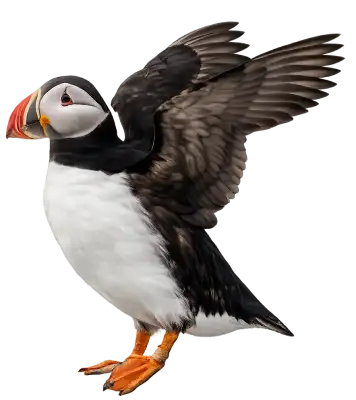

Atlantic Puffin Iceland
Atlantic Puffin

Penguin-like diver with a slender, pointed bill.

Common Murre United States
Common Murre

Stocky cliff-nester recognized by a distinct white bill stripe.

Thick-billed Murre Canada
Thick-billed Murre

A robust, black-and-white seabird recognized by its thick, blunt bill.

Read More
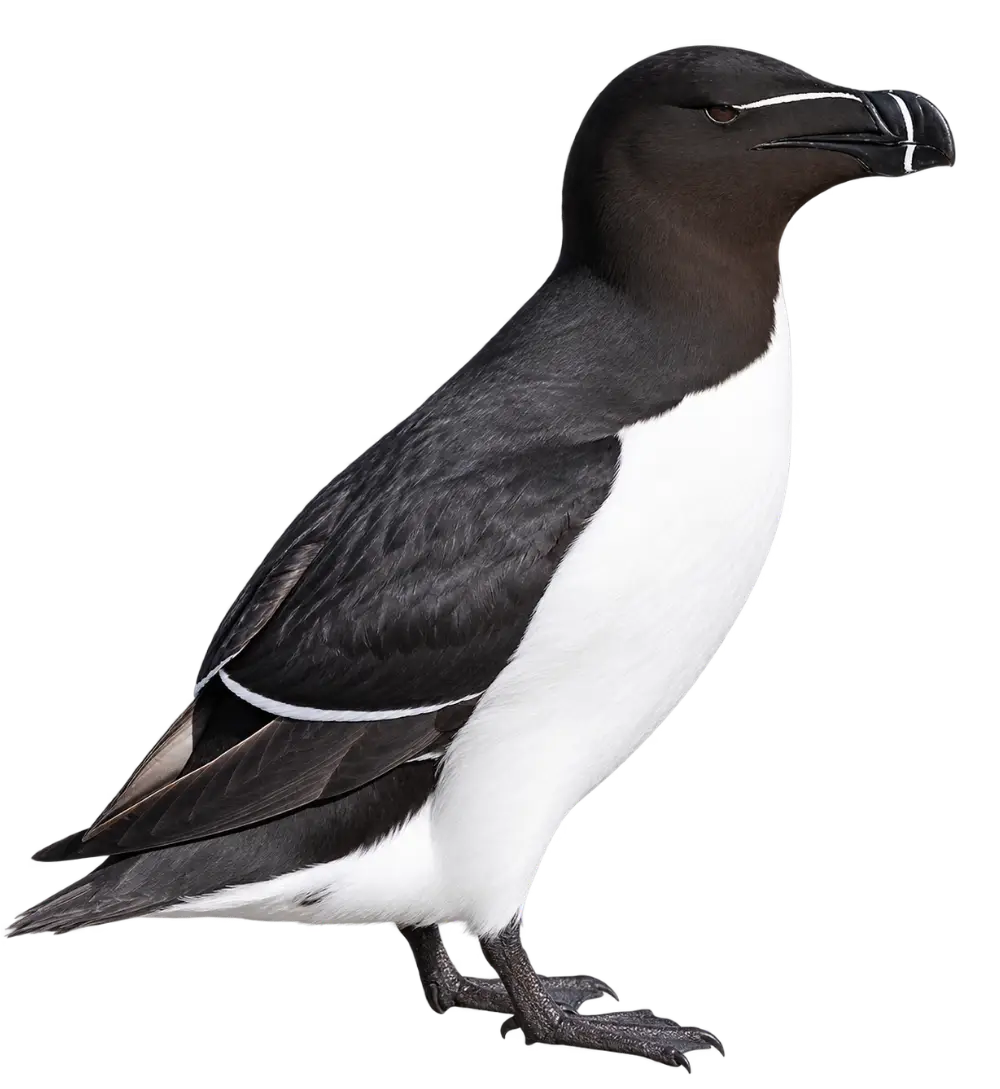
Razorbill Canada
Razorbill

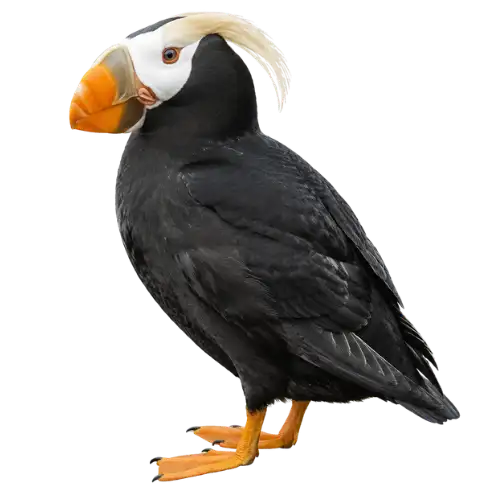
Pelagic bird sporting sweeping golden head plumes.

Read More
Tufted Puffin United States
Tufted Puffin

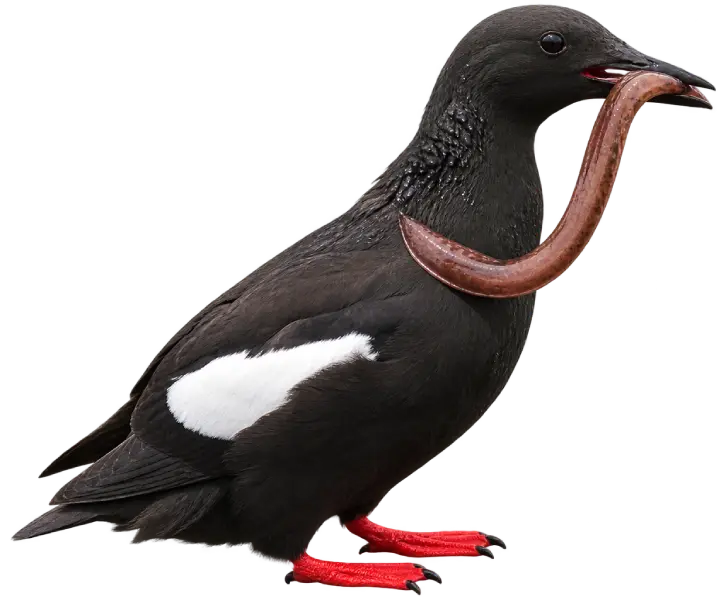
A striking coastal seabird with solid black plumage and prominent white wing patches.

Read More
Black Guillemot Iceland
Black Guillemot

Massive, flightless seabird driven to extinction in the 1800s.

Great Auk Iceland
Great Auk

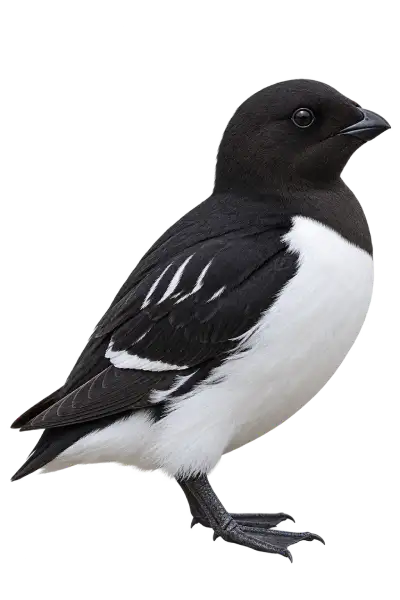
Tiny, plump Arctic seabird that gathers in massive flocks.
Little Auk Norway
Little Auk

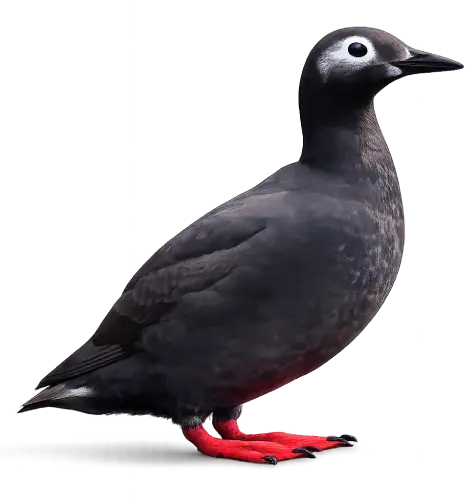
Pacific seabird known for distinct white eye-rings.
Spectacled Guillemot Japan
Spectacled Guillemot

Small seabird that remarkably nests in old-growth forests.
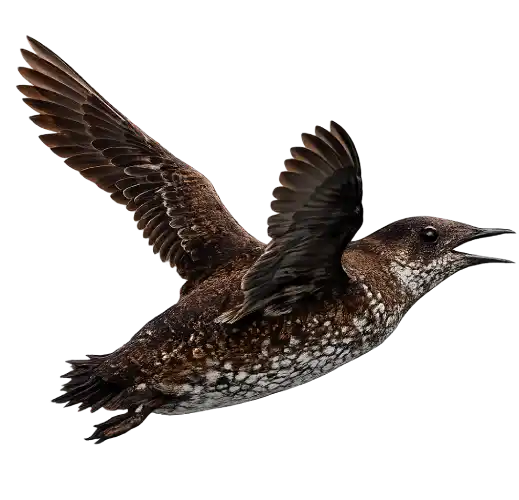
Marbled Murrelet United States
Marbled Murrelet

Striking black seabird with large white wing patches.

Read More
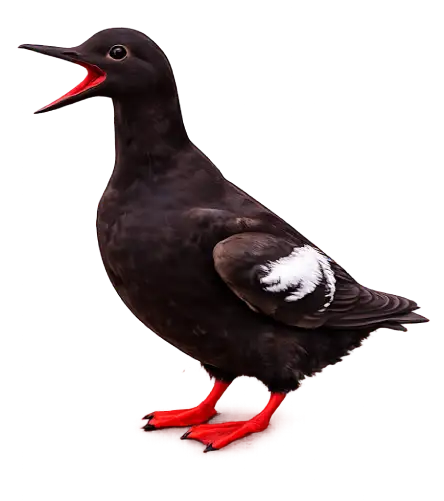
Pigeon Guillemot United States
Pigeon Guillemot

Distinctive seabird named for the fleshy horn above its eyes.

Horned Puffin United States
Horned Puffin

Common Questions About the Rhinoceros Auklet

Is the Rhinoceros Auklet actually an auklet?

No. Despite the common name, molecular and genetic studies place it firmly in the tribe Fraterculini—the true puffins. It is so closely related to puffins that ornithologists have formally proposed renaming it the "Rhinoceros Puffin" to correct the historical mistake.

Is the horn permanent?

No. The distinctive, fleshy horn at the base of the bill only grows in early spring for the breeding season. Once the chicks hatch and the breeding season ends in late summer, the horn drops off entirely, leaving the bird with a much plainer bill for the winter.

Why do they only visit land at night?

To avoid being robbed. Rhinoceros Auklets carry whole fish crosswise in their bills to feed their chicks. Arriving at the colony in broad daylight would make them an easy target for kleptoparasitic gulls and eagles looking to steal their catch or eat the auklets themselves.

Does the horn actually glow in the dark?

It glows, but under ultraviolet (UV) light, not on its own in the dark. Research confirmed that the horn is highly fluorescent under UV wavelengths. Since seabirds can see into the UV spectrum, this glowing ornament is almost certainly used as a visual signal during mate selection.

Can you tell males and females apart?

Not by looking at them. The Rhinoceros Auklet is monomorphic, meaning males and females look practically identical. Both sexes grow the unique horn and the white facial plumes during the breeding season, and both share incubation and chick-rearing duties equally.

Where can I see them?

Seeing them from land is incredibly difficult because they spend their days far out on the North Pacific Ocean and only return to their island colonies in pitch darkness. Your best chance is on a pelagic (open ocean) boat tour off the coasts of California, Oregon, Washington, British Columbia, or Alaska during the summer months.

How deep are their nests?

They are prolific diggers, excavating winding tunnels into the soil of coastal slopes that can reach anywhere from 3 to 8 feet (1 to 2.5 meters) deep. The single egg is laid in a small chamber at the very back of the burrow, keeping the chick safely insulated from weather and predators.

Are Rhinoceros Auklets endangered?

Globally, the IUCN lists them as Least Concern because the total population remains robust (over 2.5 million birds). However, because they nest underground, specific island colonies have suffered total collapse when invasive mammals like rats or foxes were introduced. Eradicating these predators is the most effective way to protect them.

Sources & References

  1. Birds of the World: Rhinoceros Auklet birdsoftheworld.org  ·  Cornell Lab of Ornithology species account
  2. IUCN Red List assessment for Cerorhinca monocerata iucnredlist.org  ·  BirdLife International (2018) population data
  3. Fluorescent ornamentation in the Rhinoceros Auklet Ibis 161(3)  ·  Wilkinson, Johns & Warzybok (2019)
  4. Pair-mates migrate independently but synchronize foraging Ibis 160(4)  ·  Kubo, Takahashi, Thiebot & Watanuki (2018)

Last reviewed August 2026.

We will be happy to hear your thoughts

Leave a reply

Wild Birds World
Logo