Atlantic Puffin (Fratercula arctica)
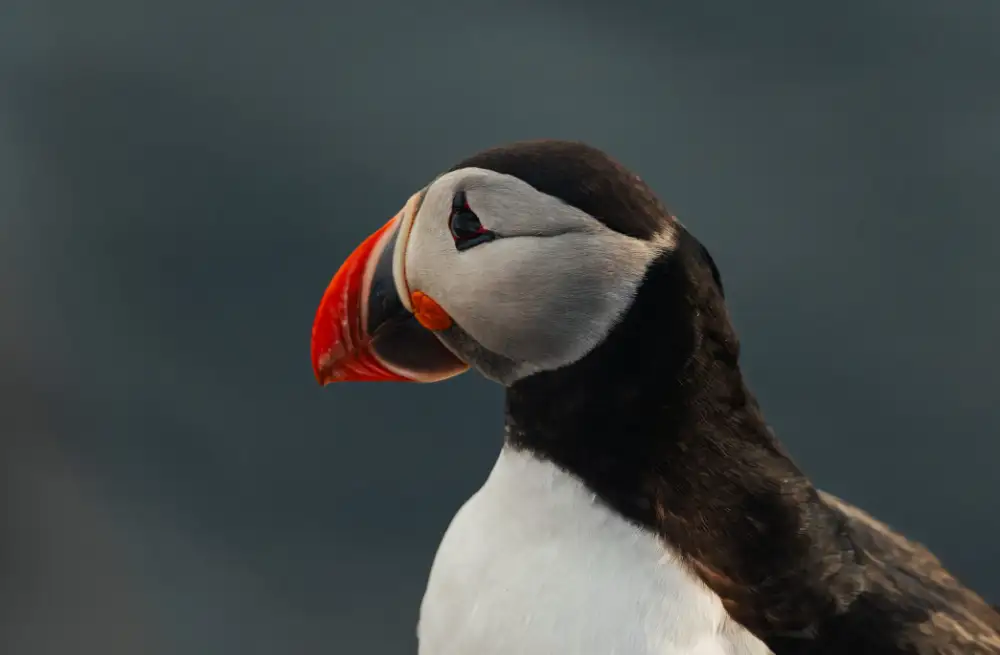
The Atlantic Puffin is the most recognizable puffin species and the only one found in the Atlantic Ocean.
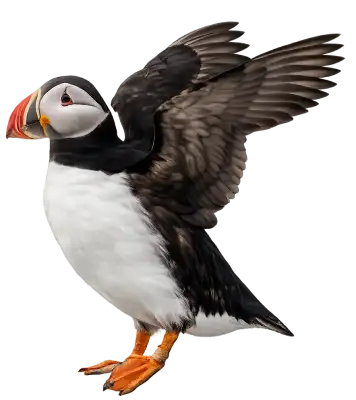
Despite its colorful appearance, it spends most of its life far out at sea, can fly at speeds of up to 55 mph (88 km/h), “flies” underwater using its wings, and molts all of its flight feathers at once each winter, leaving it temporarily unable to fly.
It is also the only puffin species currently classified as Vulnerable by the IUCN.
Species Profile
Scientific Classification
1. Relatives
The closest relative is the Horned Puffin of the Pacific. The puffins together with the Rhinoceros Auklet form the tribe Fraterculini within the auk family, Alcidae.
Three Subspecies, or None
Three are generally recognised: F. a. arctica, F. a. grabae and F. a. naumanni. The only difference between them is size, and it increases with latitude in a clean gradient.
| Weight | Wing length | |
|---|---|---|
| F. a. naumanni, northern Iceland | 650 g (1 lb 7 oz) | 186 mm |
| F. a. arctica, southern Iceland | Intermediate | Intermediate |
| F. a. grabae, Faroes | 400 g (0.9 lb) | 158 mm |
Ernst Mayr argued that the differences are clinal, typical of peripheral populations, and that no subspecies should be recognised at all. That view has not won out, but it is worth knowing that the divisions are boundaries drawn across a gradient rather than distinct groups.
2. Identification & Appearance
Fratercula arctica · Identification at a glance
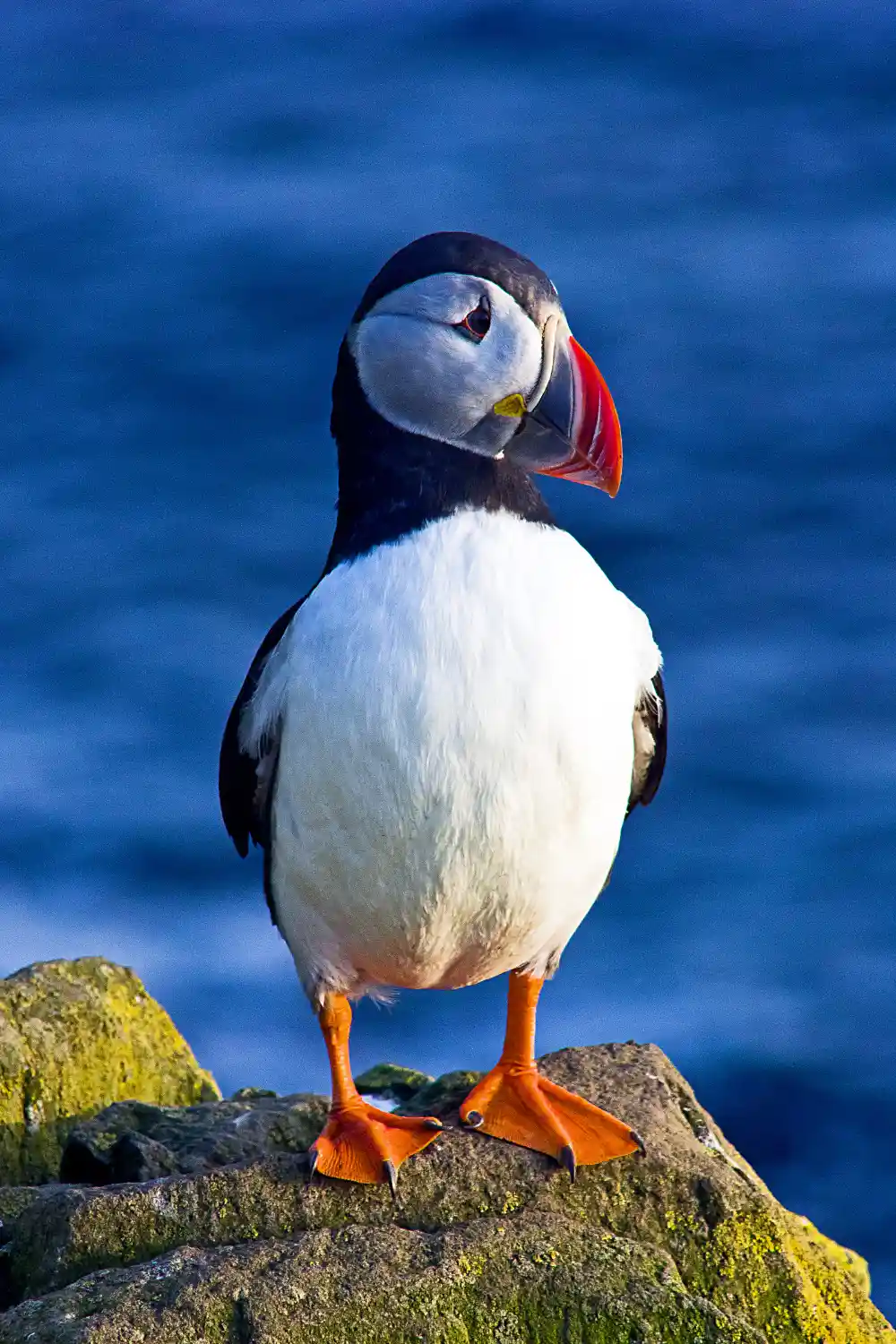
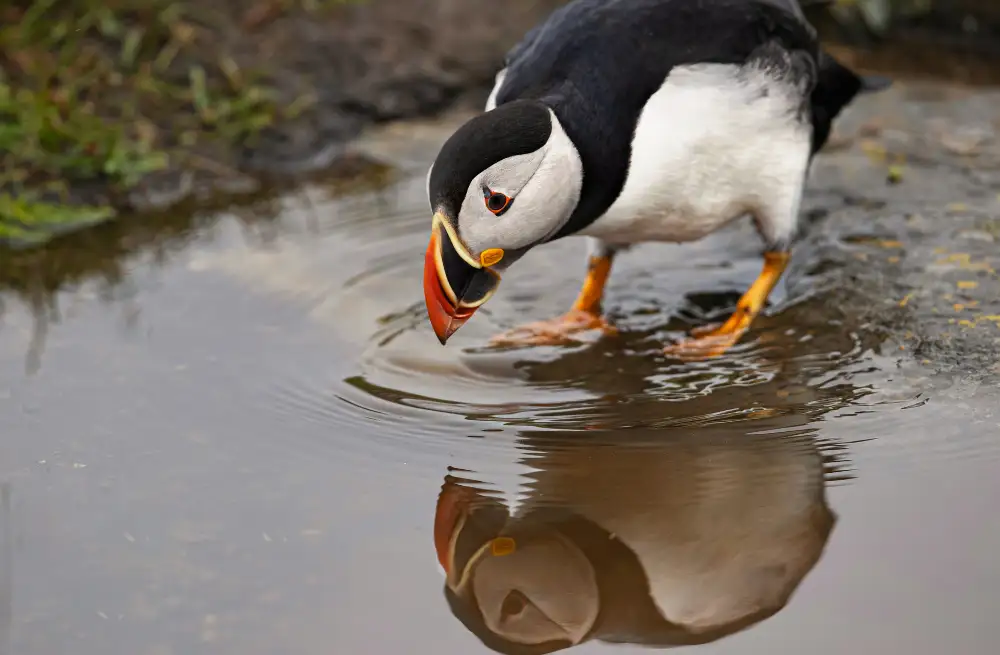
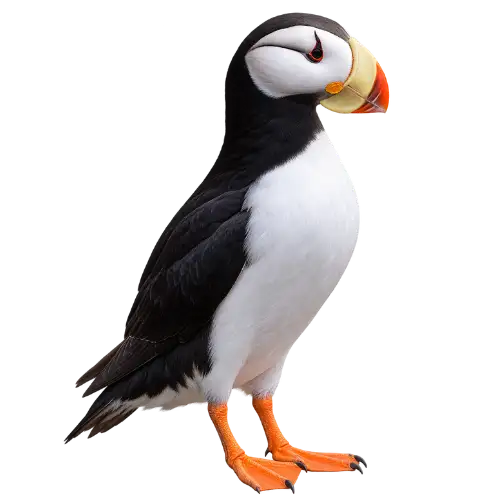
VulnerableGlossy black across the forehead, crown, nape, back, wings and tail, with a broad black collar around the neck and throat. The underparts are white. On each side of the head sits a large lozenge of very pale grey, tapering to a point and nearly meeting at the back of the neck.
The eyes look almost triangular, an effect created by a small peaked area of horny blue-grey skin above each eye and a rectangular patch below. The irises are brown or very dark blue, each ringed in red.
The legs are short and set well back on the body, which is what gives the bird its upright stance ashore. Legs and webbed feet are bright orange, against sharp black claws.
Males are generally slightly larger than females, but the two are coloured alike.
The Bill Is an Age Chart
Broad and triangular from the side, narrow from above. The outer half is orange-red, the inner half slate grey, separated by a yellow chevron-shaped ridge, with a yellow fleshy strip at the base and a yellow wrinkled rosette where the mandibles join.
The proportions change as the bird ages. An immature bird has a bill of full length but not full width. Over time it deepens, the upper edge curves, and a kink develops at the base. With age, one or more grooves may appear on the red section. The bite is powerful.
Winter Is a Different Bird
The bright bill plates and facial ornaments are grown in spring and shed in a partial moult at the end of the breeding season. The bill becomes narrower, its tip duller and its base darker grey. The eye ornaments drop away and the eyes look round. The head and neck feathers are replaced at the same time, and the face darkens.
Almost nobody sees this. Once the birds leave their chicks they head out to sea and do not return to land until the following breeding season.
Juveniles
Similar in plumage but duller throughout, with a much darker grey face, a yellowish-brown bill tip and dark legs. Each year at sea the bill broadens, the face patches pale, and the legs and bill brighten.
3. Built for Water, Not Air
The wings are small relative to body weight because they have two jobs, and the underwater one wins.
Flight is expensive. To stay airborne the wings must beat several times per second. Flight is direct and low, typically about 35 feet above the sea, which is higher than most auks manage, and the bird can reach 50 mph. Take-off means pattering across the surface while flapping hard. Landing is graceless: a crash into a wave crest, or a belly flop in calm water.
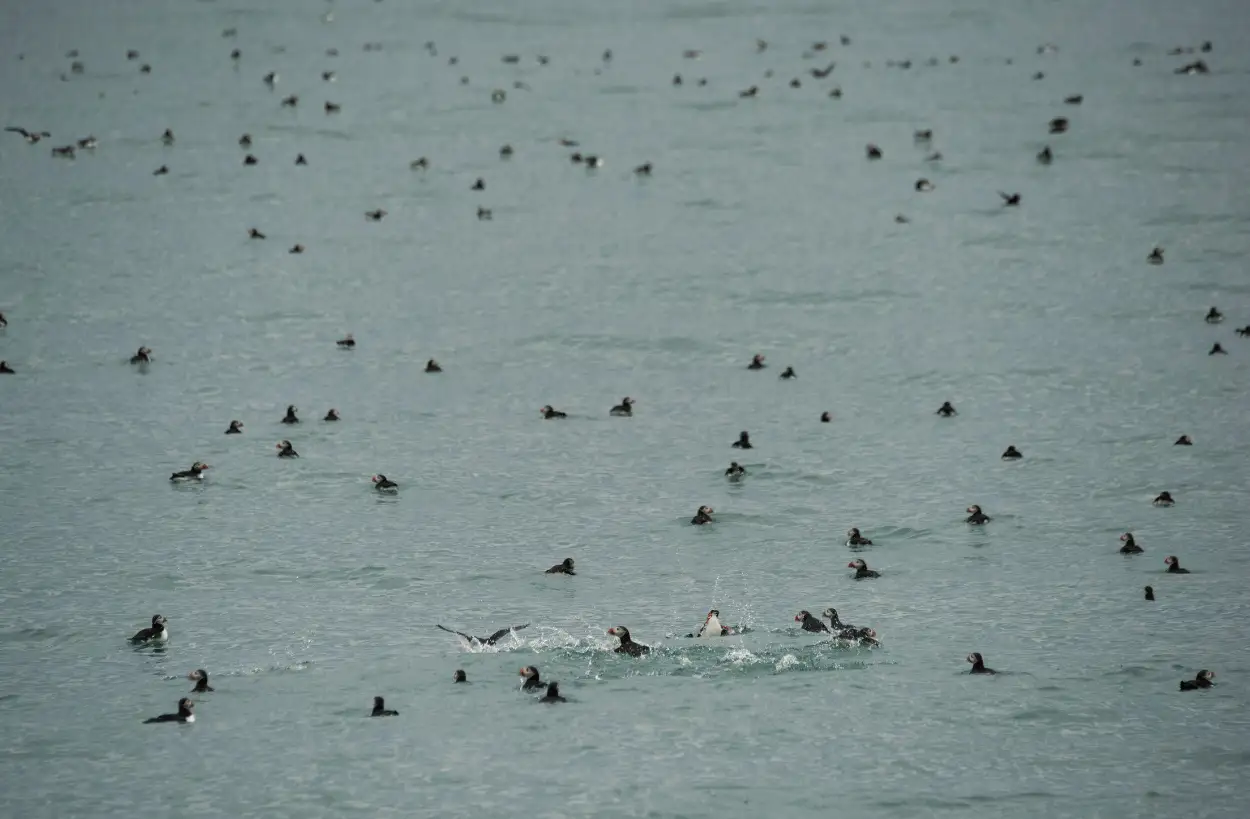
Underwater it is transformed. The bird swims with semi-extended wings as paddles and its feet as a rudder, reaching considerable depths and staying submerged for up to a minute.
It gives up flying entirely once a year. Most birds moult their primaries a pair at a time so they can keep flying. The Atlantic Puffin sheds all of them at once and is flightless for a month or two, usually between January and March, alone on the open ocean.
4. Range & Habitat
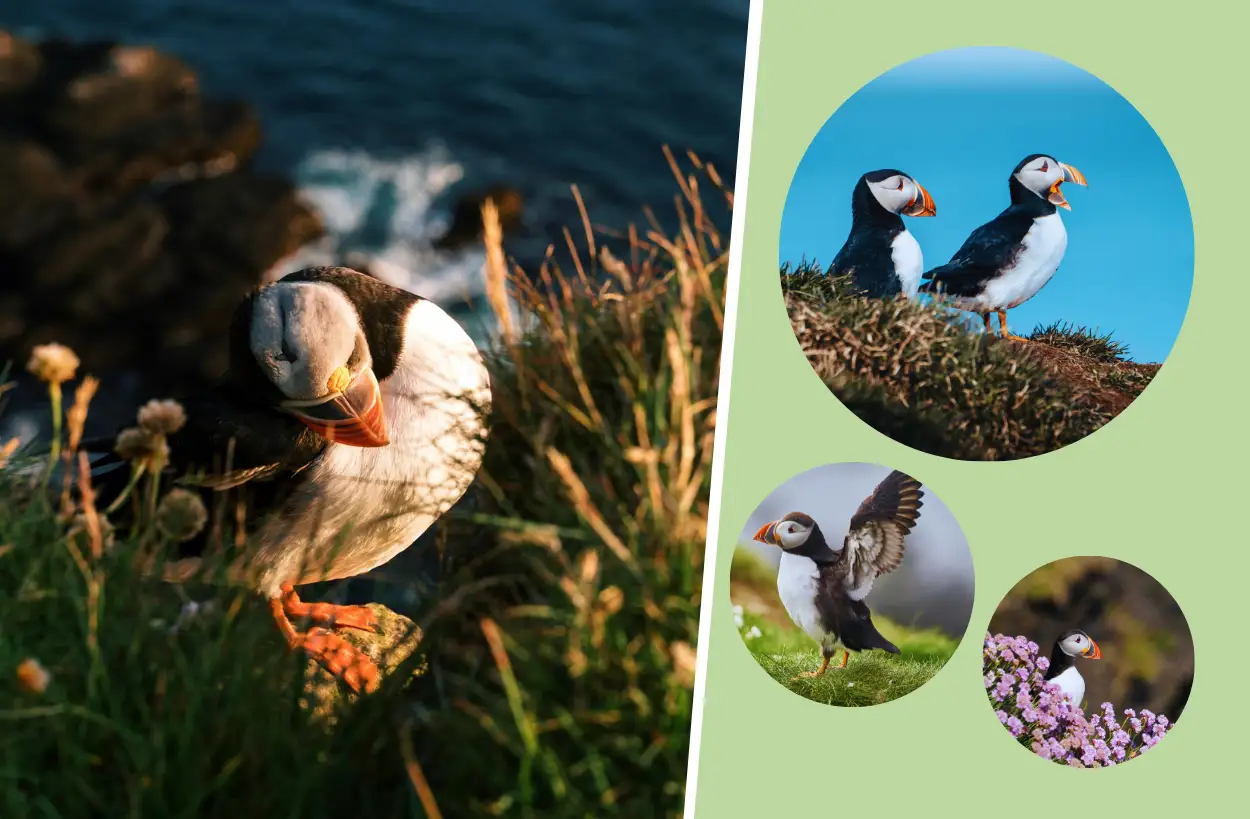
Fratercula arctica · Distribution at a glance
Pelagic-
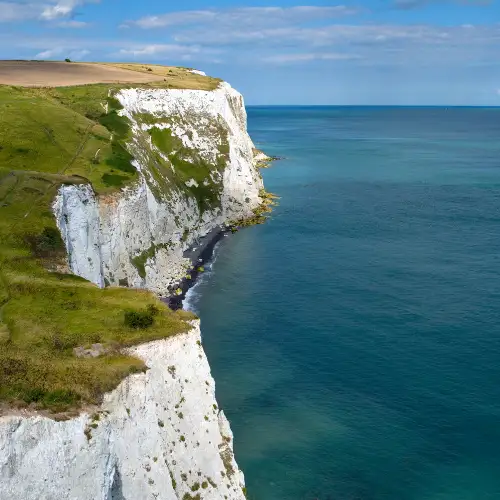 Rocky Sea Cliffs
-
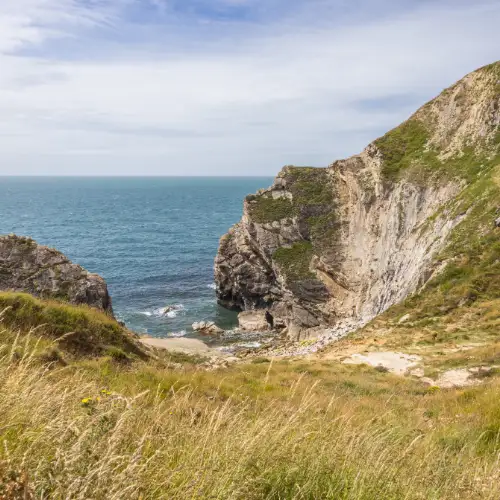 Grassy Coastal Cliffs
-
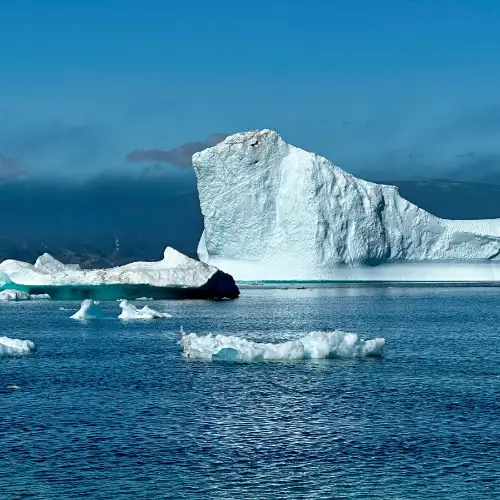 Cold Atlantic Waters
-
 Open Ocean
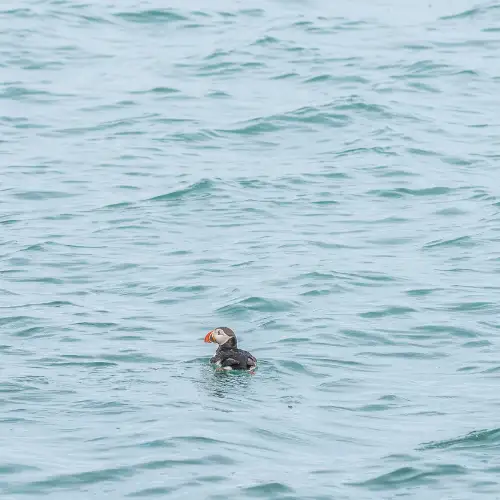
The bird breeds from Russia, Iceland and Greenland through Norway, the Faroes, Britain and Ireland, and across to Newfoundland, Labrador, Nova Scotia and Maine. Islands are strongly preferred over mainland sites, almost certainly because they lack ground predators.
The wintering range is enormous. The North Atlantic offers something between 15 and 30 million square kilometres of open water, which works out at more than a square kilometre per bird. That is why the species is so rarely encountered at sea despite its numbers.
Geolocators fitted to birds in Maine produced one striking figure: a single bird covered 7,700 km in eight months, heading north to the Labrador Sea, then southeast to the mid-Atlantic, before returning to land.
5. Diet & Foraging
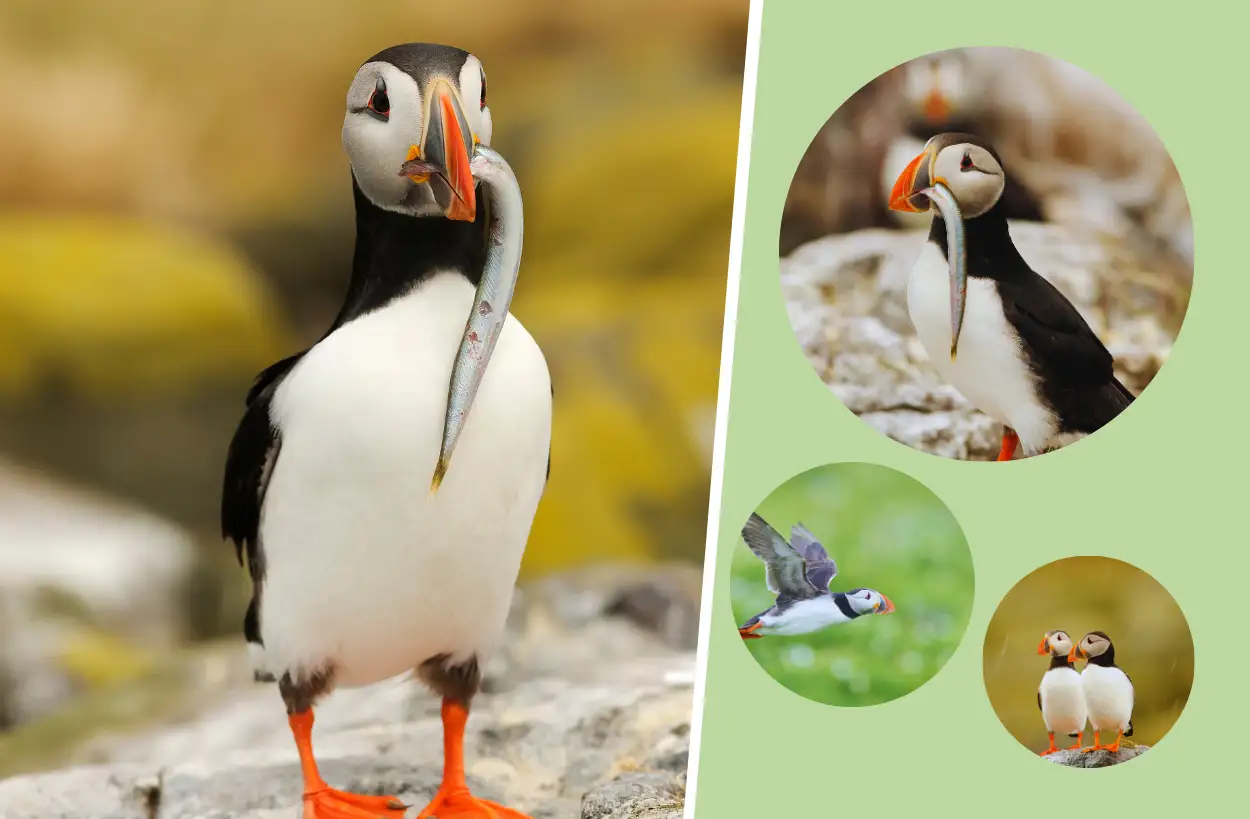
Almost entirely fish, with occasional shrimp, other crustaceans, molluscs and polychaete worms, mostly in coastal waters.
An adult needs around 40 fish a day. Sand eels, herring, capelin and sprats are the mainstays. The bird can handle shallow-bodied fish up to 7 inches long, but usually takes prey nearer 3 inches.
How It Carries So Many at Once
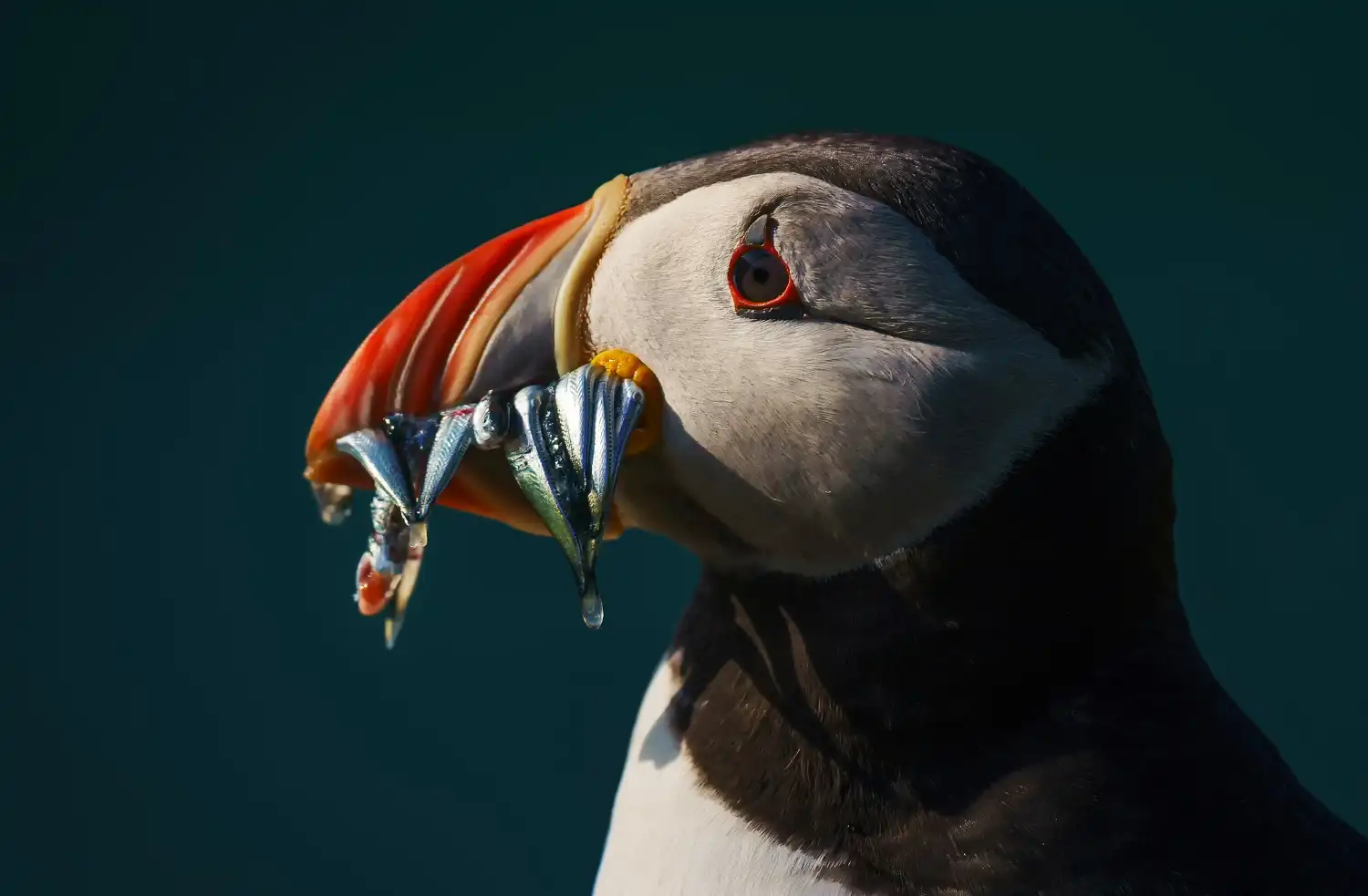
This is the image everyone knows, and the mechanism is neat. The puffin fishes by sight, swallowing small fish while still submerged but bringing larger ones up. It can catch several in a single dive, holding the earlier ones in place with a muscular, grooved tongue while it hunts more. The two mandibles are hinged so they can be held parallel, keeping a row of fish in position, and inward-facing serrations along the edges of the bill stop them sliding out.
Salt is dealt with partly by the kidneys and partly through specialised salt glands in the nostrils.
Food Supply Drives Everything
Three regional studies show how tightly breeding success is tied to a single prey species. In Shetland, sand eels normally make up at least 90% of what chicks are fed, and in years when sand eels were scarce, many chicks starved. In Norway, herring is the mainstay, and puffin numbers fell as herring numbers did. In Labrador, the birds proved more flexible, switching to other prey when capelin declined.
6. Breeding & Nesting
Fratercula arctica · Breeding at a glance
Colonial NesterColony Life
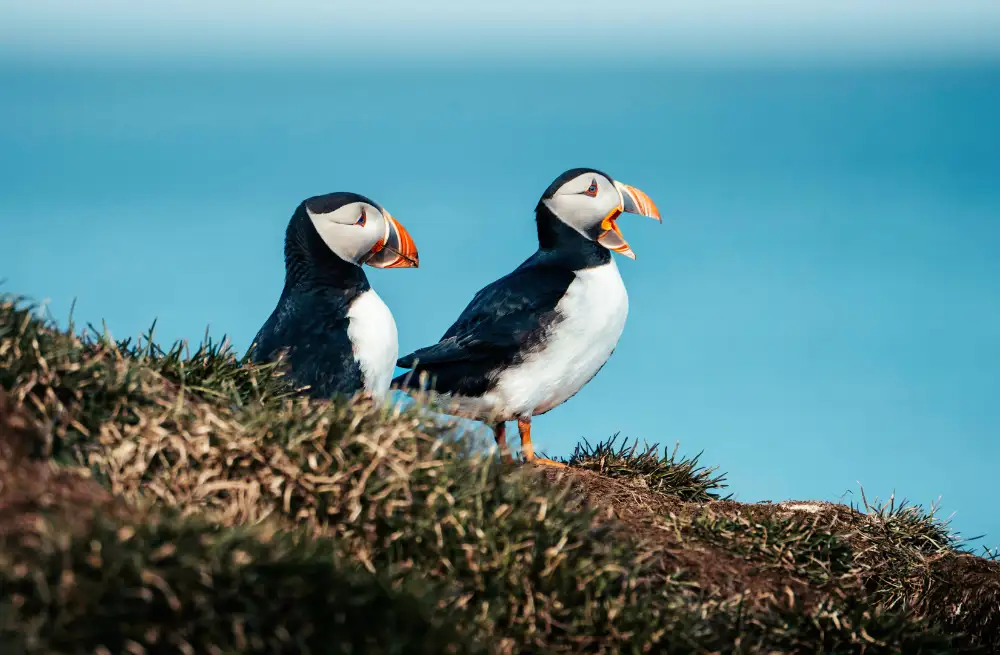
Large colonies divide into subcolonies along physical boundaries like stands of bracken or gorse. Early arrivals take the best ground, which means densely packed burrows on grassy slopes just above the cliff edge, where take-off is easiest. Latecomers are pushed to the periphery and face more predation. Younger birds arriving a month behind the adults may find nothing left and simply wait a year.
Puffins are cautious about landing where no other puffins are present, and will circle a colony several times before coming down. Dominance is displayed with an upright stance, fluffed chest, cocked tail and an exaggerated slow walk; submissive birds flatten themselves horizontally and scurry past.
Monogamous, But for an Unexpected Reason
Pairs return to the same burrow year after year, and the resulting monogamy appears to come from fidelity to the nest site rather than to the mate. The pair bond is renewed by billing, in which the two birds approach each other, wag their heads from side to side and rattle their beaks together. It happens repeatedly through courtship and continues at a lower rate all season.
Both parents incubate, each with two brood patches, and both provision the chick. The male spends more time guarding and maintaining the burrow, the female more on incubation and feeding.
The Chick
Hatches covered in black down with its eyes open, able to stand immediately, weighing about 42 g and gaining roughly 10 g a day. For the first few days fish are passed beak to beak; after that they are simply dropped on the floor beside it.
It fledges at about 75% of adult weight and leaves alone, at night, when predation risk is lowest. It walks, runs and flaps its way down to the sea, cannot fly properly yet, and may be 3 km offshore by daybreak. It does not congregate with others and does not come back to land for two or three years.
Burrows Reshape the Island
Puffins are energetic diggers, and a heavily used slope can be undermined by a network of tunnels. The turf dries out in summer, vegetation dies, and loose soil blows away. Burrows collapse, and careless human footfall across a nesting slope can cause it. The colony on Grassholm was lost entirely when erosion left too little soil to dig in.
7. Predators
Colonies sit on islands precisely to avoid foxes, rats, stoats, weasels, cats and dogs. The threats that remain come mostly from the air.
Great Black-backed Gulls and Great Skuas can take an adult in flight or catch one that cannot escape fast enough on the ground. Herring Gulls and Lesser Black-backed Gulls are not usually able to bring down a healthy adult, but they walk through colonies taking eggs that have rolled toward burrow entrances and chicks that have wandered too near daylight.
Arctic Skuas specialise in theft rather than predation, harassing puffins in the air until they drop their fish. Adults returning with food tend to arrive in groups, which is thought to reduce both this kleptoparasitism and predation by Great Skuas.
At sea the danger comes from below. Seals and large fish take puffins, and the birds can sometimes be seen dipping their heads underwater to look around.
8. Conservation
Fratercula arctica · Conservation at a glance
VulnerableThe uplisting in 2015 followed a review showing rapid and ongoing decline across the European range. Since 2000 sharp declines have been recorded in Iceland, Norway, the Faroe Islands and Greenland, and the UK increase seen between 1969 and 2000 appears to have reversed. The Fair Isle colony was estimated at 20,200 individuals in 1986 and had almost halved by 2012.
Identified causes include increased predation by gulls and skuas, introduced rats, cats, dogs and foxes on nesting islands, toxic contamination, drowning in fishing nets, declining food supplies and climate change.
Two Case Studies in Opposite Directions
Lundy fell from 3,500 pairs in 1939 to 10 pairs in 2000, chiefly because rats were eating eggs and chicks. After the rats were eliminated a juvenile was seen in 2005, believed to be the first chick raised on the island in 30 years.
Craigleith, once one of Scotland's largest colonies at 28,000 pairs, collapsed to a few thousand after an introduced plant, tree mallow, spread across the island in dense thickets and blocked access to burrowing ground. The SOS Puffin project at the Scottish Seabird Centre, with over 700 volunteers, has been cutting it back, and puffins have returned in greater numbers.
Not everywhere is declining. Skomer in Pembrokeshire holds over 43,000 puffins and numbers have risen year on year since predators were removed.
Project Puffin
Started in 1973 by Stephen Kress of the National Audubon Society, this remains one of the most instructive seabird restoration efforts on record.
Eastern Egg Rock in Maine had held nesting puffins until 1885, when overhunting ended the colony. Because young puffins usually return to breed where they fledged, biologists translocated 10 to 14 day old chicks from Great Island in Newfoundland, placed them in artificial sod burrows, and hand-fed them for about a month. This ran until 1986, moving 954 birds in total.
The first adults returned in 1977. Decoys were installed to convince arrivals that a colony already existed, since puffins will not settle where none are present. Four pairs nested in 1981. By 2014 there were 148 nesting pairs. Along the way the project established that decoys, call recordings and mirrors can be used to re-establish a seabird colony from nothing.
Oil
As a bird that winters on the open ocean, the Atlantic Puffin is exposed to spills. Oiled plumage insulates poorly and floats badly, and birds preening themselves ingest and inhale toxins, leading to inflammation of the airways and gut and, longer term, liver and kidney damage.
The recorded toll usually understates the real one. Only about 1.5% of dead auks washed up on Atlantic beaches are puffins, but many more die far from land and sink. After the Torrey Canyon spill in 1967 few dead puffins were recovered, yet the number breeding in France the following year fell to 16% of its previous level.
9. People & Culture
Puffins were historically eaten fresh, salted, or smoked and dried, with feathers used in bedding. Hunting continues under strict limits in Iceland and the Faroe Islands.
The traditional Faroese method, fleyg, used a fleygingarstong: a 3.6 metre pole with a small net suspended between two rods, resembling a very long lacrosse stick. A few dead puffins were scattered to tempt incoming birds down, and the net was flicked upward to scoop one from the air as it slowed to land. A skilled hunter could take 200 to 300 in a day. On St Kilda a different method used a flexible pole with a noose, pushed slowly toward a bird whose curiosity overcame its caution.
The species is the official bird of Newfoundland and Labrador. Informal names include "clowns of the sea" and "sea parrots", and the young are called pufflings.
Lundy in the Bristol Channel is thought to take its name from the Norse lund-ey, puffin island. The island issued its own stamps in 1929 with denominations in "puffins".
Penguin Books launched its children's imprint, Puffin Books, in 1939.
On the Icelandic island of Heimaey there is a tradition of children rescuing fledglings that become disoriented by street lighting and land in the village, then releasing them to the sea. Bruce McMillan's photo book Nights of the Pufflings records it.
And because puffins are protected on Skellig Michael, the production team for the Star Wars sequel trilogy could not remove them from shots. They digitally dressed the birds instead, and the porgs were the result.
Similar Species
A striking coastal seabird with solid black plumage and prominent white wing patches.
Read More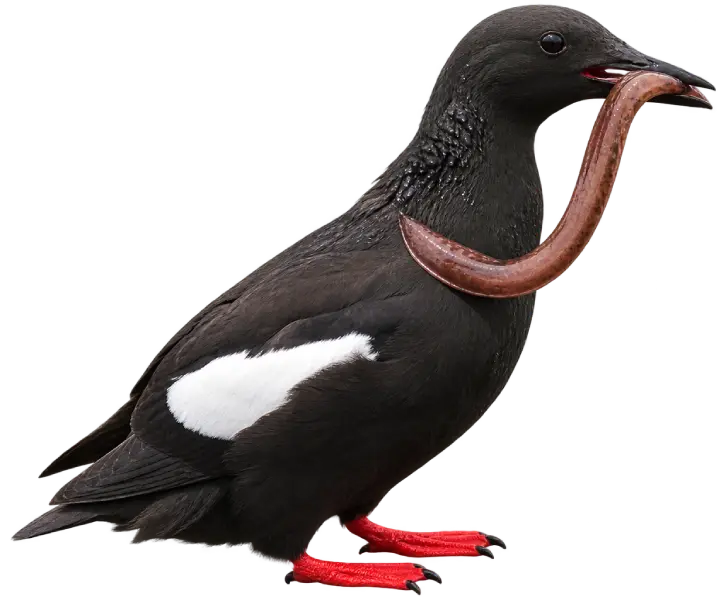
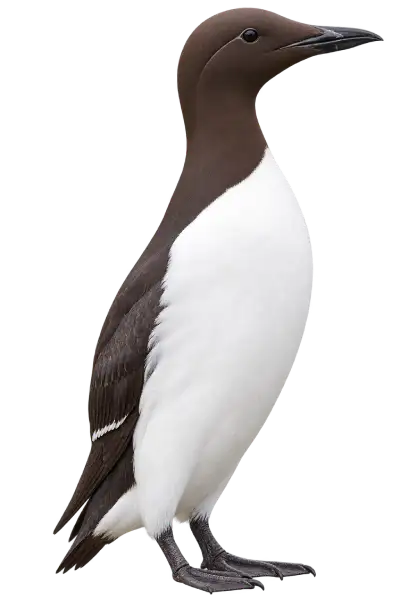
Penguin-like diver with a slender, pointed bill.

Stocky cliff-nester recognized by a distinct white bill stripe.
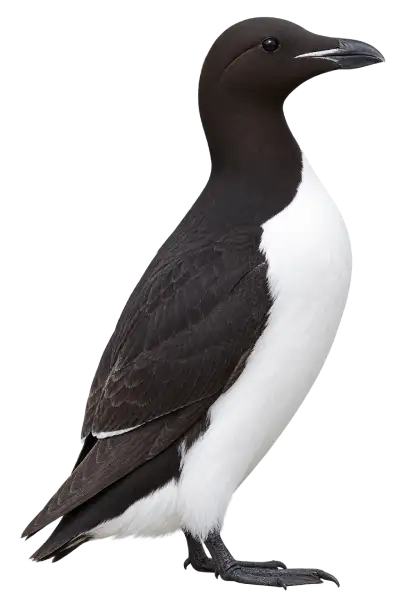

A robust, black-and-white seabird recognized by its thick, blunt bill.
Read More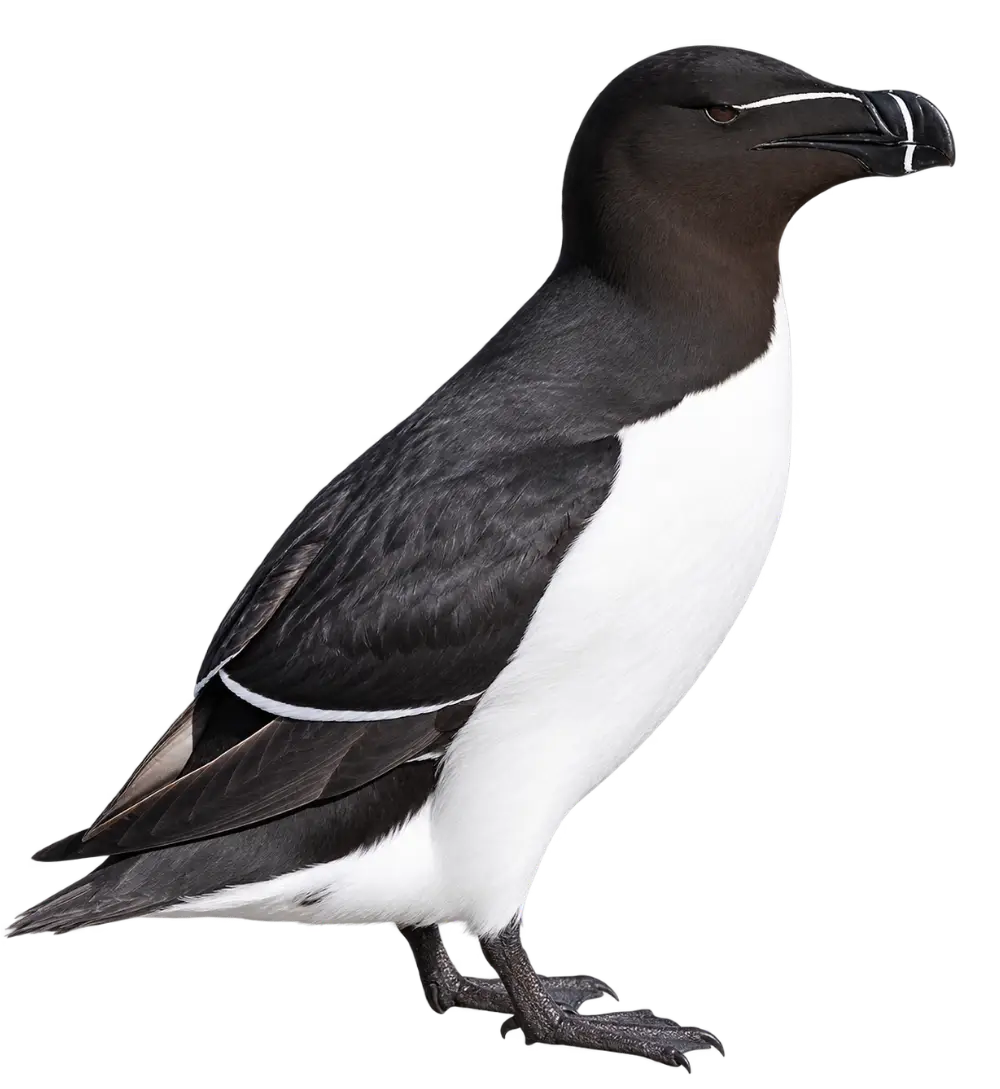
Pelagic bird sporting sweeping golden head plumes.
Read More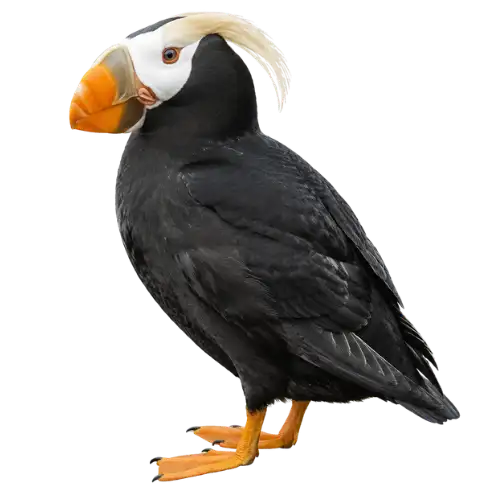
Nocturnal forager with a prominent pale bill horn.
Read More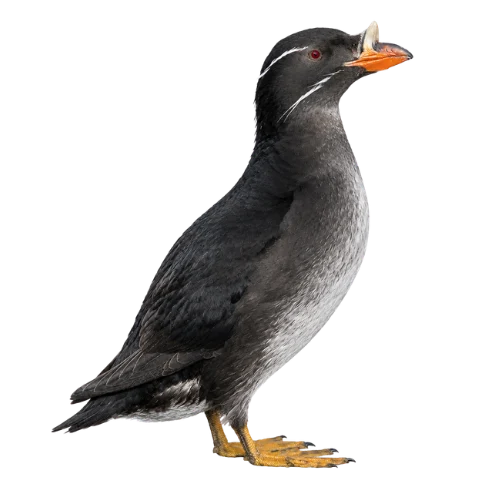
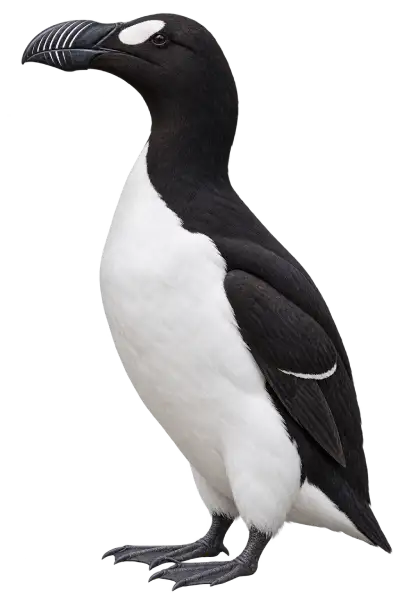
Massive, flightless seabird driven to extinction in the 1800s.
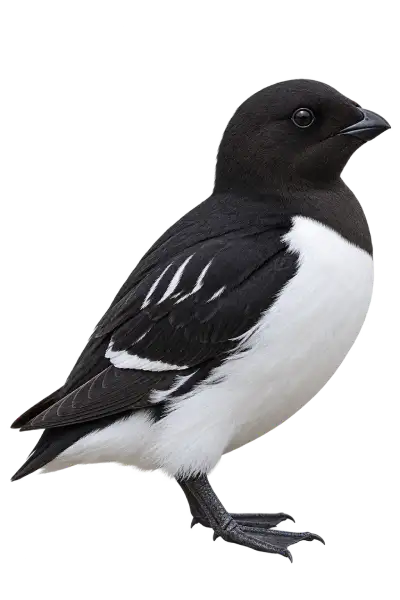
Tiny, plump Arctic seabird that gathers in massive flocks.

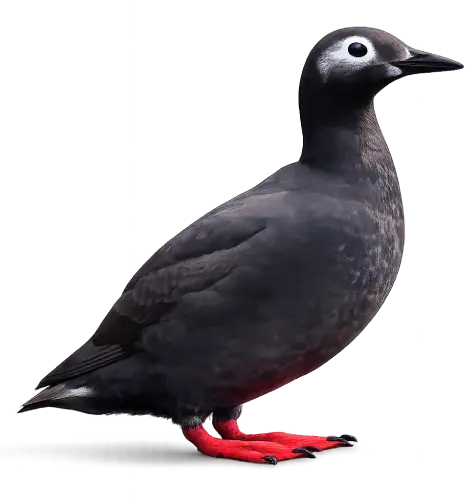
Pacific seabird known for distinct white eye-rings.

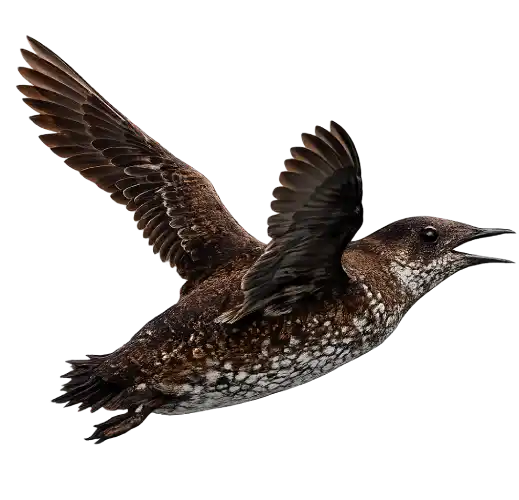
Small seabird that remarkably nests in old-growth forests.
Striking black seabird with large white wing patches.
Read More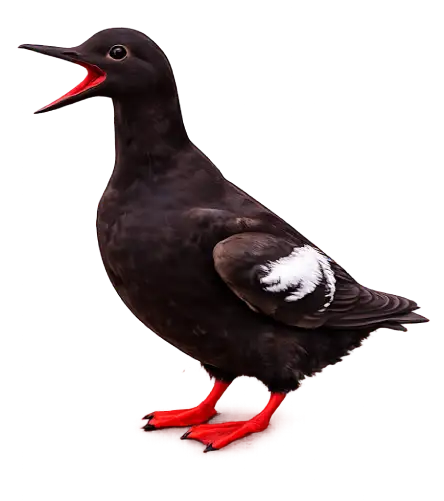
Distinctive seabird named for the fleshy horn above its eyes.
Common Questions About Atlantic Puffins
Sources & References
- Atlantic puffin — species article
- IUCN Red List assessment for Fratercula arctica
- Atlantic Puffin call recordings
- Atlantic Puffin field guide entry
- Project Puffin, National Audubon Society
Last reviewed July 2026.