Acorn Woodpecker (Melanerpes formicivorus)
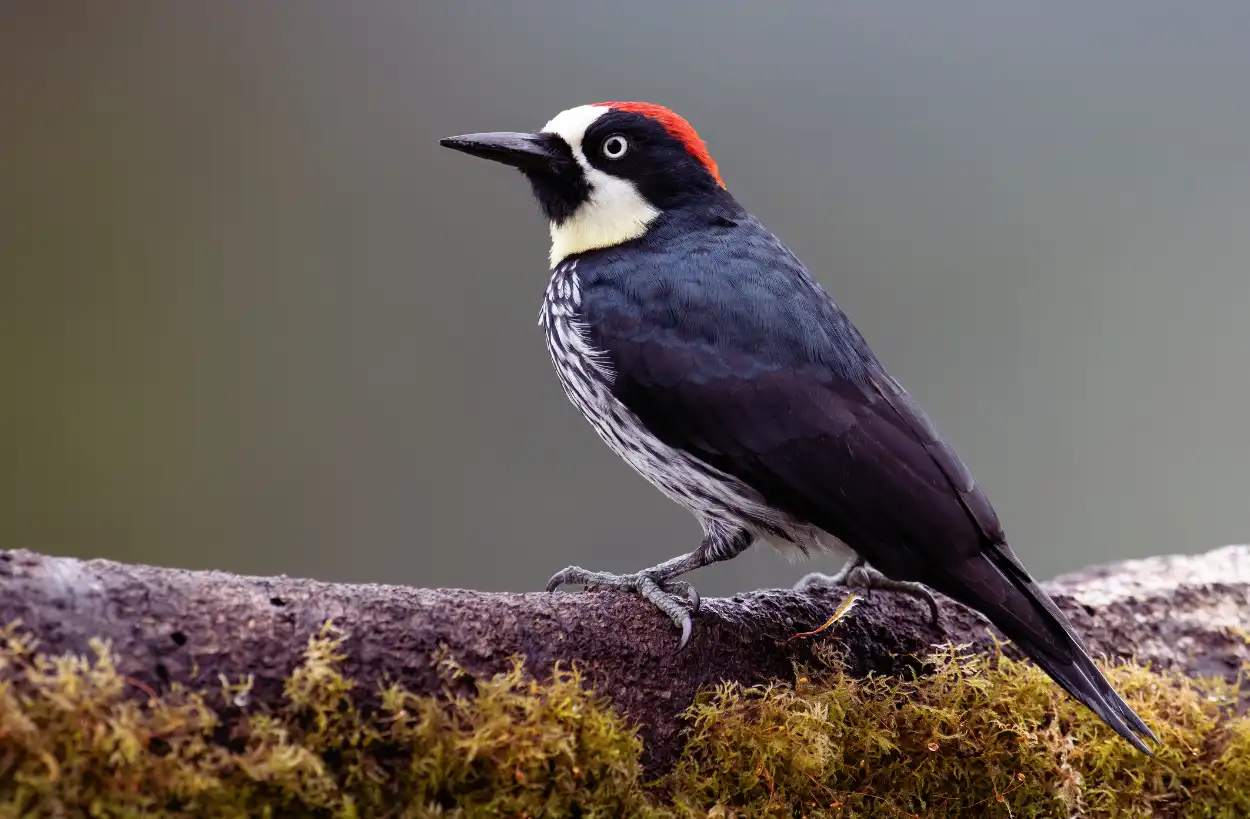
The Acorn Woodpecker is a highly social woodpecker of oak woodlands in western North America, Mexico, Central America and parts of northern South America. It is easily recognized by its black-and-white body, pale eyes and bright red crown.
Its name comes from one of its most distinctive behaviors. Acorn Woodpeckers collect acorns and store them individually in holes drilled into trees, utility poles, fence posts and other wooden surfaces. A large storage tree, known as a granary, may contain tens of thousands of holes.
Unlike many woodpeckers that spend much of their lives in pairs, Acorn Woodpeckers often live in extended family groups. Several adults may share a territory, defend food stores and help raise the same young.
Species Profile
Scientific Classification
Identification
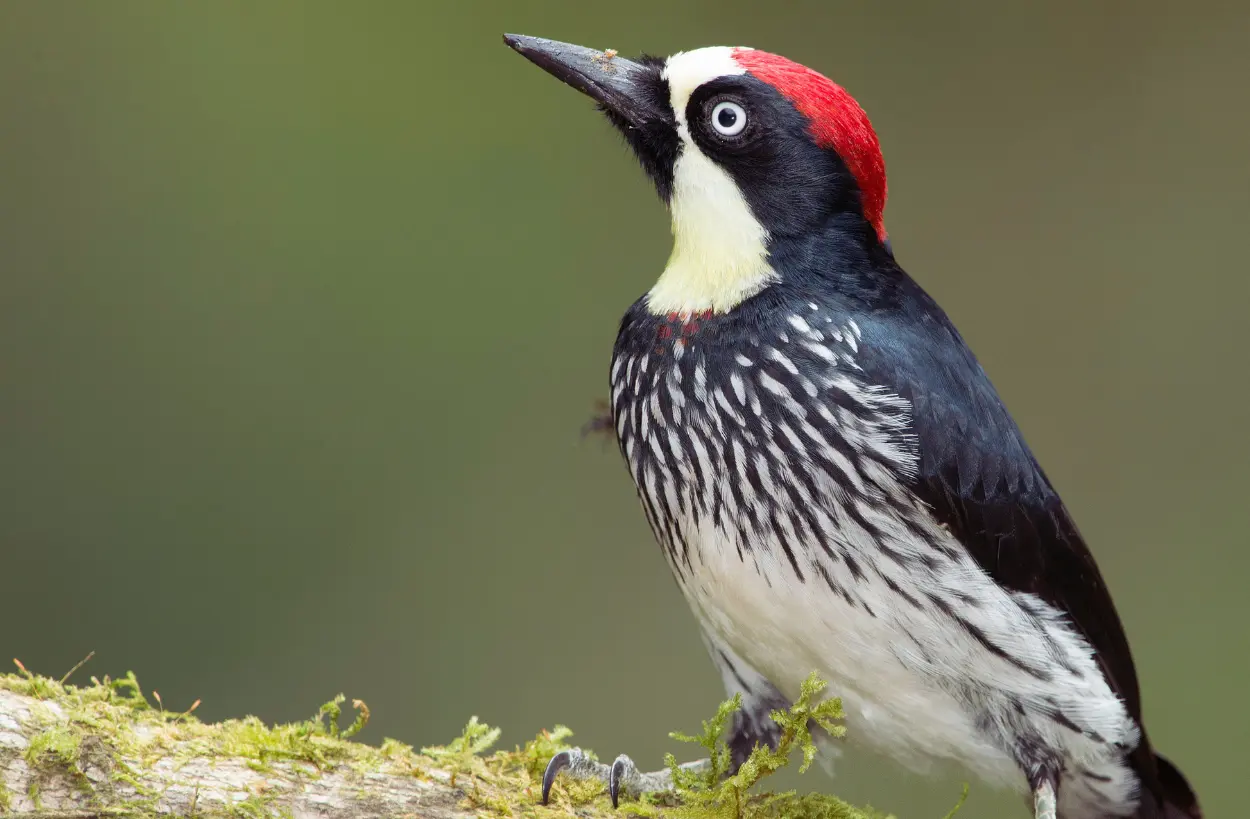
The Acorn Woodpecker is a medium-sized woodpecker with a bold pattern that is difficult to miss at close range.
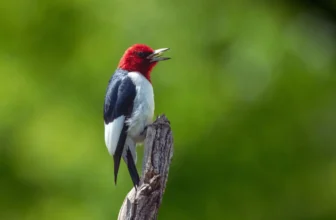
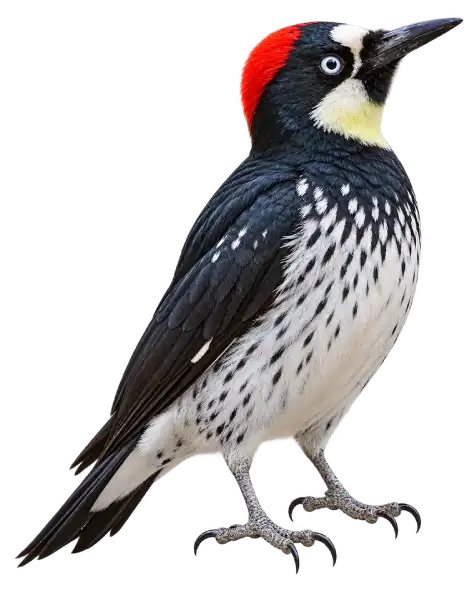
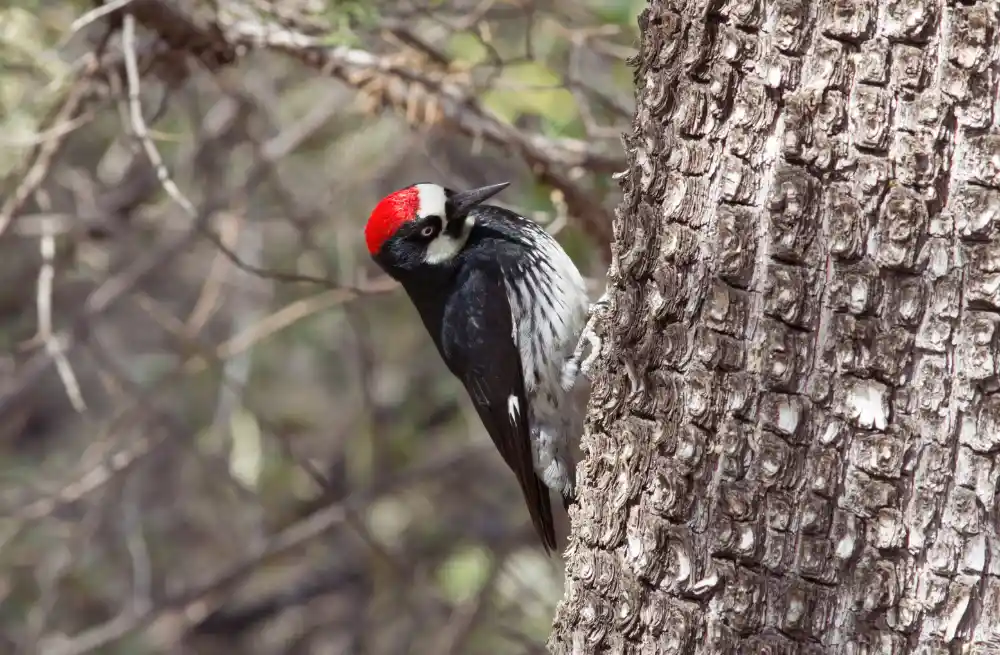
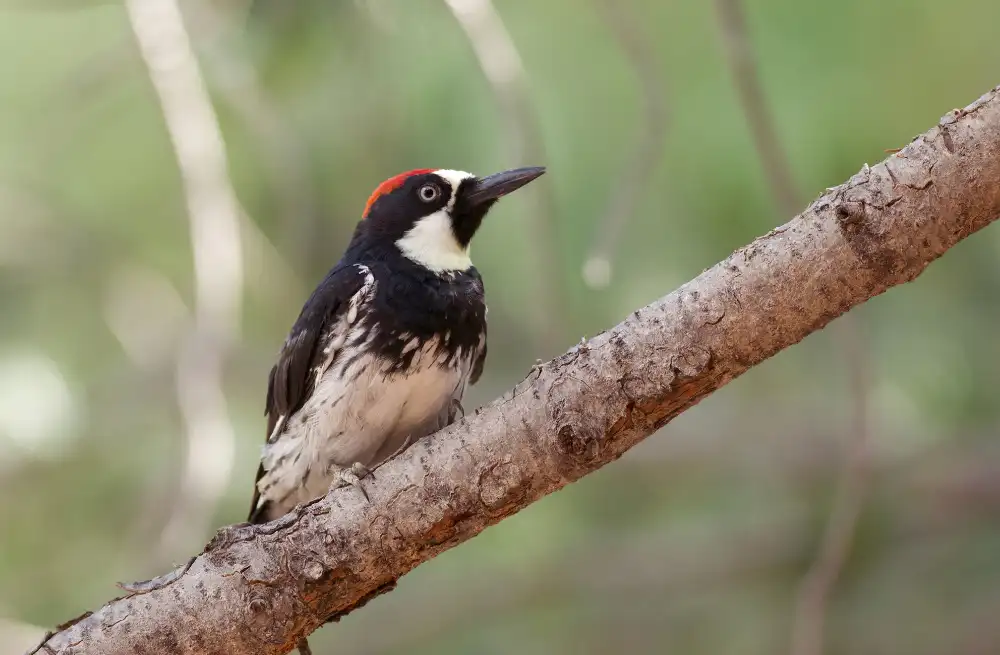
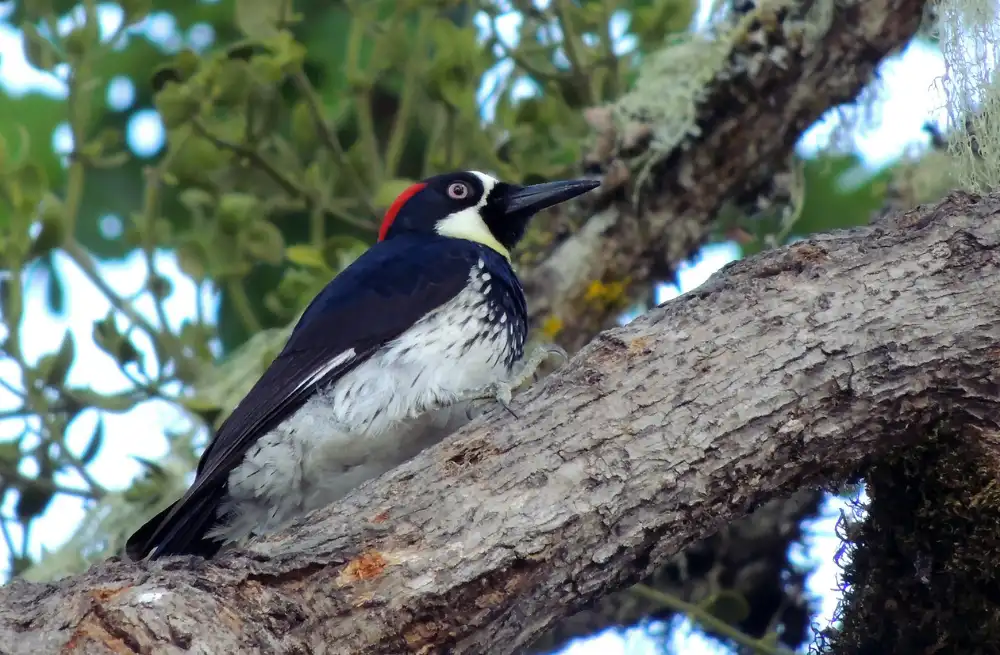
Adults have glossy black wings and upperparts, a black upper chest and a pale belly. The face and throat are creamy white, while the crown includes a bright red patch.
The eyes are pale white or light gray and stand out strongly against the darker feathers surrounding them.
In flight, the bird shows prominent white patches on the wings along with a white rump. These flashes of white can be useful when identifying birds moving quickly between trees.
The bill is straight, dark and pointed. Like other woodpeckers, the Acorn Woodpecker has strong feet for gripping bark and stiff tail feathers that help support the body while climbing vertical trunks.
Size
Acorn Woodpeckers are roughly the size of a small thrush.
- Length: 19–23 cm
- Wingspan: 35–43 cm
- Weight: around 65–90 g
Size varies somewhat between individuals and populations.
Male vs. Female
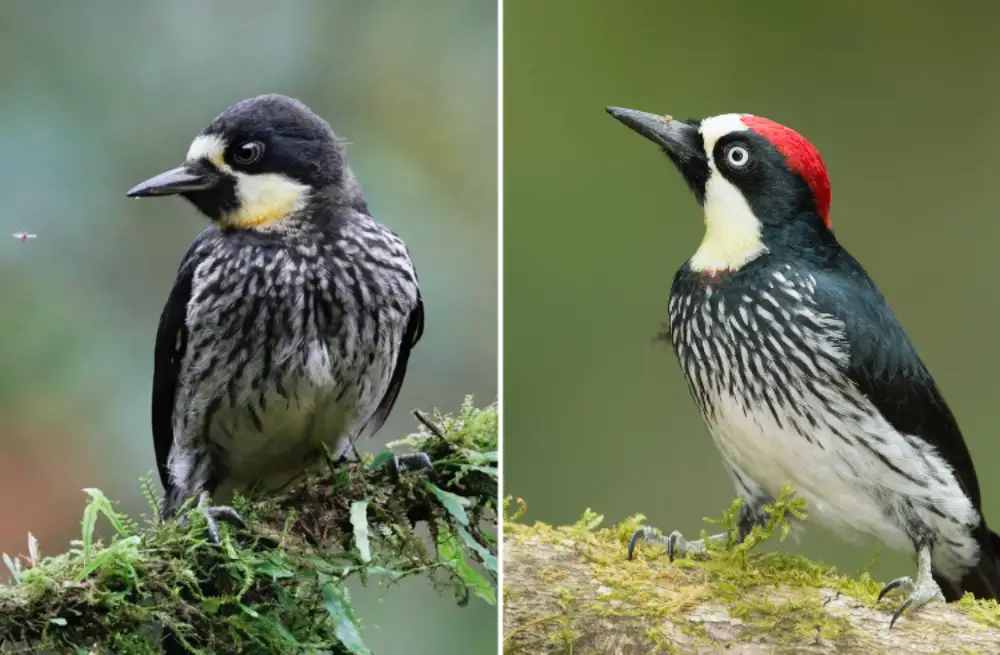
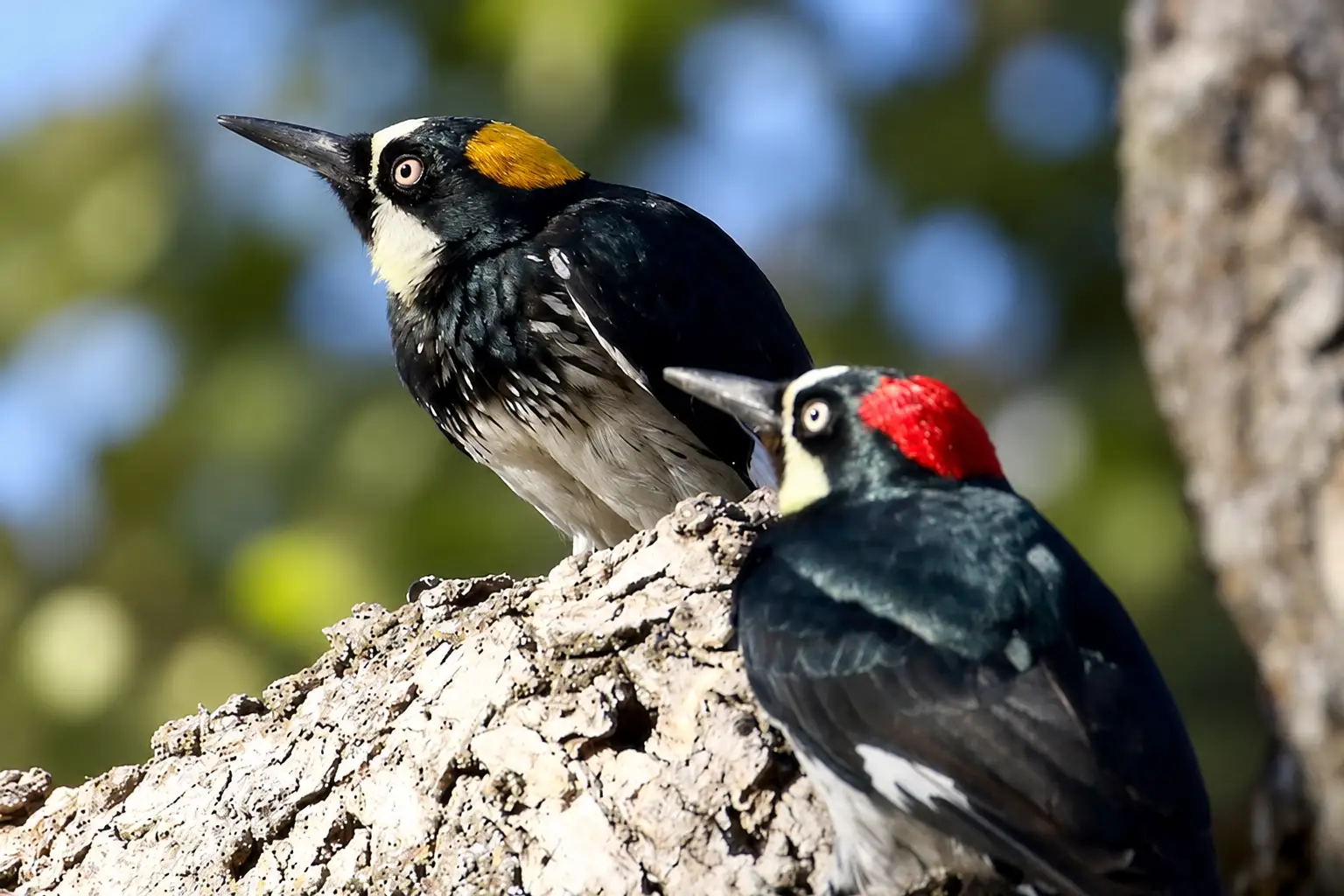
Male and female Acorn Woodpeckers look very similar, but the head pattern provides a reliable difference in most populations.
Adult males have a pale forehead followed directly by the red crown.
Adult females have a black band separating the pale forehead from the red crown.
From front to back, the typical pattern is:
Male: pale forehead → red
Female: pale forehead → black → red
The difference is easiest to see when the bird is facing sideways or slightly toward the observer.
Southern populations can show different head patterns, so this distinction is most useful for birds from the United States, Mexico and much of Central America.
Juveniles
Juvenile Acorn Woodpeckers are similar to adults but generally look slightly duller.
Young birds initially have darker eyes, which become pale as they mature.
Juvenile females can also show more red on the crown than adult females, making young males and females more difficult to separate using head pattern alone.
Range
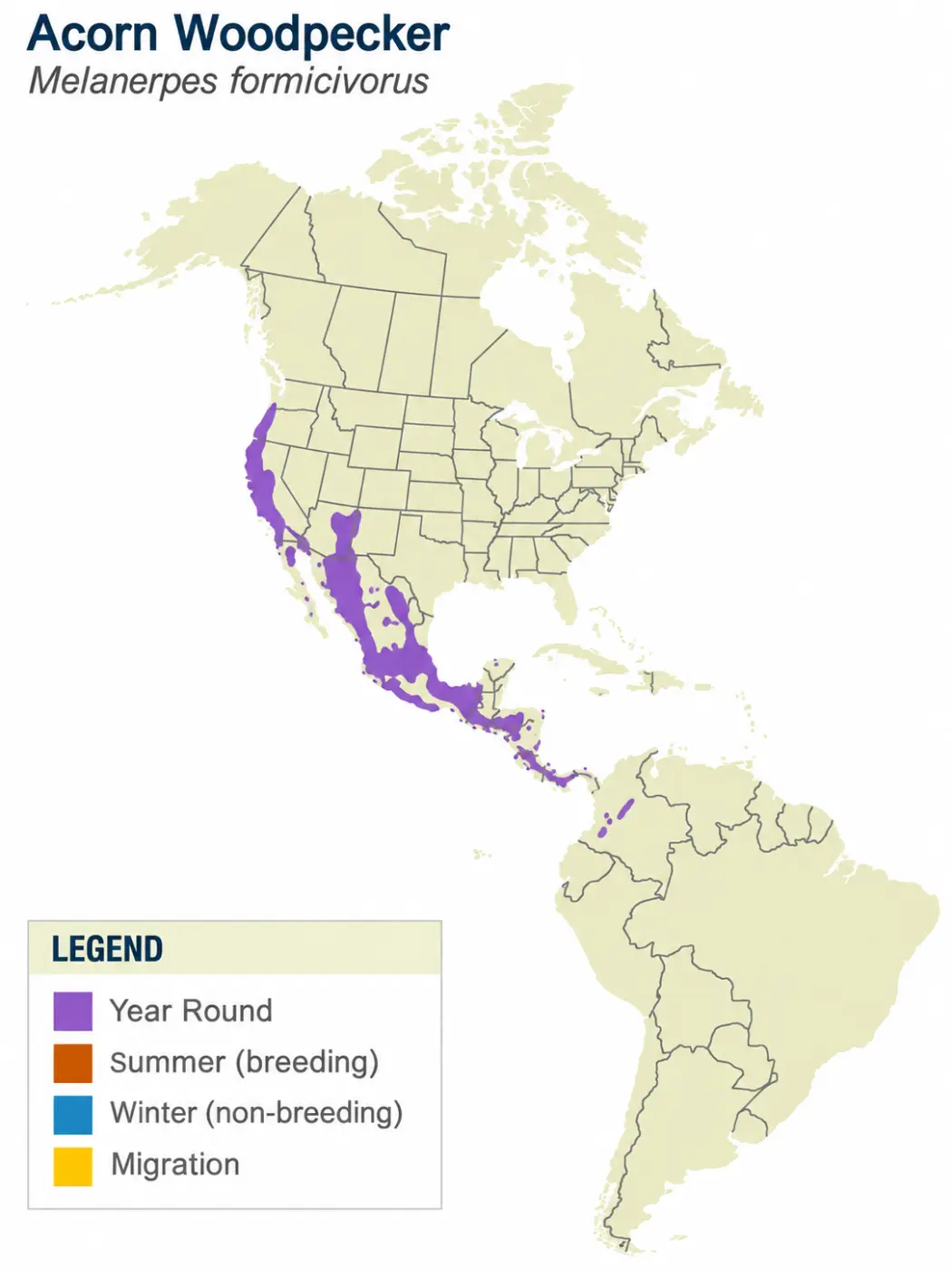
The Acorn Woodpecker has a broad but patchy distribution through the Americas.
In the United States, it occurs mainly in the West, particularly in California, but its range also extends into Oregon, Arizona, New Mexico and parts of neighboring regions.
From there, populations continue south through much of Mexico.
Acorn Woodpeckers also occur through parts of Central America, including Guatemala, Honduras, Nicaragua, Costa Rica and Panama, with the southern edge of their range reaching Colombia.
Most populations are non-migratory and remain within the same general area throughout the year.
Local movements can occur when acorn crops fail or food becomes scarce.
Habitat
Oak woodland is the habitat most strongly associated with the Acorn Woodpecker.
The species is especially common in landscapes containing mature oak trees, open woodland and standing dead trees.
It can also inhabit:
- Pine-oak forest
- Mixed woodland
- Redwood forest
- Riparian woodland
- Tropical montane forest
- Wooded ranchland
- Parks
- Large gardens
- Suburban neighborhoods with mature trees
The availability of acorns is important, but suitable nesting cavities and storage sites also influence where groups can live.
Areas containing several species of oak may be particularly useful because different oak species can produce acorns at different times or have different crop success from year to year.
Diet
Acorns are an important part of the Acorn Woodpecker's diet, especially outside the breeding season, but they are far from its only food.
The species eats a mixture of plant and animal material.
Its diet includes:
- Acorns
- Other nuts
- Insects
- Spiders and other arthropods
- Fruit
- Seeds
- Tree sap
- Nectar
Insects can become especially important during the breeding season because they provide protein for growing chicks.
Acorn Woodpeckers do not always search for insects by drilling deeply into wood.
They frequently catch flying insects in the air, launching from exposed branches and returning to a perch after making a capture. They also pick insects directly from bark, leaves and branches.
Fruit and sap provide additional food when available.
Acorn Storage
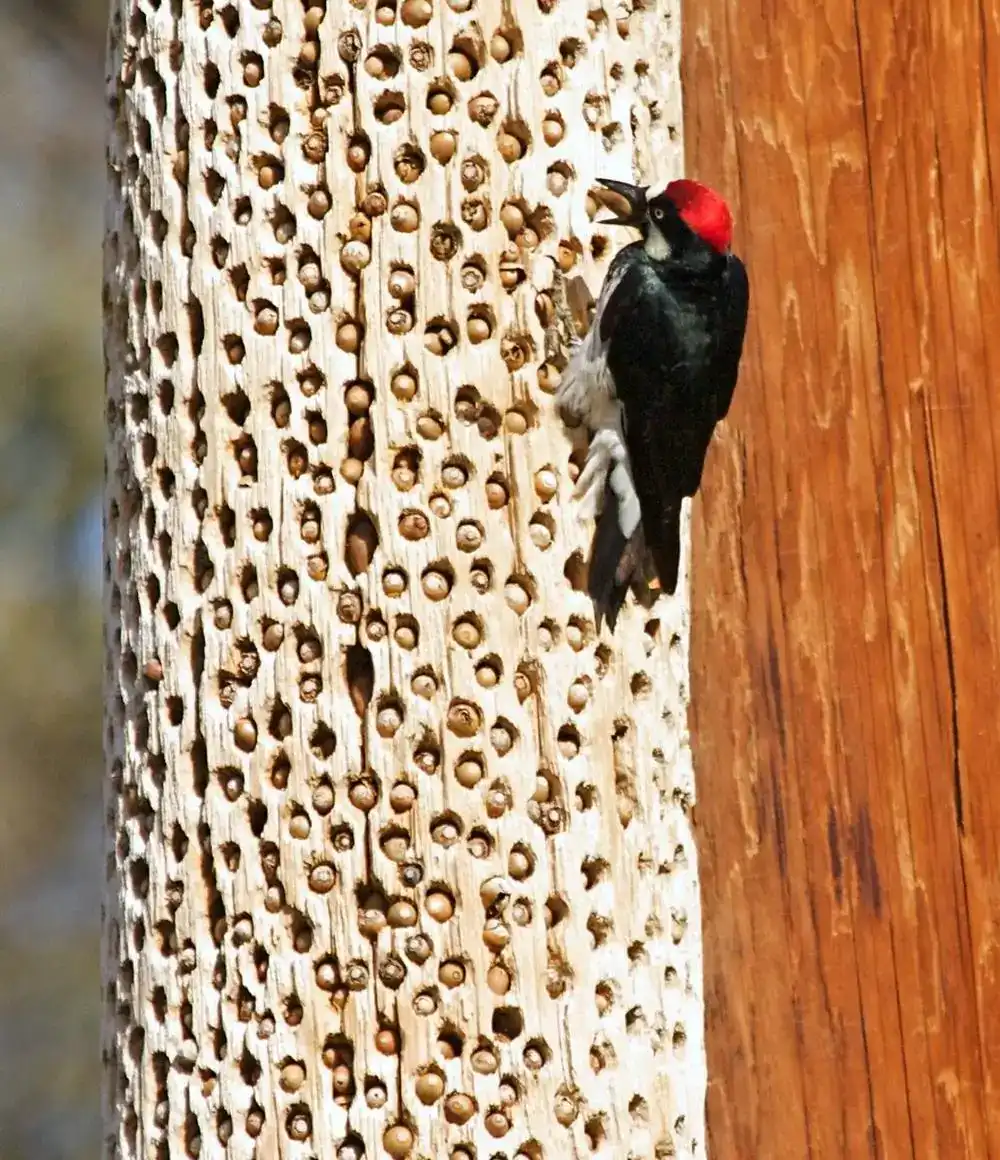
The Acorn Woodpecker is best known for creating large communal food stores.
Instead of hiding acorns randomly throughout its territory, a group often concentrates them in one or several important storage sites known as granaries.
The birds drill small holes into wood and push one acorn tightly into each hole.
A granary may contain only a few hundred holes when first established, but older sites can become enormous.
Some granary trees contain tens of thousands of holes, with exceptional examples reaching around 50,000 or more.
Granaries can be located in:
- Dead trees
- Living trees with dead sections
- Large branches
- Fence posts
- Utility poles
- Wooden buildings
A single granary may remain in use for many years.
Maintaining the Granary
Stored acorns gradually dry and shrink.
As this happens, an acorn may become loose inside the hole where it was originally placed.
Acorn Woodpeckers regularly inspect their stores and move shrinking acorns into smaller holes where they fit more tightly.
The result is a food storage system that requires constant maintenance.
A large granary can therefore represent years of work by several generations of the same social group.
Behavior
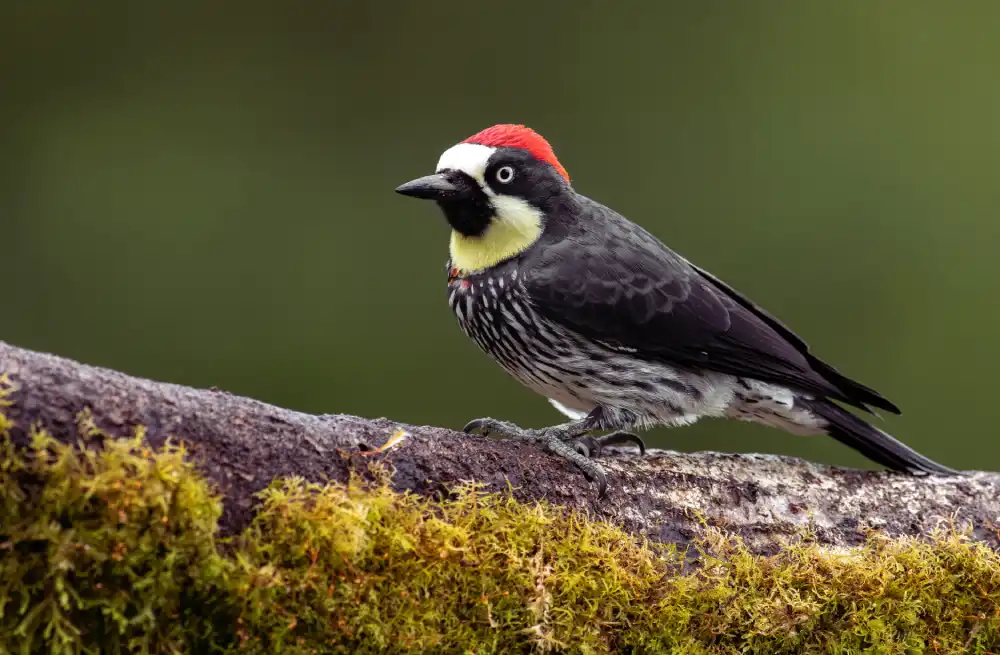
Acorn Woodpeckers are among the most social members of the woodpecker family.
Rather than living only as isolated breeding pairs, many populations form groups containing several adults and young birds from previous breeding seasons.
Group members cooperate in several activities.
They may:
- Defend the territory
- Guard granary trees
- Collect acorns
- Maintain food stores
- Excavate nest cavities
- Incubate eggs
- Feed nestlings
- Defend chicks from predators
Groups vary considerably in size.
Some consist of a simple male and female pair, while others contain several breeding adults and multiple nonbreeding helpers.
This social structure has made the Acorn Woodpecker an important species in studies of cooperative breeding.
Territory
A granary often sits near the center of an Acorn Woodpecker territory.
Because stored acorns represent a major food reserve, groups defend these areas vigorously from neighboring woodpeckers.
Territorial disputes may involve loud calls, chasing and physical confrontations.
Acorn Woodpeckers also defend nesting cavities, feeding areas and other resources within their home range.
Members of the same group frequently remain in contact through calls as they move between feeding and storage areas.
Breeding
The breeding system of the Acorn Woodpecker is unusually complex.
Some populations breed as normal male-female pairs.
Others form cooperative groups containing several breeding males and several breeding females.
The breeding males within one group are often close relatives such as brothers, while breeding females may also be sisters or other close relatives.
The male and female breeding lines are normally unrelated to each other.
Several adults may therefore contribute offspring to the same family group.
Nest
Acorn Woodpeckers are cavity nesters.
Nest cavities are usually excavated in dead trees, dead branches or decaying portions of living trees.
Both males and females may participate in excavation, and other members of the social group can help.
The inside of the nest remains simple.
There is no nest made from grass or twigs. Eggs are laid directly on wood chips and debris at the bottom of the cavity.
Old cavities may sometimes be reused.
Eggs
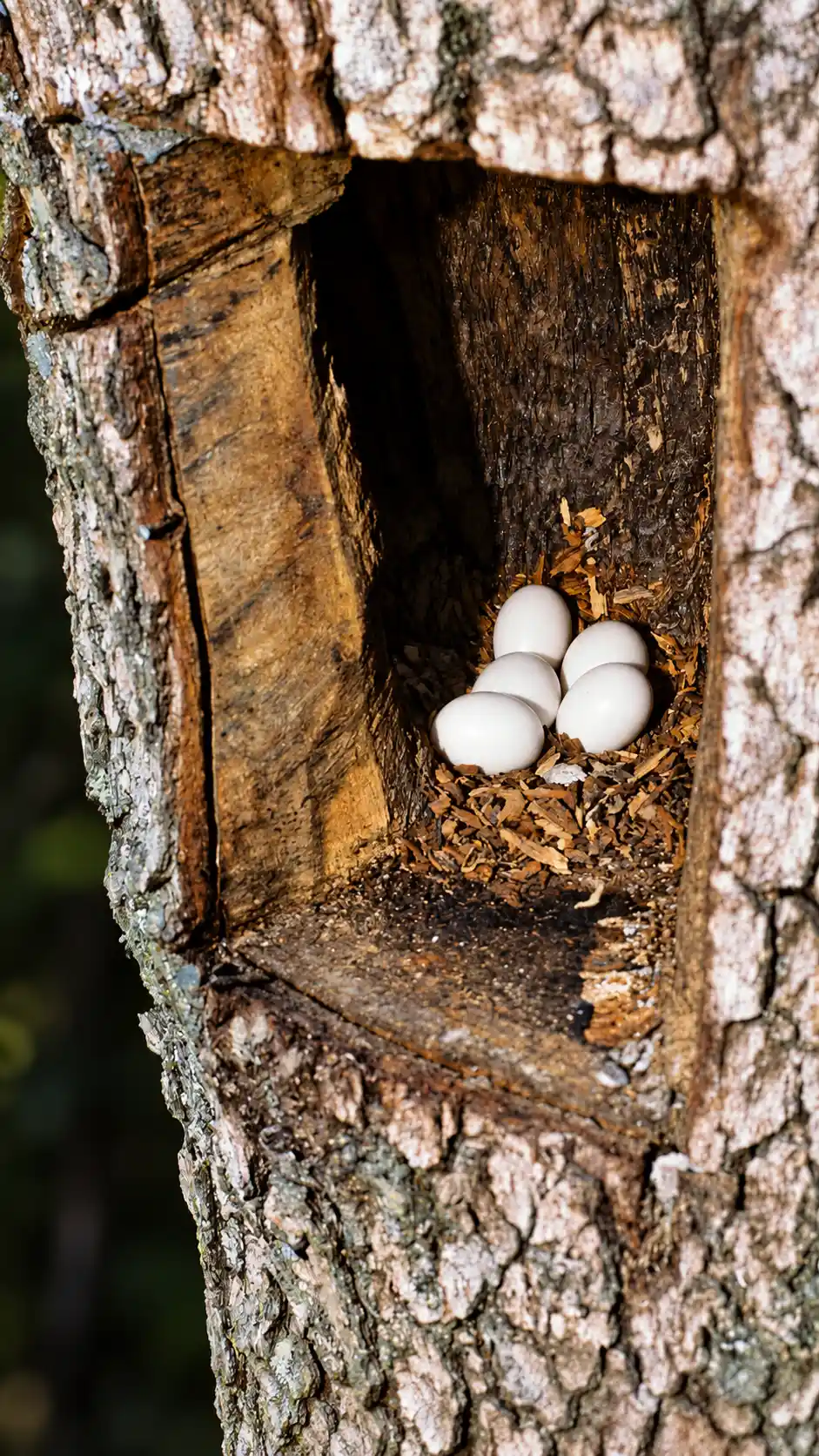
Acorn Woodpecker eggs are plain white.
A single female typically lays several eggs, often around 3–7.
In cooperative groups, however, more than one female may lay eggs inside the same cavity.
These communal nests can contain much larger clutches.
One unusual behavior occurs when females begin laying at different times.
A female may remove eggs laid by another female before she starts laying her own. Once all breeding females are laying, egg destruction normally decreases and the remaining eggs are incubated.
Incubation
Incubation lasts approximately 11–14 days.
Several members of the group may take turns sitting on the eggs.
Males, females and sometimes helpers can all participate.
This shared care continues after the chicks hatch.
Chicks
Newly hatched Acorn Woodpeckers are blind, almost naked and completely dependent on adults.
They remain inside the nesting cavity for roughly one month.
During this period, multiple members of the group may bring food to the chicks.
Insects make up an important part of the food delivered to growing nestlings.
Young birds usually leave the nest after around 30–32 days, although they may continue receiving food from adults after fledging.
Cooperative Breeding
Some young Acorn Woodpeckers remain in the territory where they were born instead of leaving immediately to breed.
These birds become helpers.
Helpers may assist with:
- Feeding chicks
- Incubating eggs
- Guarding the nest
- Defending the territory
- Maintaining granaries
Remaining with the family can be useful when suitable breeding territories are difficult to obtain.
A young bird may spend several years as a helper before eventually gaining a breeding position.
Power Struggles
Breeding vacancies can cause intense competition.
If a breeding adult disappears from a group, related birds from other territories may attempt to take its place.
Groups of potential breeders can arrive and compete for access to the vacant position.
These events are sometimes called power struggles.
They can involve extended chasing, calling and fighting between rival groups.
For nonbreeding helpers, gaining one of these positions can provide an opportunity to reproduce after years of waiting.
Calls
Acorn Woodpeckers are vocal birds.
Their most familiar call is a loud nasal series often written as:
waka-waka-waka
The sound can carry a considerable distance through open woodland.
Groups frequently call back and forth while moving around their territory.
Other sounds include:
- Rattles
- Short calls
- Harsh notes
- Alarm calls
- Drumming
When several members of a group become excited at once, the resulting chorus can be surprisingly loud.
Drumming
Like other woodpeckers, Acorn Woodpeckers drum by rapidly striking their bills against resonant surfaces.
Drumming is different from drilling for food or creating storage holes.
It is primarily a communication behavior used to advertise presence and territory.
Dead limbs, trunks and sometimes human structures can serve as drumming surfaces.
Flight
Acorn Woodpeckers usually have the undulating flight typical of many woodpeckers.
They alternate quick wingbeats with short periods when the wings are partially folded.
The white wing patches and white rump become especially noticeable in flight.
These marks can help identify a bird even when the red crown and facial pattern cannot be seen.
Similar Species
Acorn Woodpeckers have a distinctive combination of markings, but several other western woodpeckers may cause confusion at a distance.
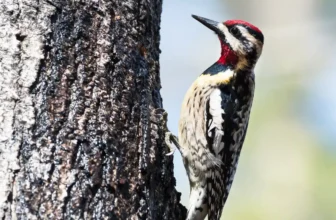
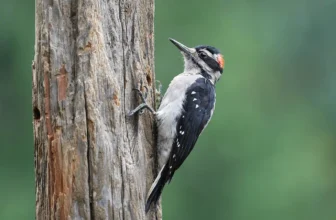
White-headed Woodpecker
The White-headed Woodpecker has an almost completely white head and a mostly black body.
The Acorn Woodpecker has a much more complex combination of black, white and red around the head.
Red-breasted Sapsucker
Red-breasted Sapsuckers have extensive red around the head and upper body.
They lack the pale eyes and strongly patterned face of an Acorn Woodpecker.
Lewis's Woodpecker
Lewis's Woodpecker can occur in some of the same western regions but has very different plumage, including a dark greenish back, gray collar and pinkish belly.
Its flight is also more crow-like than the strongly undulating flight of many other woodpeckers.
Predators
Adult Acorn Woodpeckers can be hunted by birds of prey, including hawks.
Eggs and nestlings may be vulnerable to snakes, mammals and other animals capable of reaching tree cavities.
Cavity nesting provides considerable protection compared with an exposed nest.
Group living may offer another advantage.
With several birds watching the territory, predators have a greater chance of being detected early.
Alarm calls can quickly alert other members of the group.
Lifespan
Acorn Woodpeckers can survive for many years in the wild.
Banding records have documented individuals living for well over a decade, with some reaching at least 17 years.
A long lifespan fits well with their social system because territories, breeding positions and granary sites can remain important for many years.
Threats
The Acorn Woodpecker is still widespread, but local populations can be affected by changes to oak woodland.
Important threats include:
Habitat Loss
Clearing oak woodland for development or agriculture removes feeding, nesting and storage habitat.
Loss of Mature Trees
Large old trees are especially important because they can provide cavities, granary sites and feeding areas.
Removing dead trees and dead limbs can also reduce available nesting habitat.
Poor Oak Regeneration
Some oak woodlands contain many mature trees but relatively few younger trees.
Without successful regeneration, suitable habitat can gradually decline as old trees die.
Competition for Cavities
European Starlings and other cavity-nesting birds may compete with Acorn Woodpeckers for nesting sites.
Human Conflict
Acorn Woodpeckers sometimes drill storage holes into houses, utility poles and other wooden structures.
Large numbers of stored acorns can also cause problems when birds use buildings as granaries.
Protection
Protecting mature oak woodland is one of the most important ways to maintain Acorn Woodpecker populations.
Healthy habitat should include a mixture of mature trees, younger replacement trees and standing dead wood where it can safely remain.
Dead trunks and limbs provide valuable places for nesting, roosting and food storage.
Preserving several oak species within the same landscape can also help provide more reliable acorn crops from year to year.
The Acorn Woodpecker is currently considered Least Concern and remains common across much of its range.
Interesting Facts
Acorn Woodpeckers may store tens of thousands of acorns in one granary.
Each acorn is placed into its own hole.
Granary trees can be used for generations.
A storage site may outlive many of the individual birds that originally created it.
They constantly rearrange their food.
When stored acorns shrink, the birds move them into smaller holes.
Several females can lay eggs in the same nest.
Communal nesting is an important part of the species' complex social system.
Older offspring may help raise their siblings.
Young adults sometimes remain with their family for years before breeding.
They catch insects in the air.
Acorn Woodpeckers often fly from a perch to capture insects rather than drilling them from inside wood.
They sometimes store acorns in buildings.
Wooden walls, roofs, fence posts and utility poles can all become granaries.
Their pale eyes are unusual among North American woodpeckers.
They are one of the easiest features to notice on an adult bird at close range.
Groups defend their food together.
A large granary is an extremely valuable resource and may become the center of the territory.
Breeding positions can trigger large fights.
When a vacancy appears, groups of related birds may compete to take over the position.