The Common Murre (Uria aalge), also known as the Common Guillemot, is a seabird found across the colder waters of the North Atlantic and North Pacific. With its dark upperparts, white belly, and upright posture, it looks a little like a penguin. The resemblance is easy to see, especially when hundreds of these birds are standing together on a rocky cliff.
But Common Murres can fly, and they do it surprisingly well considering their compact bodies and relatively small wings.
Most of their lives are spent at sea, swimming and diving for fish. They come ashore mainly to breed, gathering in enormous colonies where thousands of birds may occupy the same stretch of coastline. Some colonies are so crowded that nesting adults sit almost shoulder to shoulder.
Their breeding habits are unusual, too. Common Murres don’t build proper nests, lay just one egg at a time, and raise chicks that leave the cliffs long before they’re able to fly.
Species Profile
- Length
- 15–18 in 38–46 cm
- Wingspan
- 25–28 in 64–71 cm
- Weight
- 33–44 oz 945–1,240 g
- Subspecies
- 5 recognized Atlantic & Pacific races
- Clutch size
- 1 egg Pear-shaped (pyriform)
- First breeding
- 4–6 years Lifespan up to 30+ yrs
- Range
- N. Atlantic & Pacific Boreal & Low-Arctic waters
- Population
- ~18–20 Million Mature individuals globally
- Key Feature
- Dagger-like bill & “bridled” eye-ring morph
- Nest
- Bare Cliff Ledges No nest material used
- Diet
- Schooling Fish Capelin, sand lance, sprat
- Incubation
- 28–34 days Shared by both parents
Scientific Classification
- Kingdom
- Animalia
- Phylum
- Chordata
- Class
- Aves
- Order
- Charadriiformes
- Family
- Alcidae
- Genus
- Uria
- Species
- U. aalge
- Described
- Pontoppidan, 1763 Originally as Colymbus aalge
Common Murre Conservation Index
Globally abundant across northern seas, yet highly sensitive to marine heatwaves and prey collapse.
| Dataset | Year | Index Value | Observation |
|---|---|---|---|
| Pacific Index (USGS) | 2005 | 100% | Historical baseline before heatwave anomalies. |
| Pacific Index (USGS) | 2016 | 48% | 4 million murres starve during Pacific heatwave. |
| Pacific Index (USGS) | 2025 | 49% | Colonies remain halved with minimal recovery. |
Identification & Appearance
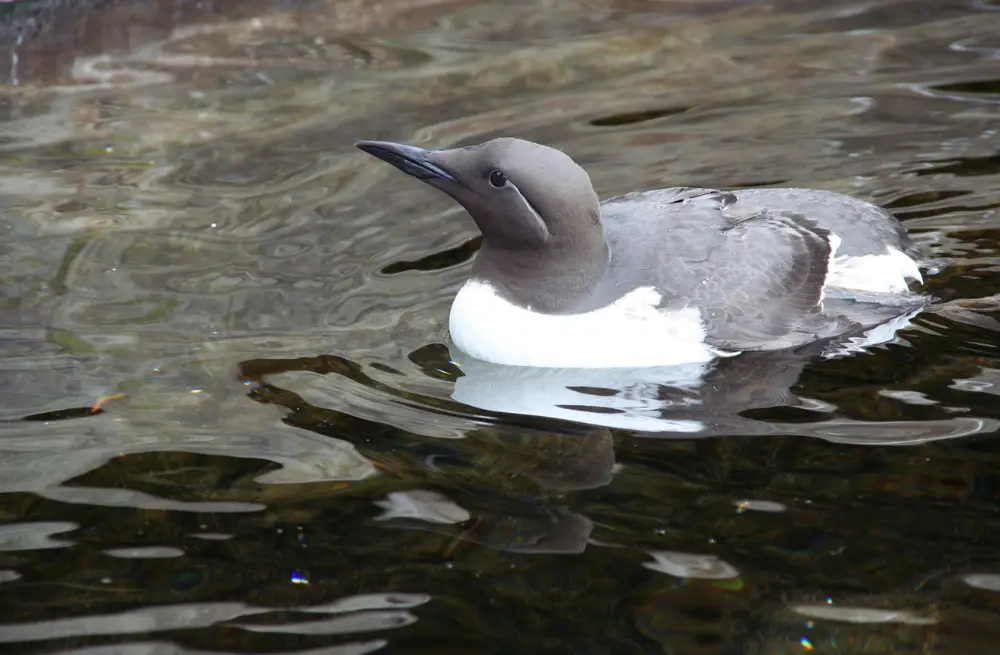
Common Murres have a rather simple appearance, but their shape makes them recognizable once you know what to look for.
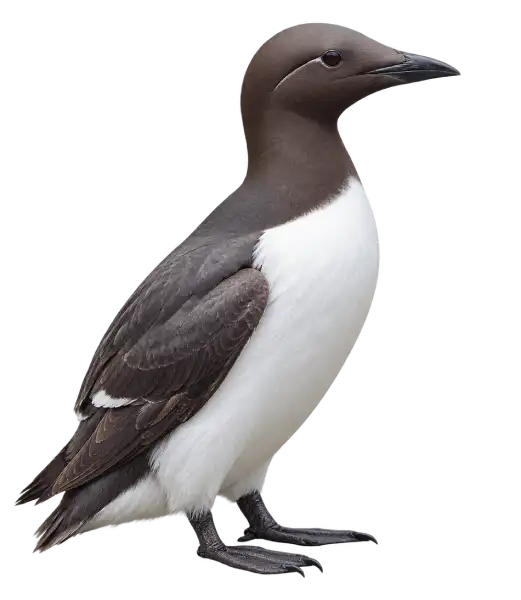
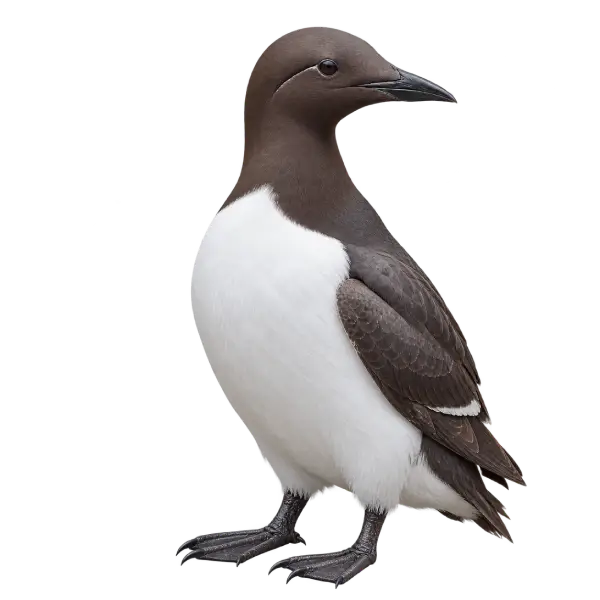
Adults have dark brownish-black plumage covering the head, neck, back, and upper wings. The belly and chest are white, producing a sharp contrast between the upper and lower body.
Their bills are long, narrow, pointed, and entirely dark. The tail is short, and the wings are relatively small for a bird of this weight.
On land, Common Murres stand upright, often resting on their heels with their bodies held almost vertically. In the water, they sit fairly low, sometimes with only the head, neck, and upper back visible above the surface.
Males and females look much alike, and distinguishing them by appearance alone is difficult.
Breeding and Nonbreeding Plumage
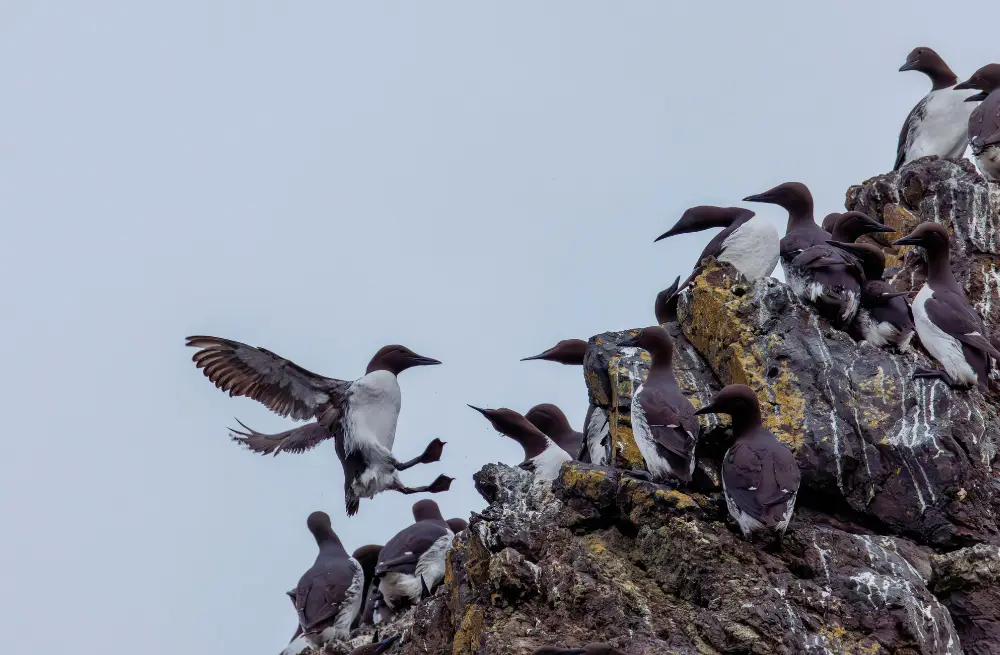
The appearance of a Common Murre changes noticeably throughout the year.
During the breeding season, adults have a completely dark head and throat, with the white underparts beginning sharply at the chest. Their plumage is usually darkest and most uniform at this time.
Outside the breeding season, much of the throat, chin, and face turns white. A dark line extending behind the eye remains visible, giving the bird a rather different facial pattern.
Young birds resemble nonbreeding adults, although their plumage and proportions can vary as they develop.
The Bridled Common Murre
Some Common Murres have a distinctive white ring around each eye, accompanied by a narrow white line extending backward.
These individuals are known as bridled murres or bridled guillemots.
The feature is particularly associated with Atlantic populations, becoming more frequent toward the northern part of their breeding range.
Despite their different appearance, bridled murres aren't a separate species or subspecies. They're simply a naturally occurring color form of the Common Murre.
Common Murre vs. Thick-billed Murre
The Common Murre is frequently confused with the Thick-billed Murre (Uria lomvia). Both have similar body shapes, dark upperparts, white bellies, and a preference for cold northern seas.
The easiest difference to notice is usually the bill.
Common Murres have a longer, slimmer bill that tapers gradually toward the tip. Thick-billed Murres have a shorter, heavier bill, often with a thin white line near its base.
The two species also differ slightly in their breeding plumage. Common Murres generally have a more rounded boundary between the dark throat and white chest, while Thick-billed Murres often show a sharper, pointed division.
Thick-billed Murres tend to breed farther north and are more closely associated with Arctic conditions and sea ice.
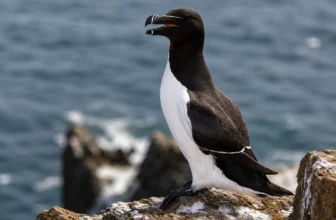
Another similar bird is the Razorbill (Alca torda). Razorbills have a deeper, blunter bill and a more prominent tail, which can help separate them from Common Murres.
Range & Habitat
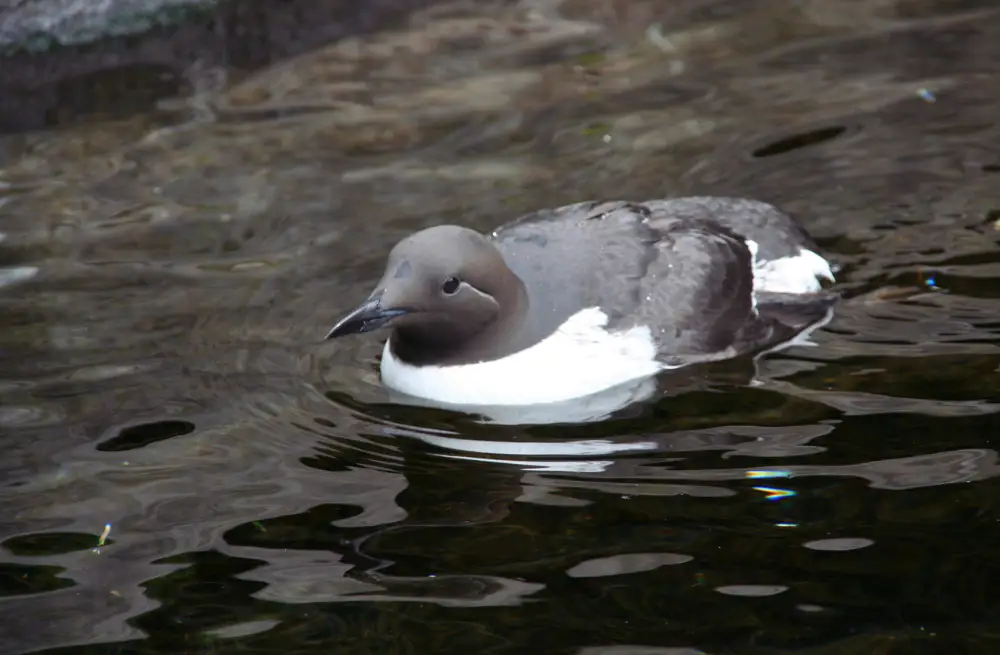
Common Murres are widely distributed across the Northern Hemisphere, occupying temperate, subarctic, and low-Arctic marine environments.
Their range covers two major ocean regions: the North Atlantic and the North Pacific.
North Atlantic Distribution

In the Atlantic, Common Murres breed along the coasts and islands of eastern Canada, Greenland, Iceland, the British Isles, Scandinavia, and parts of northern Europe and Russia.
They are familiar breeding birds around the rocky coastlines of Scotland, Ireland, Iceland, and Norway, where suitable cliffs can support large colonies.
In North America, important breeding areas include Newfoundland and Labrador, Quebec, and coastal islands farther north. Smaller breeding populations also occur in Maine.
During winter, birds spread across offshore waters, including the North Sea and parts of the western Atlantic farther south than their breeding colonies.
North Pacific Distribution
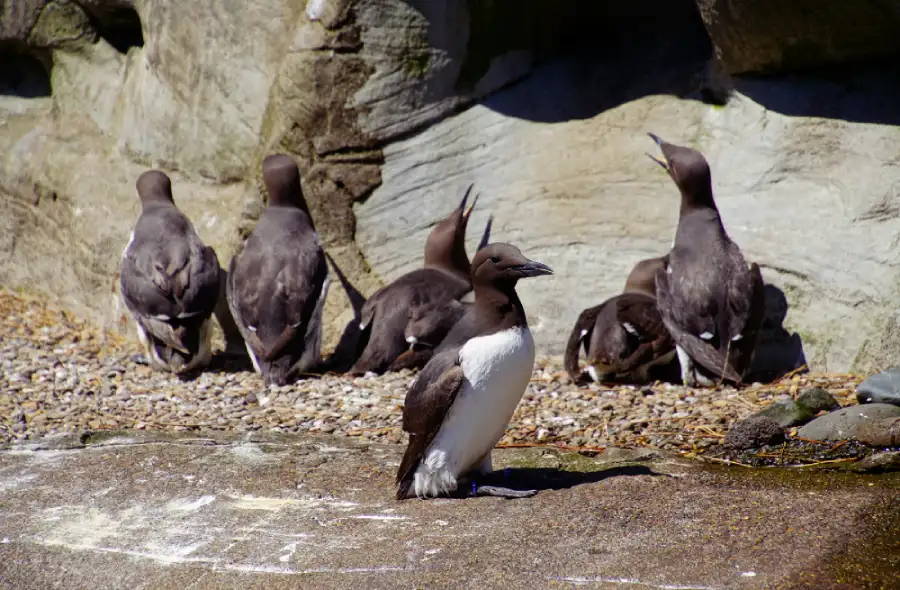
Pacific populations occur along the coasts of eastern Asia and western North America.
Their breeding range extends from the Russian Far East through the Aleutian Islands and Alaska, then southward through British Columbia, Washington, Oregon, and California.
The Farallon Islands off California are among the best-known breeding locations in the eastern Pacific.
Some populations remain relatively close to their breeding regions throughout the year, while others move considerable distances as ocean conditions change.
Preferred Habitat
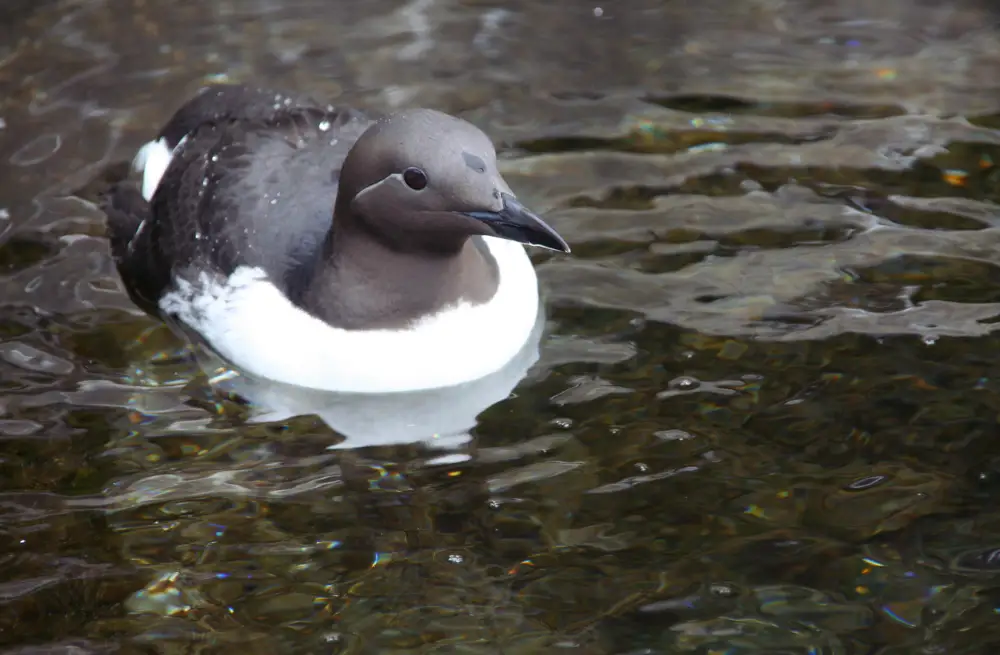
Common Murres are closely associated with productive marine waters, particularly areas over the continental shelf where fish are abundant.
They often forage where ocean currents, underwater topography, and temperature differences help concentrate prey.
During the breeding season, they use steep sea cliffs, rocky islands, offshore stacks, and occasionally flatter rocky surfaces that offer some protection from land predators.
Once breeding is finished, they spend almost all their time at sea.
They don't need to return to land to sleep or rest, and many individuals remain offshore for months.
Diet & Feeding Behavior
Fish make up the majority of the Common Murre's diet.
The exact species eaten depend on location, season, and what is available in the surrounding waters. Rather than relying on one particular fish, murres take advantage of several small schooling species.
Common prey includes:
- Sand lance
- Capelin
- Herring
- Anchovies
- Sardines
- Pollock
- Cod and other small marine fish
- Young rockfish
They also eat squid, krill, amphipods, and other marine invertebrates, particularly when fish are less available.
Their diet can change significantly between the breeding and nonbreeding seasons.
For example, murres nesting along the Pacific coast may feed heavily on anchovies or juvenile rockfish during one season and switch to other fish when local conditions change.
How Common Murres Hunt
Common Murres capture prey underwater, using their wings to propel themselves forward.
Unlike ducks, which often rely heavily on their feet, murres move through water with powerful wing strokes. They can pursue fish through the water column, changing direction while maintaining considerable speed.
Most feeding dives are relatively shallow compared with their maximum capability, commonly taking place around 20–50 meters (65–165 feet).
However, recorded dives have reached approximately 180 meters (590 feet).
That's an impressive depth for a bird weighing around one kilogram.
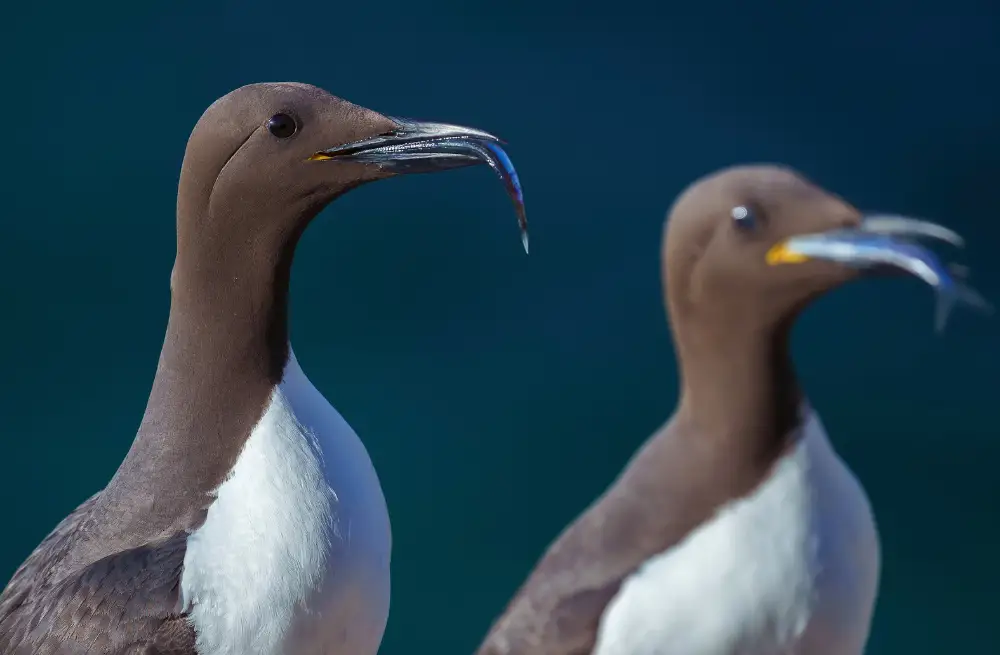
Murres usually swallow their prey underwater, but adults feeding chicks carry fish back to the colony in their bills.
Their mouths contain small, backward-pointing structures called denticles that help them grip slippery fish.
During the breeding season, an adult may repeatedly travel between fishing grounds and the nesting cliff, sometimes carrying just one fish at a time for its chick.
Flight, Swimming & Diving
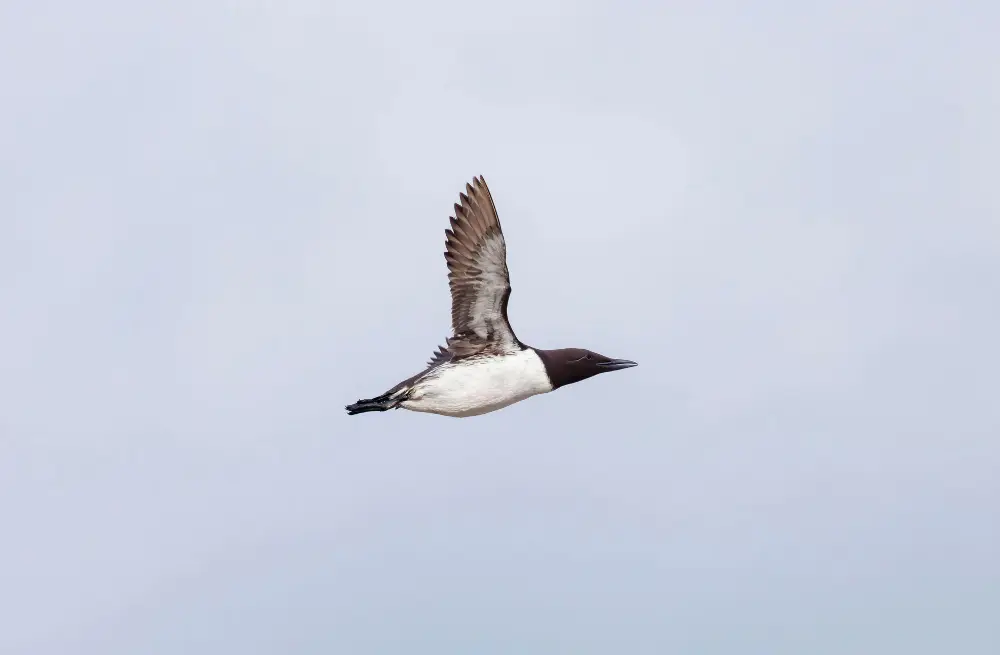
Common Murres are excellent swimmers, although their movements in the air can look rather hurried.
Their short, narrow wings are adapted for underwater propulsion, where they function somewhat like flippers.
The compromise is that the same wings must also generate enough lift to carry a relatively heavy bird through the air.
As a result, Common Murres fly with exceptionally rapid wingbeats.
They often travel low over the ocean in straight, fast flights, sometimes appearing in groups moving toward or away from their breeding colonies.
Taking off from the water requires considerable effort. A murre may beat its wings rapidly while pushing along the surface with its feet before becoming airborne.
Underwater, the situation changes completely.
The bird's streamlined body and powerful wing strokes allow it to pursue fish efficiently, while its feet help with steering.
After the breeding season, Common Murres undergo a molt that temporarily leaves them unable to fly. During this period, they remain at sea, relying on their swimming and diving abilities.
Nesting & Breeding
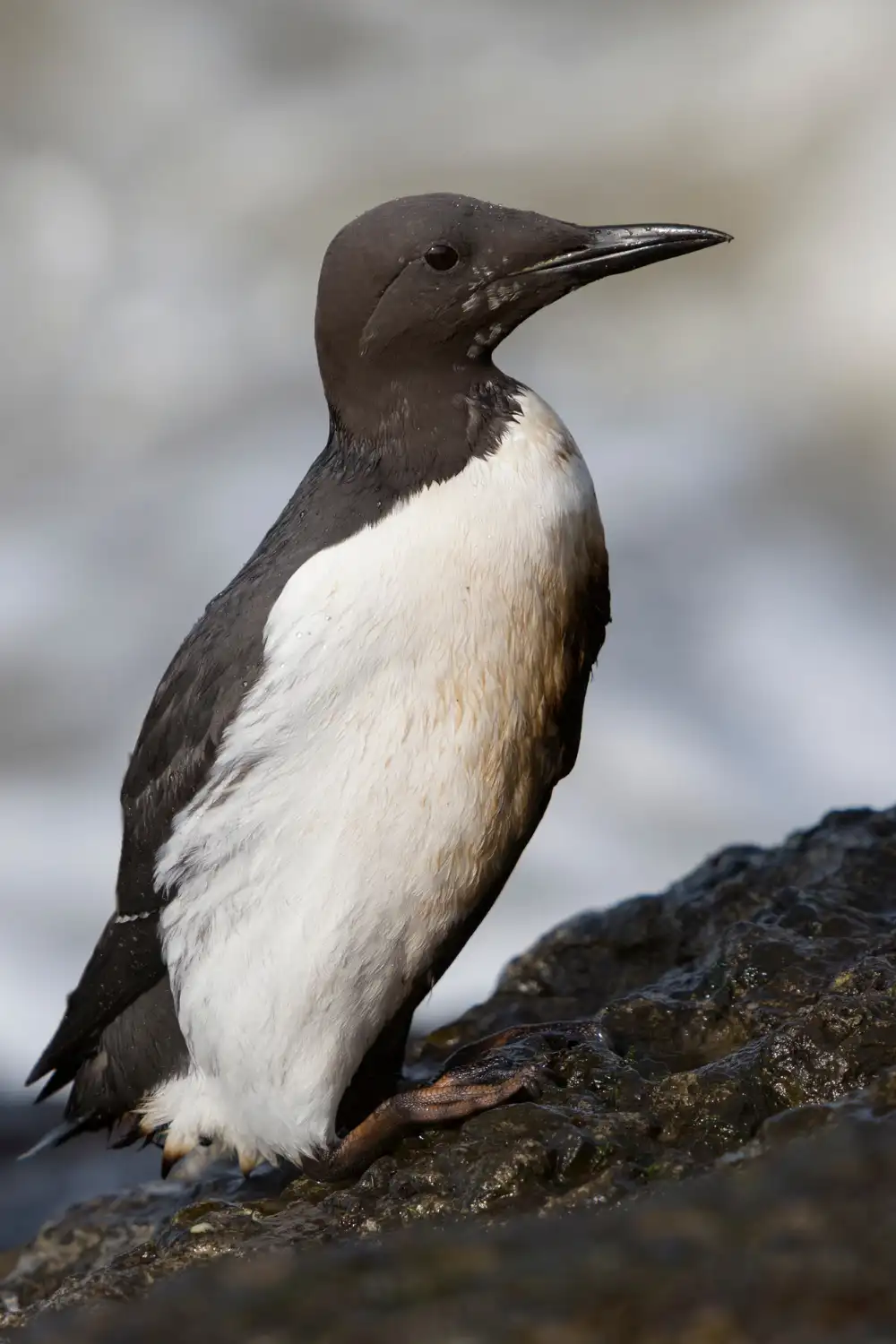
Few seabirds nest as densely as the Common Murre.
At major colonies, thousands of adults gather on rocky ledges, often occupying almost every available patch of suitable ground.
Breeding pairs may be so close that neighboring birds physically touch one another while incubating their eggs.
This crowded arrangement provides some protection against predators, although it can also lead to disputes when birds interfere with their neighbors.
Common Murres generally begin breeding at around four or five years of age.
They form long-term pair bonds, with many pairs returning to the same breeding location over successive years.
Courtship involves bowing, touching bills, mutual preening, and vocal exchanges.
Partners may also greet one another when returning from the sea.
Do Common Murres Build Nests?
No, not in the usual sense.
Rather than collecting grass, twigs, or other materials, Common Murres lay their eggs directly on bare rock.
Some adults may arrange a few small stones around the egg, but they don't construct a proper nest.
The breeding site may be little more than a small space on a cliff ledge.
With so many birds nesting together, space becomes valuable. Adults defend the area immediately surrounding their egg or chick, sometimes using their bills to push away neighboring birds.
Eggs & Incubation
A female Common Murre normally lays a single egg per breeding attempt.
The egg is unusually large relative to the bird and has a distinctive pear-like shape, technically described as pyriform.
Its narrow, pointed end and broader rounded end help distinguish it from the more oval eggs of many other seabirds.
Common Murre eggs also vary enormously in appearance.
Some are pale blue or turquoise, while others are greenish, cream, or tan. Many have dark spots, streaks, or irregular markings.
These individual patterns may help parents recognize their own eggs in crowded colonies.
Both parents share incubation duties, with the incubation period typically lasting about four to five weeks.
If an egg is lost early enough, a female may lay a replacement.
Why Are Common Murre Eggs Pointed?
For many years, the unusual shape of murre eggs was explained by the idea that they would roll in tight circles rather than falling from a cliff.
The story sounds convincing, but scientific research has shown that the explanation is more complicated.
A 2018 study published in The Auk compared the stability of Common Murre eggs with the more elliptical eggs of Razorbills.
Researchers found that the more pointed murre eggs were generally more stable on sloping surfaces and easier to stabilize.
In other words, their shape may help prevent them from rolling in the first place.
Other proposed advantages include greater resistance to certain impacts and reduced contamination of the broader end of the eggshell.
It's a useful reminder that even familiar explanations in natural history sometimes change as researchers gather better evidence.
Chicks & Parental Care
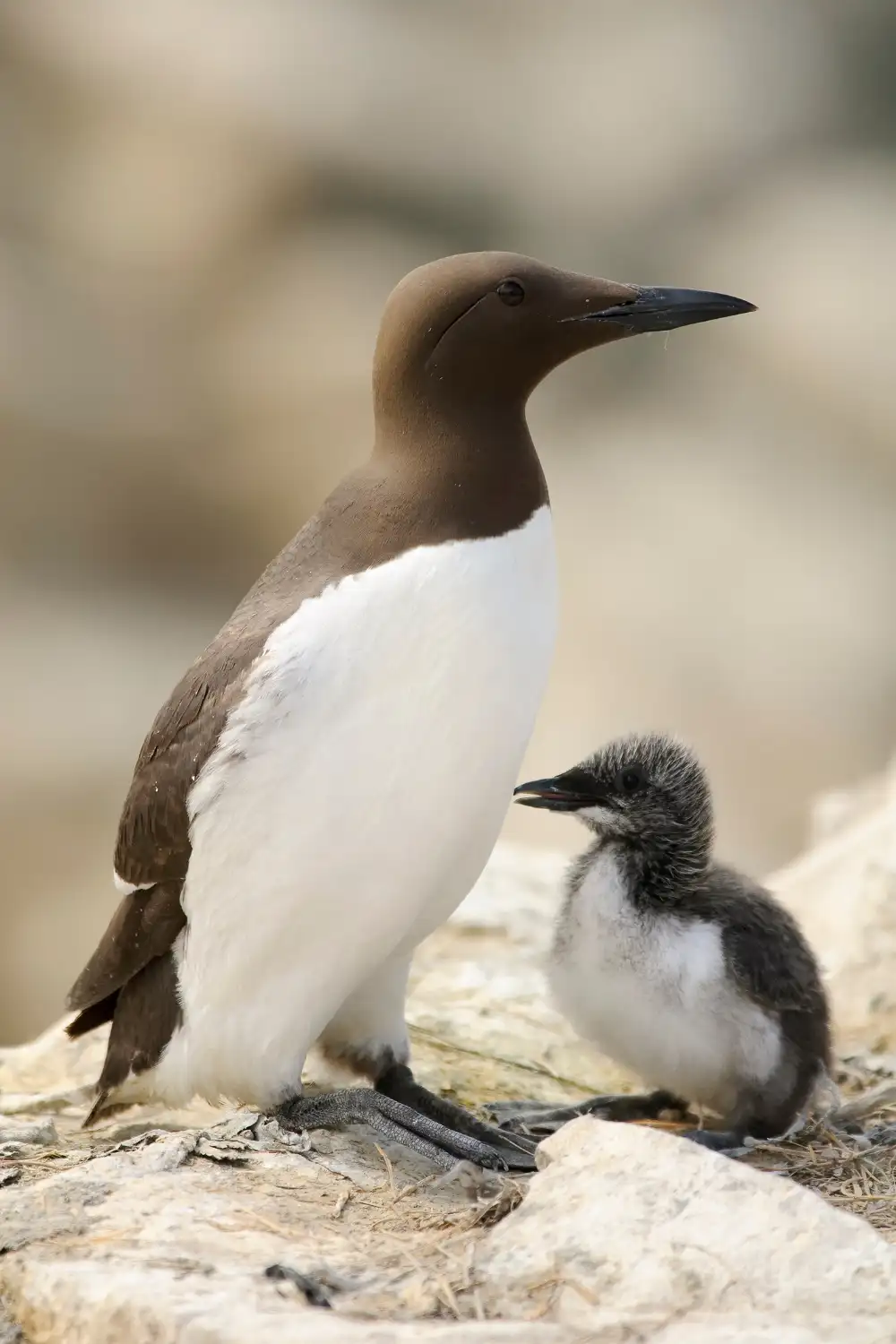
Common Murre chicks hatch covered in soft down and are able to stand soon after emerging from their eggs.
Both parents initially care for the chick, keeping it warm and delivering small fish.
But the young bird doesn't remain on the cliff until it can fly.
Instead, it leaves the breeding colony when it's only about two to three weeks old.
At this stage, the chick is still quite small and its wings aren't developed enough for powered flight.
The First Journey to the Sea
Leaving the colony is one of the most unusual moments in a Common Murre's life.
The chick approaches the edge of the nesting ledge and jumps toward the water below, fluttering its small wings as it descends.
Depending on the nesting location, the drop can be considerable.
The adult male typically waits below or accompanies the chick, calling to maintain contact.
Once the two are together at sea, the father takes over the main responsibility for raising the young bird.
He continues feeding and protecting the chick while it grows and develops its ability to dive and forage independently.
This period of care can last several more weeks.
The female usually remains around the breeding colony for a time after the chick departs.
Eventually, the surviving family members spend the remainder of the season offshore.
Behavior & Vocalizations
Common Murres are highly social during the breeding season.
Their colonies are constantly active, with birds arriving from fishing trips, replacing partners on eggs, feeding chicks, or defending the small spaces they occupy.
Despite the close contact, they aren't always peaceful neighbors.
Disagreements between adults can involve sharp bill movements, lunges, and brief physical confrontations.
Pairs also spend time maintaining their bonds through mutual preening and bill-touching displays.
What Does a Common Murre Sound Like?
Common Murres produce a variety of low, rough calls.
Their vocalizations include deep murmurs, growls, croaks, and longer braying sounds.
At large breeding colonies, the combined noise of thousands of birds can become surprisingly loud.
Chicks also produce calls that help them maintain contact with their parents.
Away from the breeding colonies, Common Murres are generally less vocal.
Threats & Predators
Although the Common Murre remains widespread, it faces several threats throughout its range.
Some of the most serious problems come from changes in the marine environment.
Because Common Murres depend heavily on small fish, anything that reduces prey availability can affect both adult survival and breeding success.
Climate Change & Marine Heatwaves
Ocean warming is an increasingly important concern for Common Murre populations.
Marine heatwaves can alter food webs, change the distribution of fish, and reduce the availability of energy-rich prey.
One especially severe event occurred in the northeast Pacific between 2014 and 2016.
During this period, unusually warm ocean temperatures disrupted marine ecosystems across a large area, including the Gulf of Alaska and the Bering Sea.
The consequences for Common Murres were enormous.
A study published in Science in December 2024 estimated that approximately four million Common Murres were lost from Alaska's population following the heatwave.
At 13 monitored colonies, researchers recorded declines of 52–78% when comparing the years before and after the event.
The study found no clear recovery during the years examined through 2022.
It was one of the largest documented wildlife mortality events of modern times and a serious example of how quickly ocean conditions can affect seabirds.
Oil Pollution
Oil spills are another significant threat.
Common Murres spend much of their lives floating on or diving beneath the ocean surface, making them particularly vulnerable to oil contamination.
Oil damages the insulating and waterproofing properties of their feathers, increasing the risk of hypothermia.
Affected birds may also ingest oil while attempting to clean their plumage.
Fishing Activities
Common Murres can become accidentally entangled in fishing nets, particularly gillnets.
Because they pursue fish underwater, they may encounter nets at the same depths where they normally feed.
Competition with commercial fisheries can also become a problem when important prey species are heavily harvested.
The effects vary by region and depend on the type of fishing, local fish populations, and management practices.
Natural Predators
At breeding colonies, eggs and chicks may be taken by gulls, ravens, and other opportunistic predators.
Larger birds of prey, including eagles in some regions, can also disturb colonies or prey on adult murres.
Introduced mammals such as rats and foxes are especially dangerous on islands where seabirds historically nested without land predators.
Repeated disturbance can cause breeding failures or even lead birds to abandon a colony.
Conservation & Protection
The Common Murre is currently classified as Least Concern on the IUCN Red List.
Its broad geographic distribution and large overall population mean that the species is not considered globally threatened with extinction.
However, that classification doesn't mean every population is doing well.
Numbers have declined in some parts of the Pacific, and the severe losses associated with marine heatwaves show how vulnerable large breeding populations can be.
In the United Kingdom, the species is also placed on the Amber List of Birds of Conservation Concern.
Conservation work focuses on protecting breeding colonies, reducing accidental capture in fishing gear, preventing oil pollution, managing introduced predators, and monitoring changes in ocean conditions.
Long-term seabird surveys are particularly valuable because Common Murres return to established colonies and can be monitored over many breeding seasons.
Their dependence on fish also makes them useful indicators of broader changes in marine food webs.
When a colony suddenly stops producing chicks or large numbers of adults disappear, the cause may lie far beyond the nesting cliff itself.
Where to See Common Murres
The best opportunity to observe Common Murres is usually during the breeding season, when adults gather at established coastal colonies.
In North America, well-known viewing regions include coastal Alaska, Newfoundland and Labrador, and parts of California's rocky coastline.
In Europe, Common Murres can be seen at seabird colonies in Scotland, Iceland, Ireland, and Norway, among other locations.
Outside the breeding season, birds may be spotted resting on the ocean surface or flying low over the water.
A spotting scope can be particularly useful when watching from shore, as murres often remain farther offshore than many familiar coastal birds.
When visiting colonies, it's important to observe from established viewing areas and avoid approaching nesting birds.
Similar Species
Iconic seabird famous for its vibrant, multi-colored beak.
Read More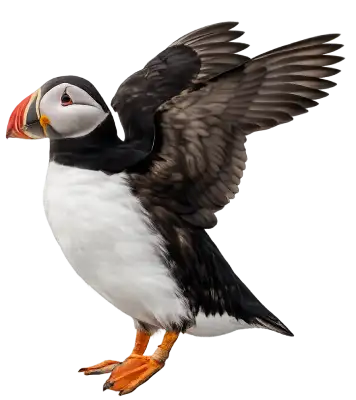

Penguin-like diver with a slender, pointed bill.
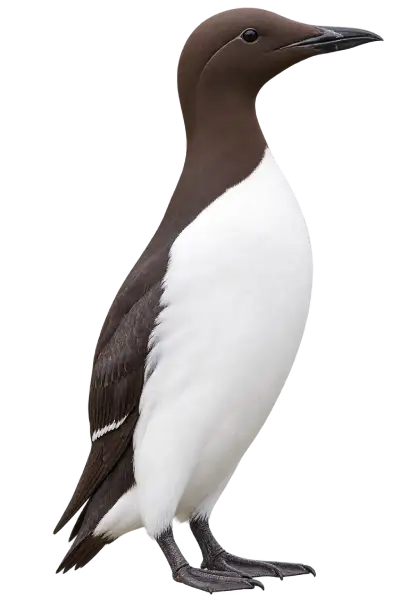

Stocky cliff-nester recognized by a distinct white bill stripe.
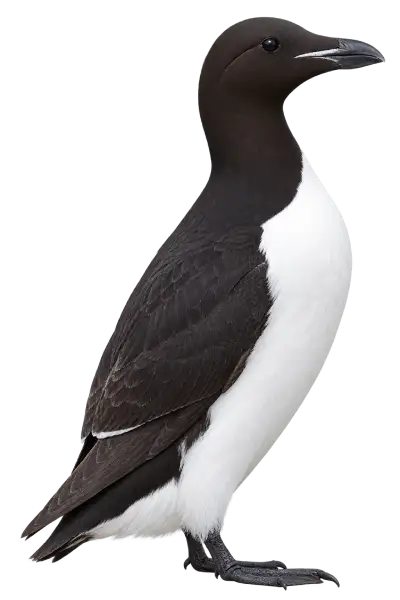

A robust, black-and-white seabird recognized by its thick, blunt bill.
Read More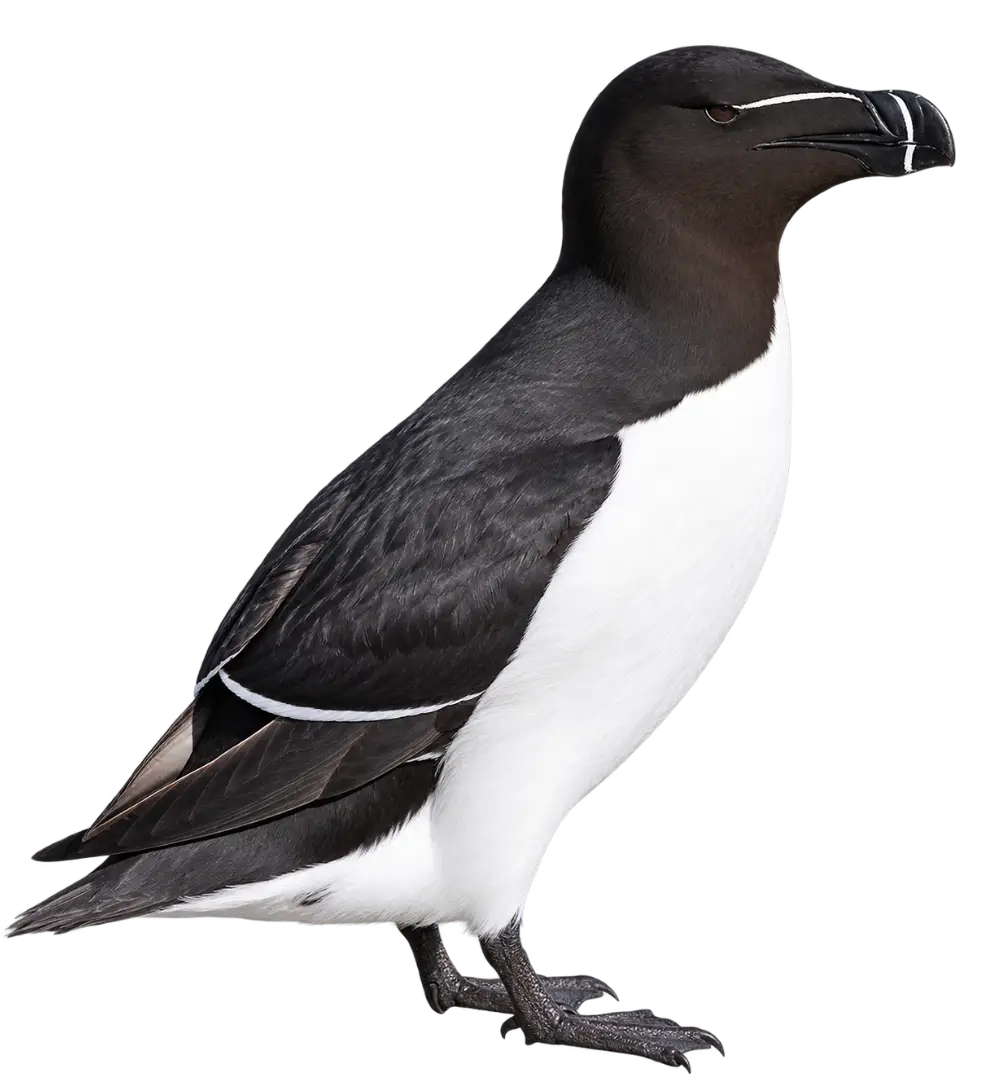
Pelagic bird sporting sweeping golden head plumes.
Read More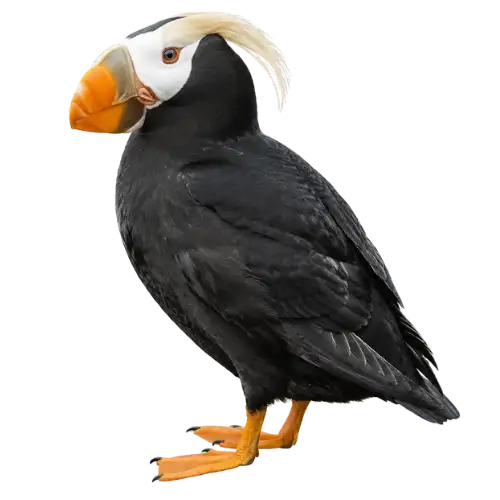
Nocturnal forager with a prominent pale bill horn.
Read More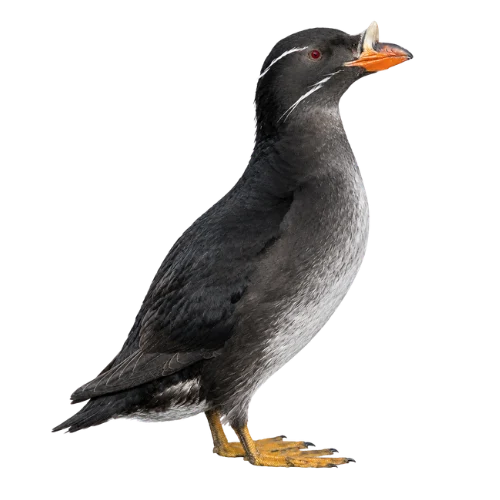
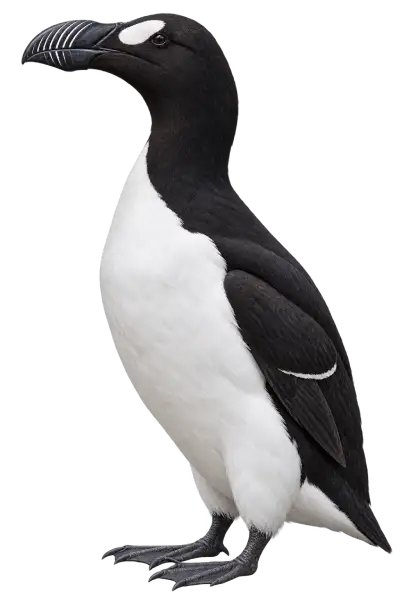
Massive, flightless seabird driven to extinction in the 1800s.
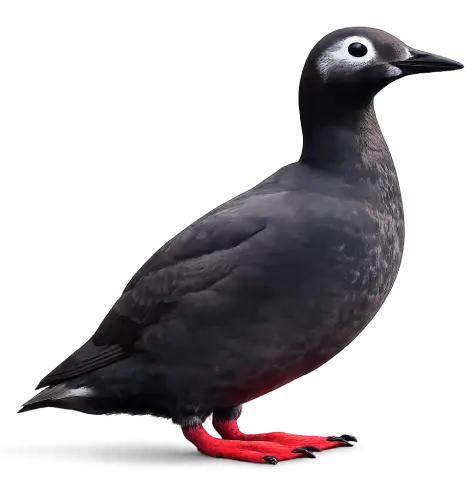
Pacific seabird known for distinct white eye-rings.

Small seabird that remarkably nests in old-growth forests.
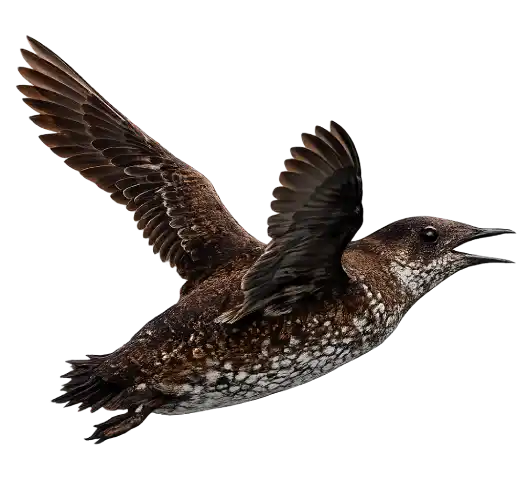
Striking black seabird with large white wing patches.
Read More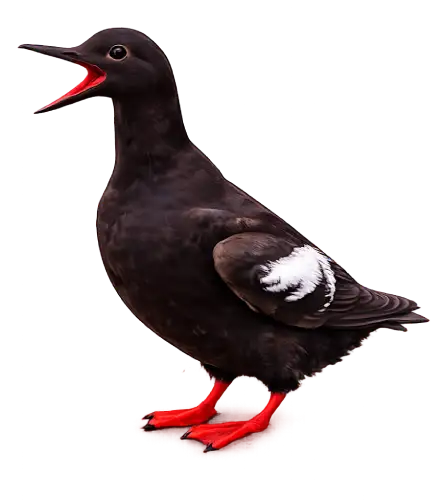
Distinctive seabird named for the fleshy horn above its eyes.
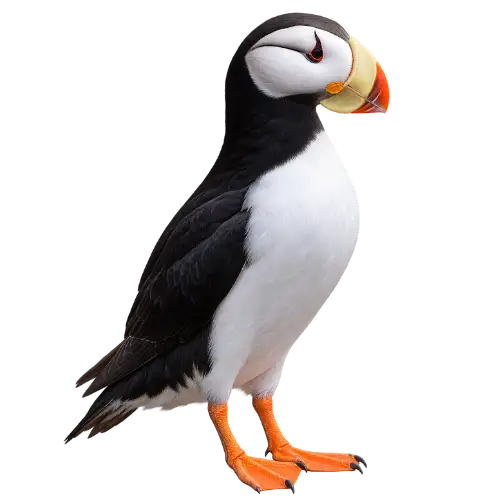
Striking dark seabird known for its bold white wing patch and bright red legs.
Read More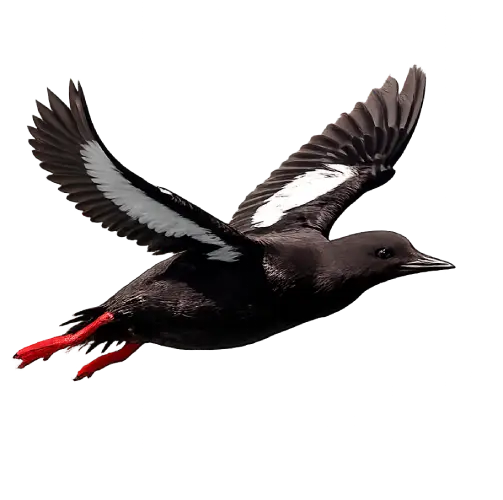
Large, graceful seabird known for its dark eye stripe and impressive wingspan.
Read More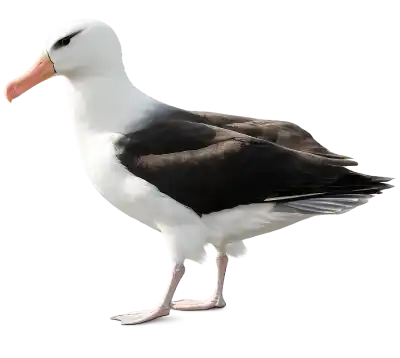

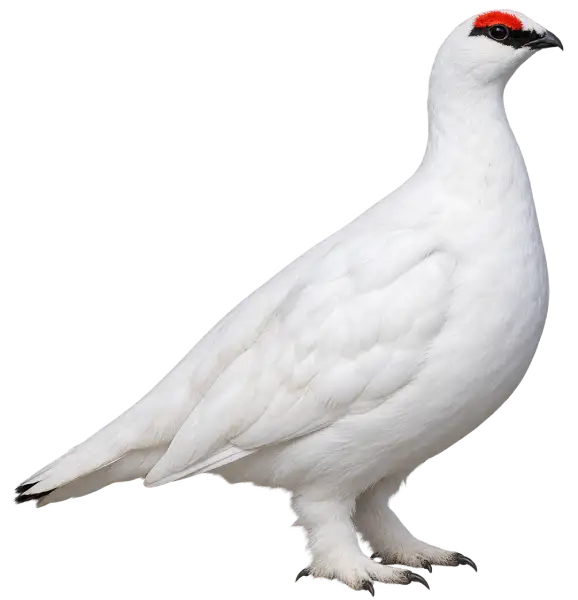
Hardy Arctic gamebird that changes its plumage to match the seasonal snow.

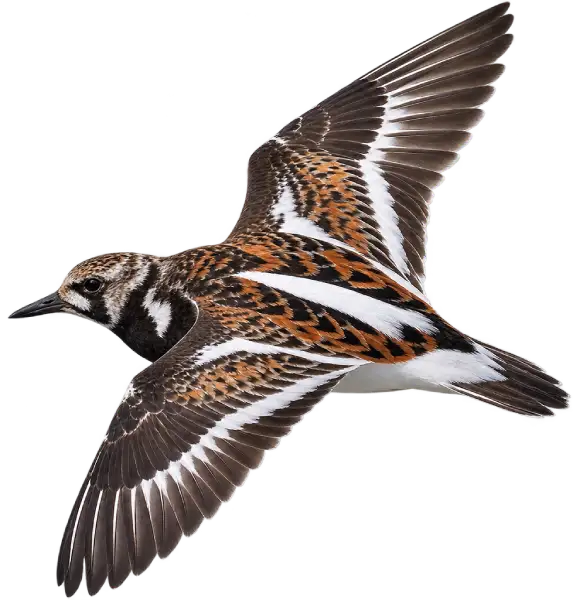
Stocky shorebird recognized by its habit of flipping stones to find hidden prey.
Resilient coastal wader that overwinters on rocky, wave-battered northern shores.