Painted Bunting (Passerina ciris)
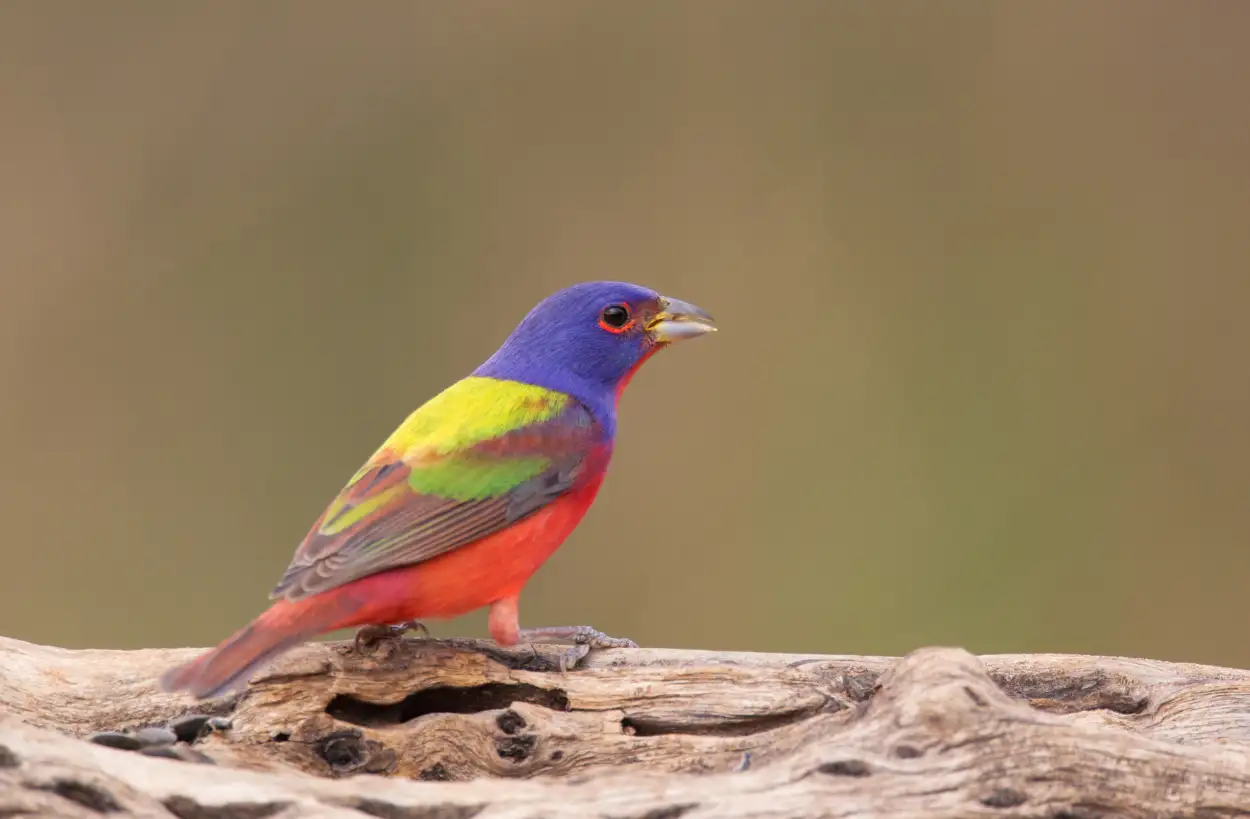
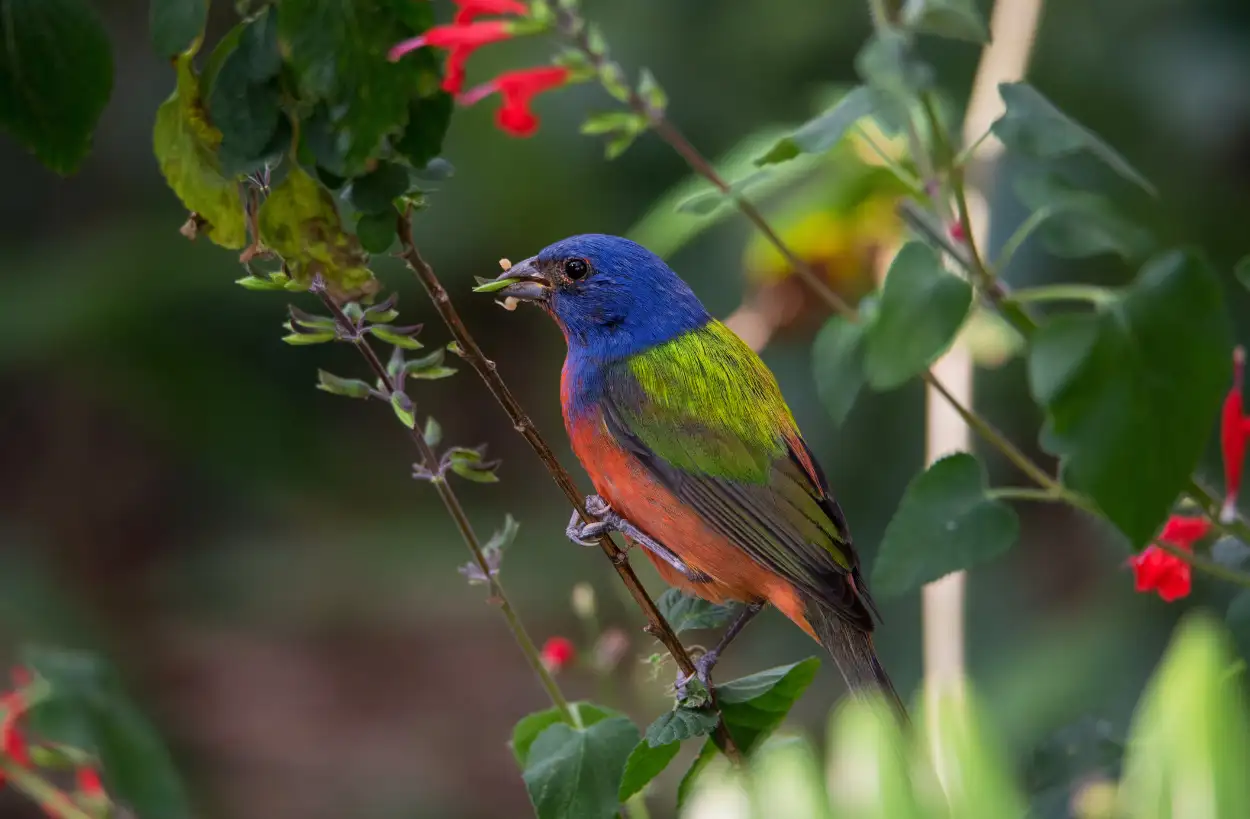
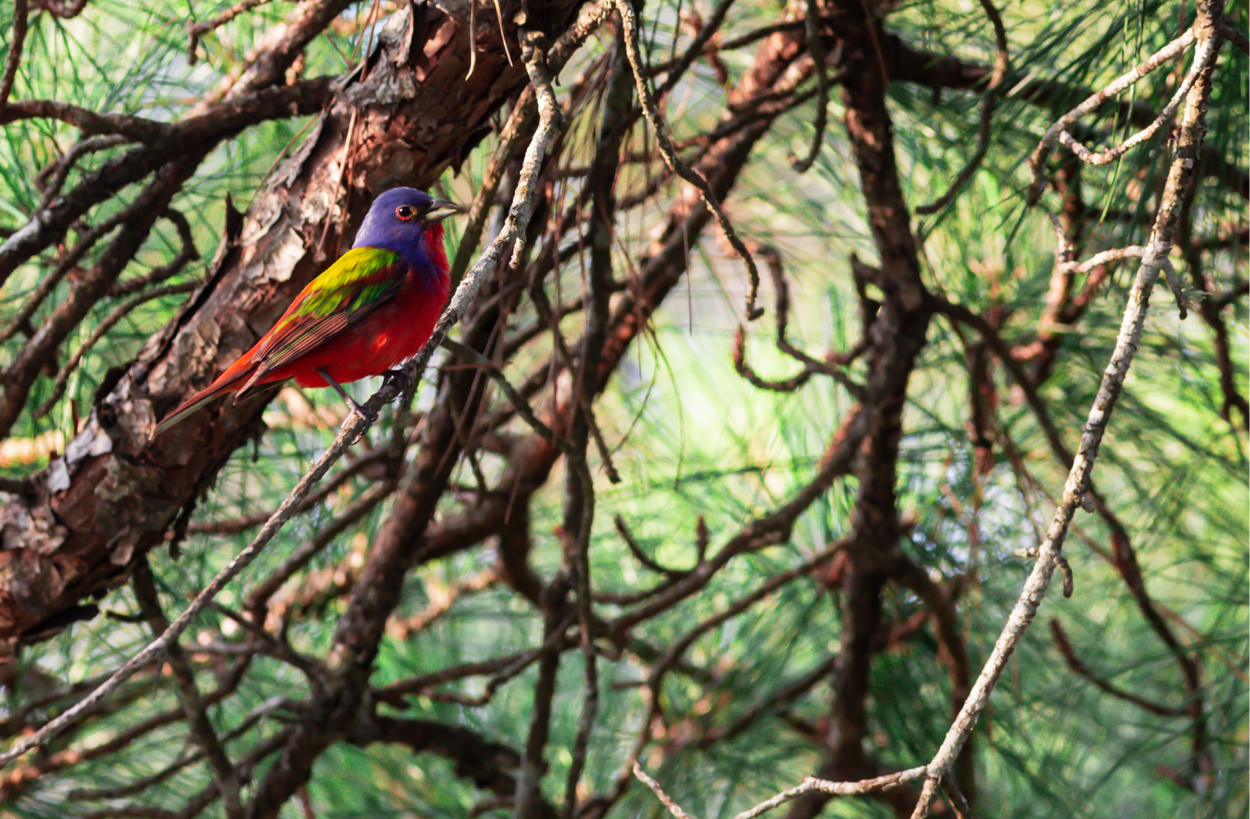
If there is a North American songbird that looks like it escaped from a paint box, this is it. The adult male Painted Bunting wears blue, green and red at the same time, which is why the French called it nonpareil, without equal.
Species Profile
Scientific Classification
History & Background
Carl Linnaeus formally described the species in 1758, in the tenth edition of Systema Naturae, under the name Emberiza ciris. He was not working from a specimen he had collected himself.
His account rested mainly on the "Painted Finch" that the English naturalist Mark Catesby had described and illustrated around 1730 in The Natural History of Carolina, Florida and the Bahama Islands.
Linnaeus gave the type locality simply as "America." The American Ornithologists' Union narrowed it to South Carolina in 1931.
The species epithet ciris is a Latin name for a mythical bird, taken from the Ancient Greek keiris, which referred to a bird nobody has since been able to identify. The genus Passerina came later, introduced in 1816 by the French ornithologist Louis Pierre Vieillot, and now holds seven species.
The bird has collected a long list of common names over the years, including Mexican canary, painted finch, pope, and nonpareil.
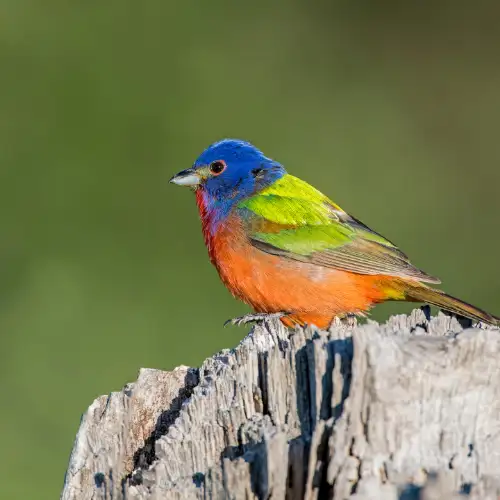
A 4.7 to 5.5 inch songbird of dense low cover. Males sing from exposed perches in spring, but the birds otherwise skulk in foliage and are far easier to hear than to see.
All feathered, winged, bipedal, warm-blooded, egg-laying vertebrates.
The perching birds, containing more than half of all bird species. Defined by an anisodactyl foot: three toes forward, one back.
The cardinal family, alongside the Northern Cardinal and the grosbeaks. Despite the name, the Painted Bunting is not an Old World bunting and is not a finch. Thick conical bills for cracking seed are the family trait.
Seven species of small, brightly coloured New World buntings, introduced by Vieillot in 1816. The name comes from Latin passer, sparrow.
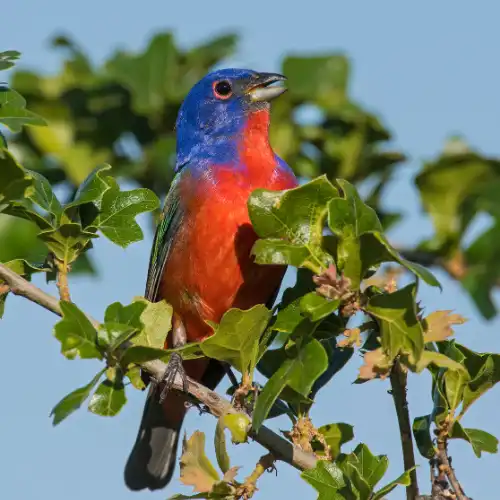
Described by Linnaeus in 1758. The epithet ciris is the Latin name of a mythical bird, from Greek keiris, a bird that has never been identified. Two subspecies are recognised.
Almost pure seed-eaters in winter, taking grasses, sedges and forbs. When breeding and feeding nestlings they switch to spiders, snails, grasshoppers and caterpillars, and will raid spider webs for trapped insects.

Thickets, woodland edges and riparian scrub. In the east it uses maritime hammocks and scrub. It also takes to roadsides, suburbs and gardens with thick shrubby planting.
Migrates at night over short to medium distances. Western birds moult partway through migration; eastern birds moult before setting off.
Solitary or paired while breeding, and mostly monogamous. Males defend small territories with song and a set of visual displays, and rival males sometimes fight hard enough to kill one another. Small loose flocks form in winter.
Breeds in two geographically separate blocks: a western one from Arizona and New Mexico through Texas to Louisiana, and an eastern one along the coast from South Carolina to northern Florida. Winters from South Florida and the Caribbean through Mexico and Central America.
Listed as Least Concern, though the trend is downward. Habitat loss to development is the main pressure, especially in eastern coastal thickets and in riparian habitat used during migration and winter. The cage-bird trade was the historic threat; capture has been illegal in the US since 1918.
Identification & Appearance
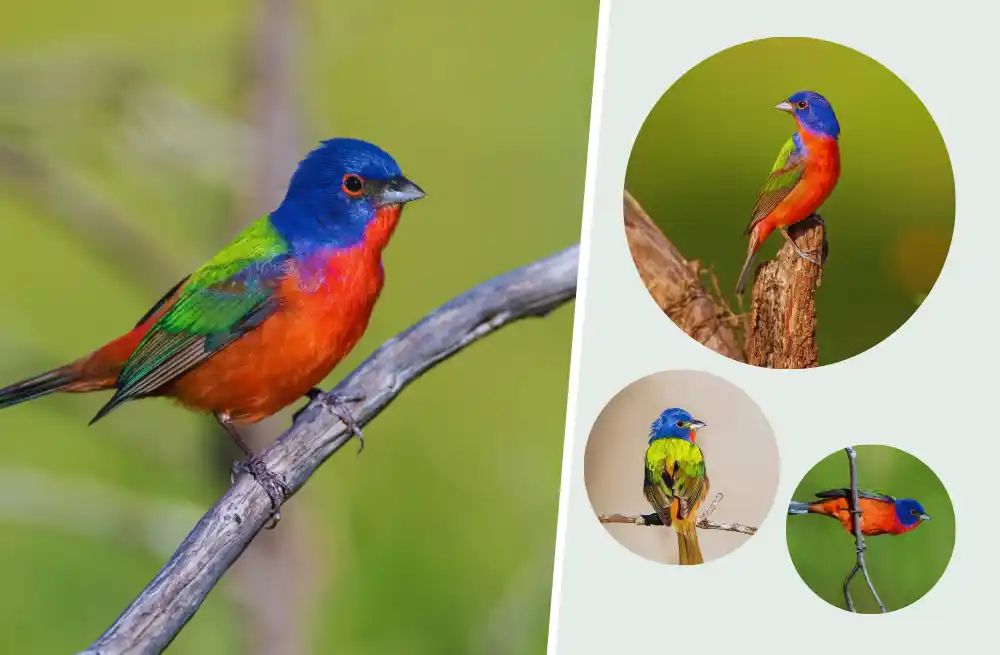
The Adult Male
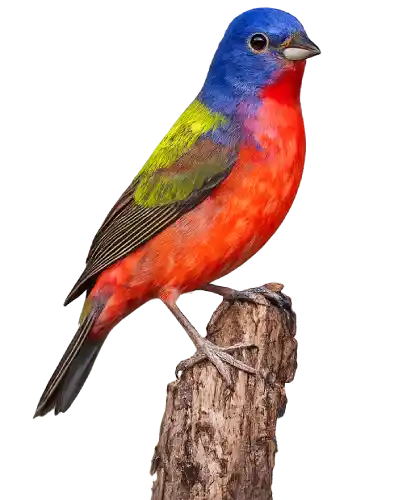
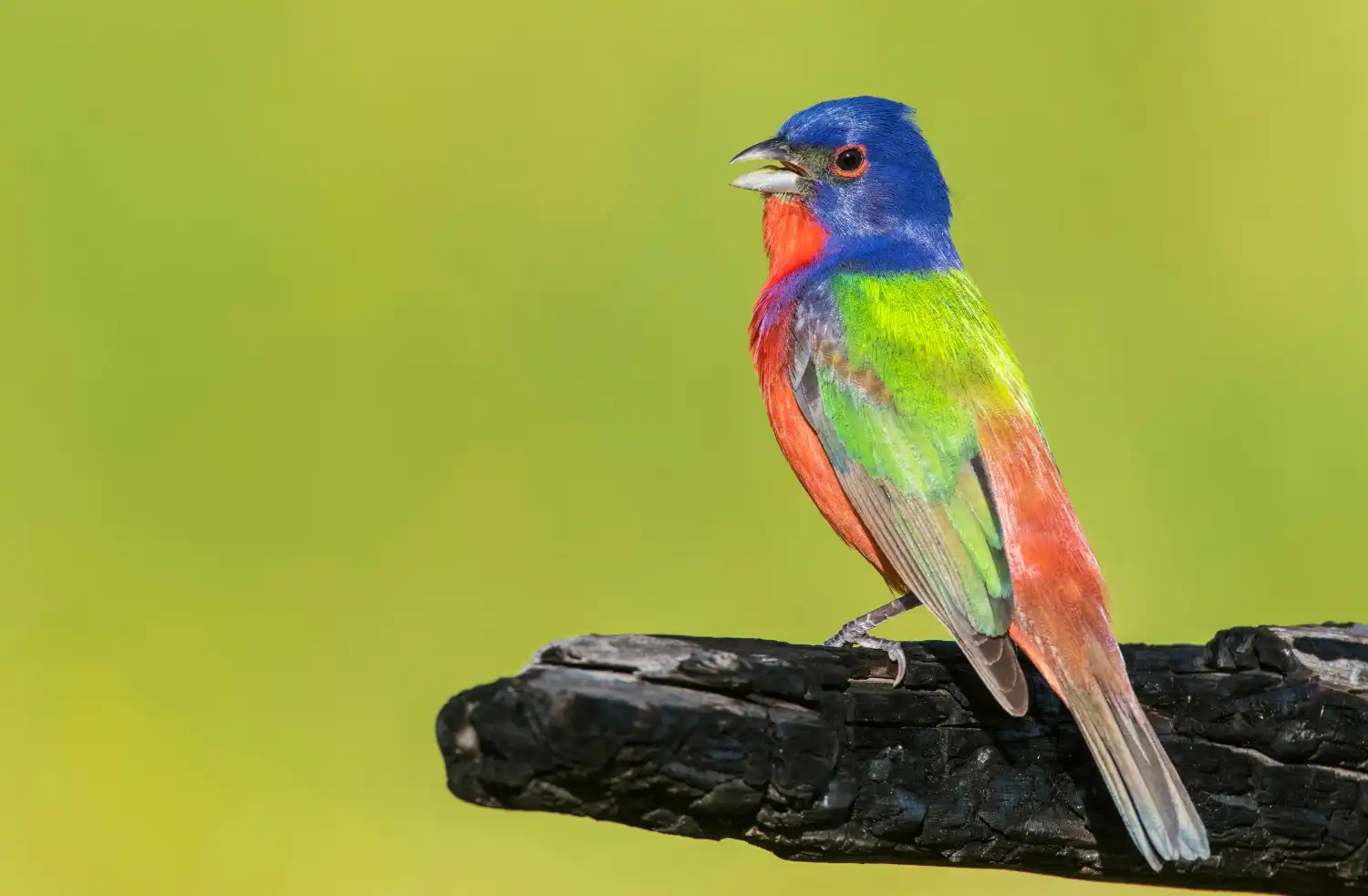
Dark blue head, green back, red rump and red underparts. No other North American songbird combines those colours, so identification is instant once you actually see the bird. That last part is the catch. Painted Buntings skulk in foliage even while singing, so hearing one is far easier than seeing it.
Females and Young Birds
Green above, yellow-green below, with no streaking. The colouring works as camouflage, but it is not drab. The adult female is a brighter, truer green than other songbirds she might be confused with, which is the most reliable way to pick her out.
The Two-Year Wait
Males do not hatch colourful. The bright plumage only starts to come in during the second year of life. Through their first year, males look like females and can be separated only by close inspection in the hand.
Young birds also go through two extra moults in their first autumn, each producing a plumage resembling an adult female. The first begins a few days after fledging, the second about a month later.
Subspecies
P. c. ciris occupies the southeastern United States. P. c. pallidior, described by Mearns in 1911, covers the central southern United States and northern Mexico.
Range & Habitat
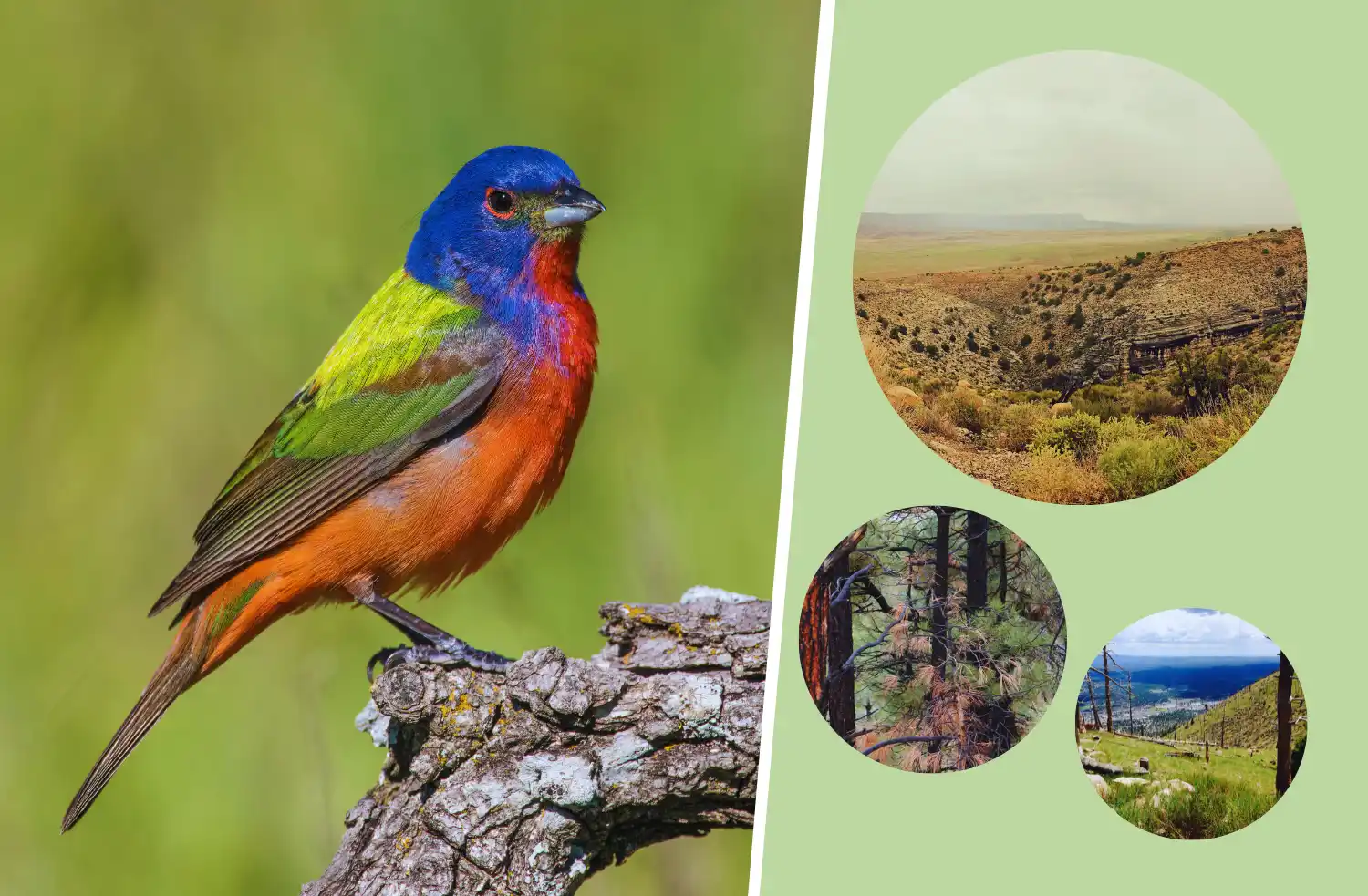
Passerina ciris · Distribution at a glance
Migratory-
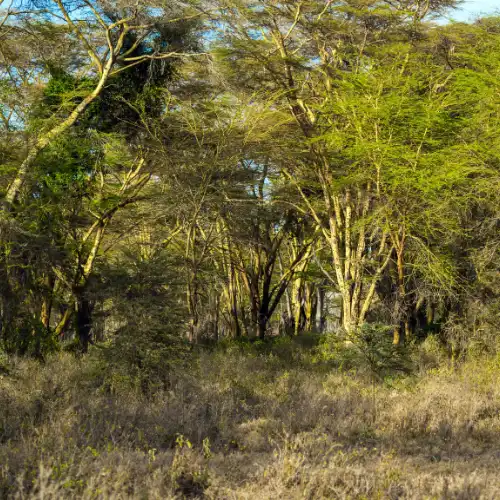 Thickets
-
 Woodland Edges
-
 Riparian Scrub
-
 Brushy Areas
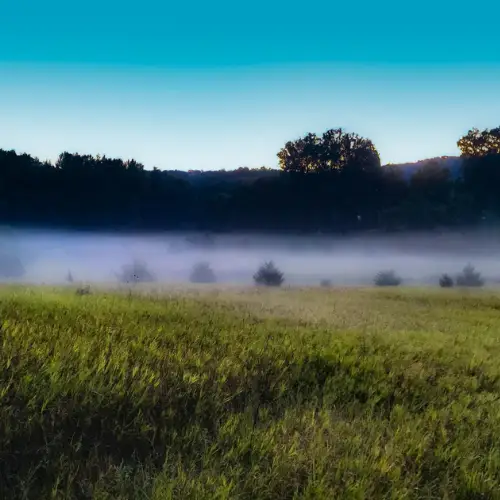
The breeding range splits into two geographically separate blocks with a wide gap between them, which is unusual and has real consequences for how the species is studied and protected. Genetic analysis has since divided the species into three main breeding groups: western, central and eastern.
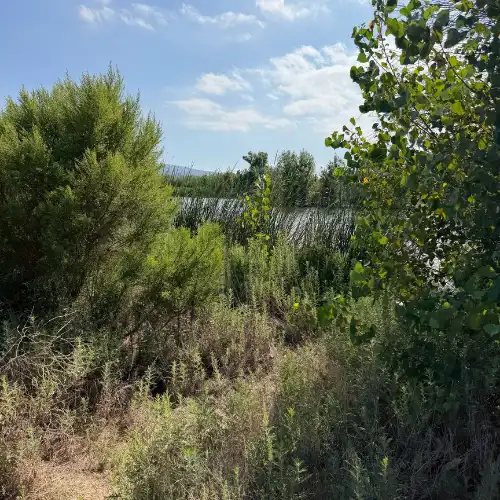
Habitat is typical for the family. Painted Buntings want dense, low, tangled cover: thickets, woodland edges, riparian scrub. In the east they breed in maritime hammocks and scrub communities.
They have adapted to human landscapes to a degree, turning up along roadsides, in suburbs, and in gardens with thick shrubby planting. In winter they use the shrubby margins of tropical forest and heavily vegetated savanna.
Vagrants show up well outside the normal range, with records from Washington DC, New York, Pennsylvania and New Jersey. Every few years one reaches as far north as New Brunswick in Canada.
Diet & Foraging
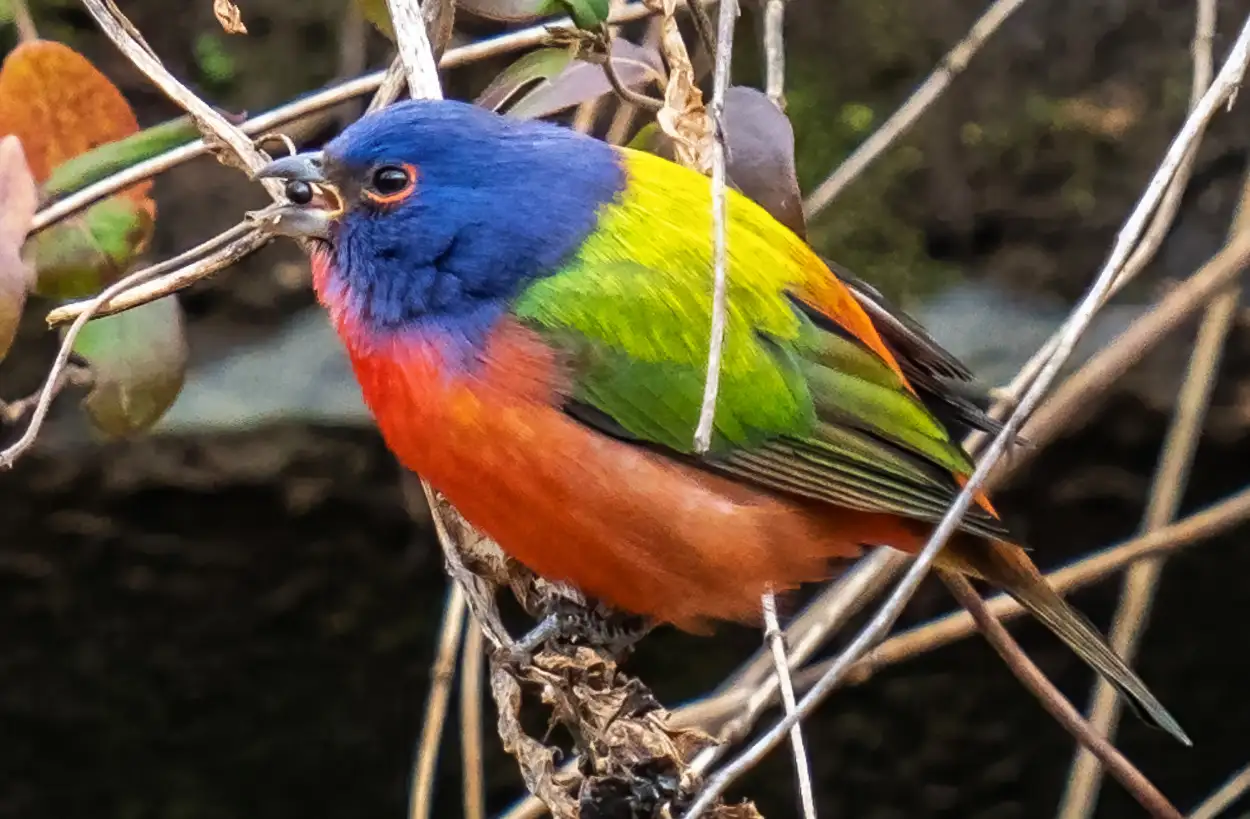
Painted Buntings feed mostly by hopping along the ground, pausing every few moments to look around. The diet shifts with the season, and the shift is sharp.
In winter they eat seeds almost exclusively, taking grasses such as Panicum, sedges such as Carex, and forbs including Amaranthus, Oxalis and Euphorbia.
During the breeding season, and especially when feeding nestlings, they switch to small invertebrates: spiders, snails, grasshoppers and caterpillars. They will also work spider webs opportunistically, picking off insects that the spider caught first.
Behavior & Display
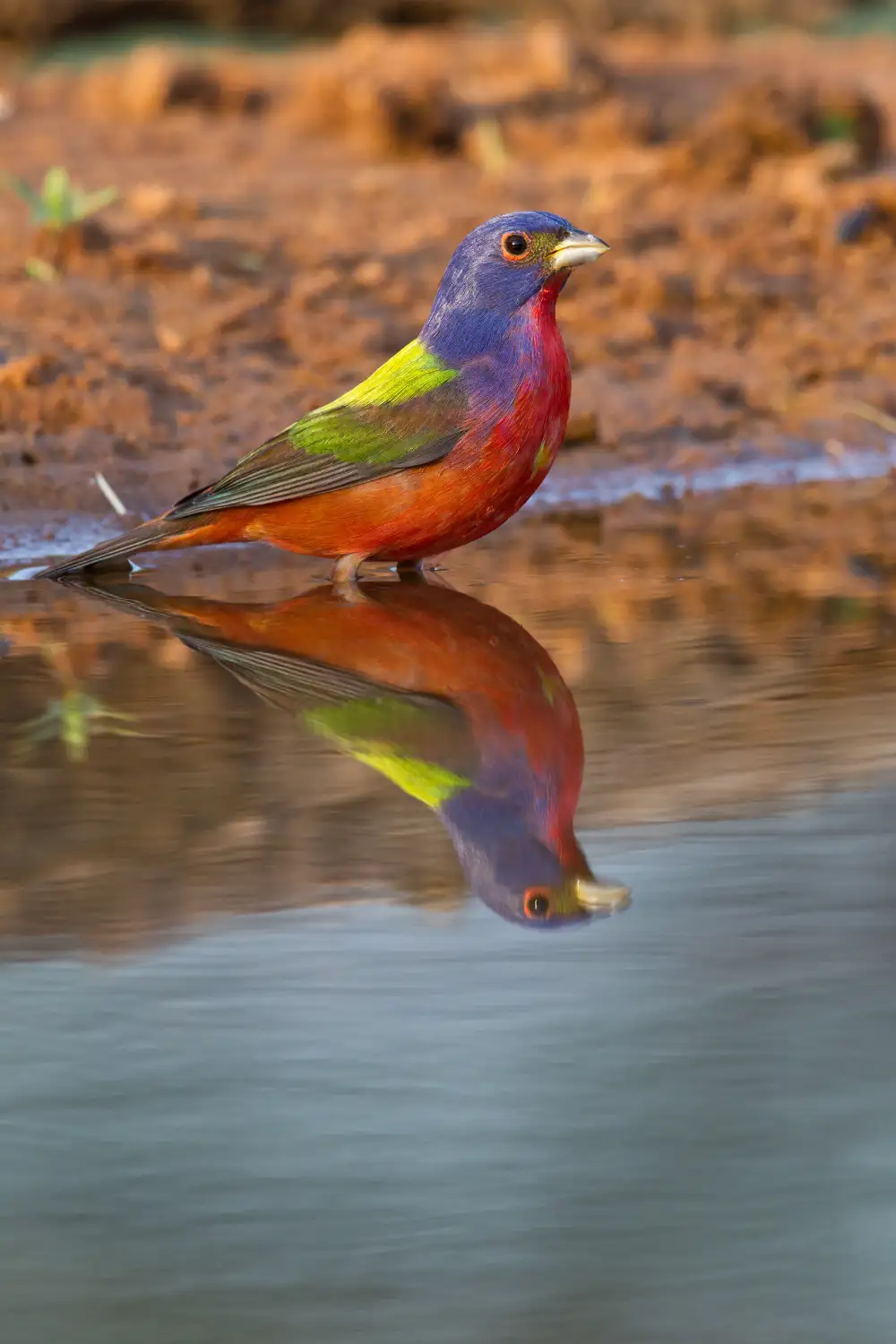
This is a shy, secretive bird, and difficult to observe. Where they have grown used to bird feeders they can become fairly approachable, which is how most people get their first proper look at one.
Males sing from exposed perches in spring to advertise territory. They also use a set of visual displays: a bouncing, butterfly-like flight, an upright posture, a body-fluff display, a bow, and a wing-quiver. These serve both in disputes with rival males and in courtship. Females rarely display.
Male rivalry is not always ceremonial. Males sometimes clash physically, and those fights can end with one bird killing the other.
Migration happens at night, over short to medium distances. The two populations handle moult differently: western birds, in Arizona and northern Mexico, moult partway through migration, while eastern birds moult before they set off.
Breeding & Nesting
Passerina ciris · Breeding at a glance
Mostly MonogamousPainted Buntings are mostly monogamous, though polygamy does occur. The male arrives about a week ahead of the female and sets up a small territory.
The female builds the nest alone, hidden in low dense vegetation and woven into the surrounding stems for strength, usually three to six feet off the ground and occasionally as high as twelve. She also incubates and raises the young without help from the male. Roughly thirty days after the first eggs hatch, she typically starts a second brood.
Nests face two significant pressures. Cowbirds parasitise them frequently, and large snakes take eggs, nestlings and even brooding females, including coachwhip snakes, eastern kingsnakes, eastern racers and black rat snakes.
Conservation & Threats
The IUCN lists the Painted Bunting as Least Concern, but that label covers a declining trend rather than a stable one.
The historic threat was the cage-bird trade. The male's colours made him a prized captive, and the trade was significant enough that capturing and keeping the species has been illegal in the United States since the Migratory Bird Treaty Act of 1918. Trapping for overseas sale may still take place in Central America.
The current threat is habitat loss to development. It bites hardest in the coastal swamp thickets and woodland edges of the eastern range, and in the riparian habitat the birds depend on during migration and winter across the southeastern United States and Mexico.
The split breeding range matters here too. Because the eastern and western populations are separated and genetically distinct, losses in one are not offset by the other, and each needs protecting on its own terms.
Similar Species
- Indigo Bunting: Same genus and often found alongside during migration. Males are entirely blue, with none of the green or red.
- Varied Bunting: Another close Passerina relative. Males are purple-red with a red nape rather than a patchwork of three colours.
- Female buntings generally: The greenish female Painted Bunting is unstreaked and a cleaner, brighter green than the brown-toned females of related species.
Painted Bunting FAQ
Sources & References
- Painted bunting — species article
- IUCN Red List assessment for Passerina ciris
- Painted Bunting song recording, XC653211
- Animal Diversity Web account for Passerina ciris
Last reviewed July 2026.