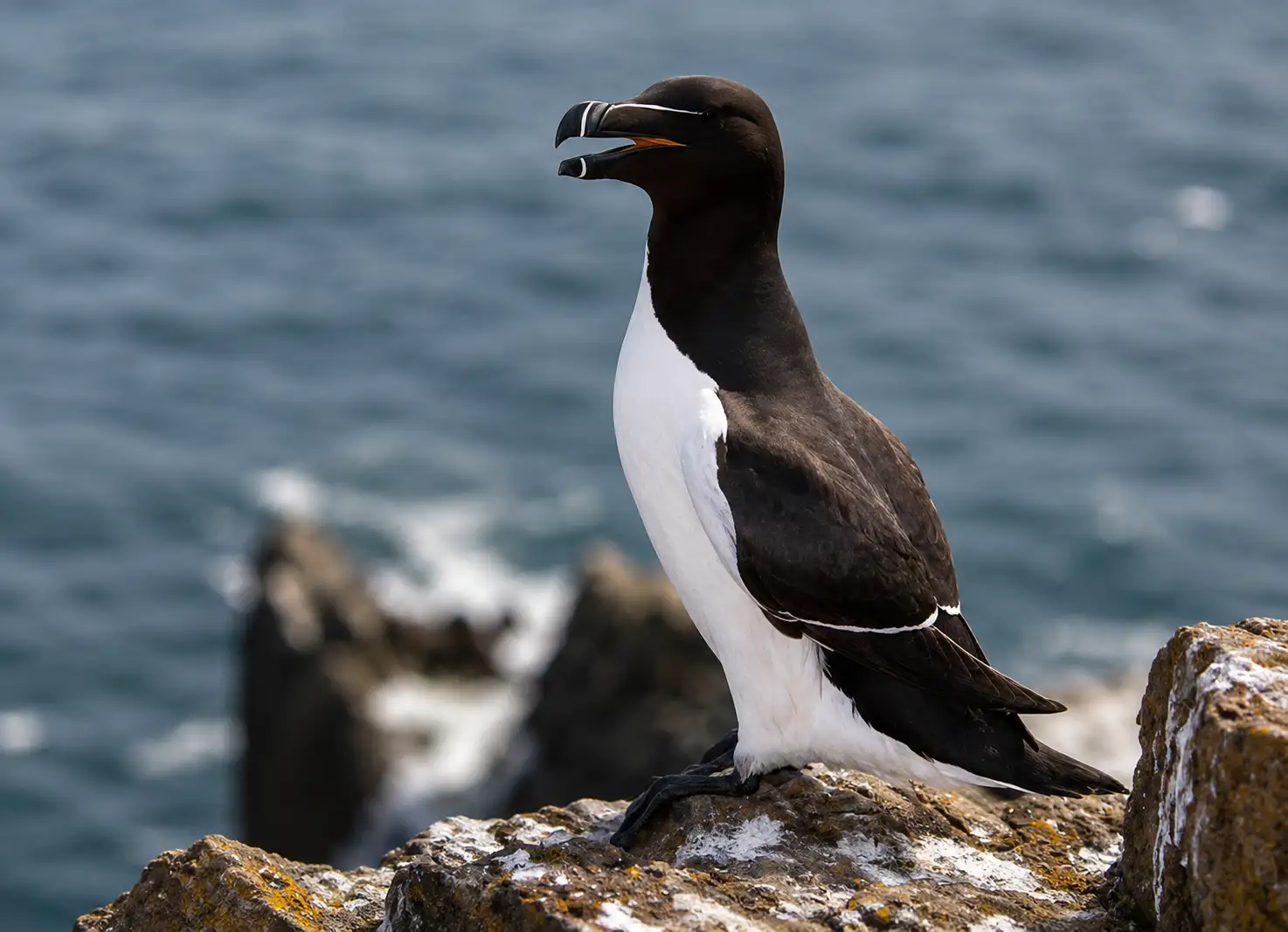
The Razorbill is a bird built for life at sea. Its thick, distinctive bill, black-and-white plumage, and powerful underwater swimming make it one of the most recognizable members of the auk family.
It breeds on rocky North Atlantic coasts and spends much of the year offshore, diving deep beneath the surface in pursuit of fish. The species is also the only living member of the genus Alca and the closest living relative of the extinct Great Auk.
Species Profile
Scientific Classification

The global population is estimated at approximately 1,200,000 individuals. While classified globally as Least Concern, significant regional populations face steep declines due to shifting food availability, warming ocean temperatures, and severe weather events.
Shifts in the lipid richness of vital prey species like sandeels have caused mass breeding failures in historic strongholds.

Warming sea surface temperatures disrupt marine food webs, shifting crucial forage fish distributions further north.

Increasingly severe winter storms in the North Atlantic lead to starvation events and mass winter wrecks.

Industrial harvesting of small schooling fish directly competes with the foraging needs of breeding colonies.

Diving pursuit-predators like Razorbills are highly susceptible to fatal entanglement in coastal gillnets.

Unregulated tourism and human presence near cliff-ledge nesting sites can cause panic flights and egg loss.
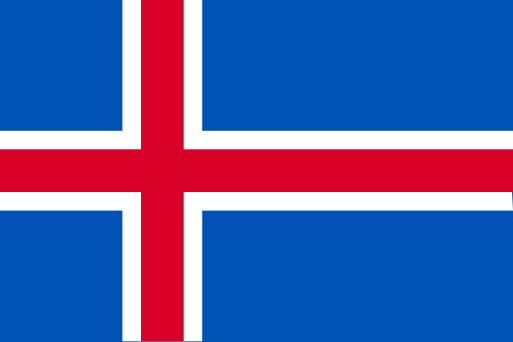
Colonies in Iceland, home to a massive percentage of the global population, experienced sharp declines due to consecutive years of poor sandeel recruitment.
Unprecedented winter storms battered the eastern Atlantic, preventing Razorbills and Puffins from foraging and resulting in the deaths of thousands of exhausted birds.
The IUCN elevated the Razorbill to Near Threatened globally in response to the rapid regional population drops, sparking increased international monitoring.
Now considered Least Concern globally due to stabilization in some regions, localized populations still require active management like fishery closures and habitat protection.

Designation of vital offshore feeding zones ensures that critical foraging grounds adjacent to breeding cliffs remain undisturbed.

Targeted closures of industrial sandeel fisheries in sensitive regions help guarantee an abundant food supply during the crucial chick-rearing season.
Active wardening of sea cliff nesting colonies reduces human disturbance and monitors breeding success rates year over year.
Birds that have adapted to life within the marine environment, spending most of their time on the open ocean and coming to land strictly to breed.
A diverse order of birds encompassing shorebirds, gulls, and auks. They are typically found near water and exhibit a wide variety of feeding behaviors.
A family of web-footed diving seabirds, known for their compact bodies, upright posture, and incredible ability to "fly" underwater to pursue prey.
A genus of auks that currently contains only one living species: the Razorbill. They are the closest living relatives to the extinct Great Auk.
An animal that feeds primarily on fish. Razorbills are deep divers, powerfully swimming underwater to hunt schooling fish like sand lance, herring, and capelin.
Steep, rocky coastal cliffs that provide ideal, inaccessible elevations for massive seabird colonies to breed safely away from terrestrial predators.
Birds that breed on narrow, precarious rock ledges. Razorbills lay a single, pear-shaped egg designed to roll in a tight circle rather than fall off the edge.
An IUCN conservation category assigned to species that are widespread and abundant, facing no immediate threat of severe decline or global extinction.
Similar Species
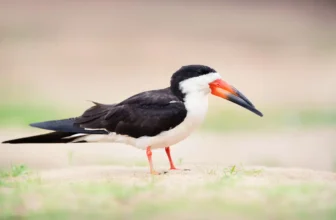
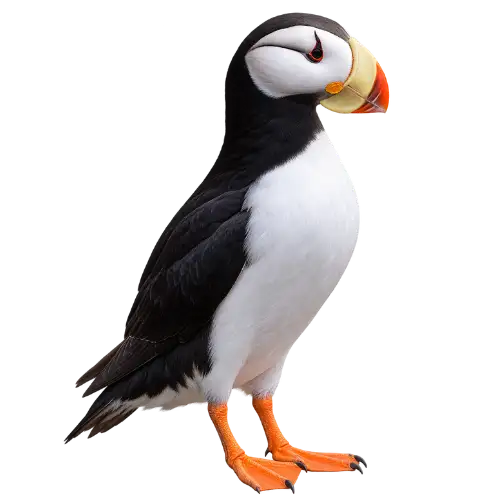
Iconic seabird famous for its vibrant, multi-colored beak.
Read More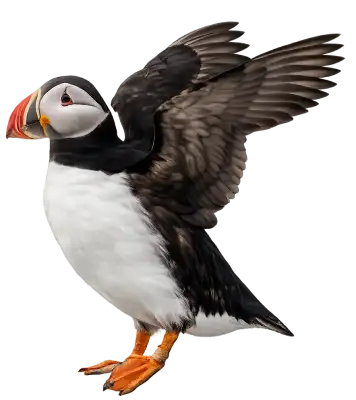
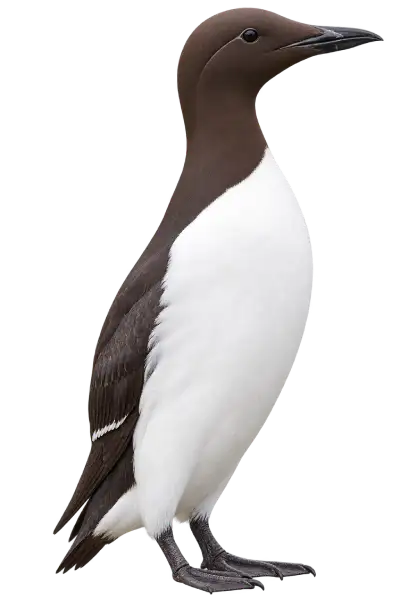
Penguin-like diver with a slender, pointed bill.

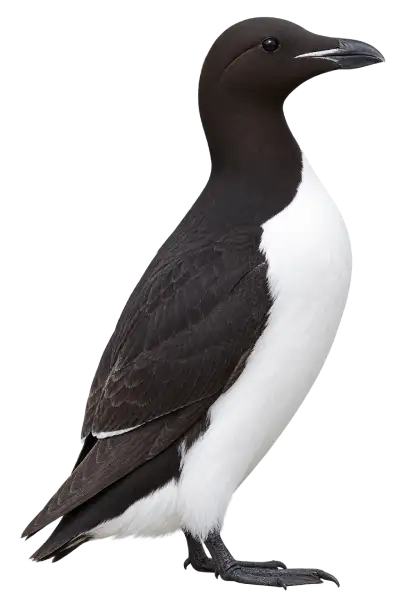
Stocky cliff-nester recognized by a distinct white bill stripe.

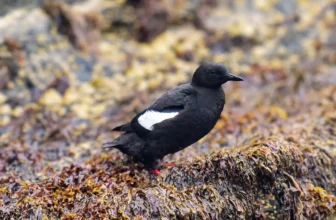
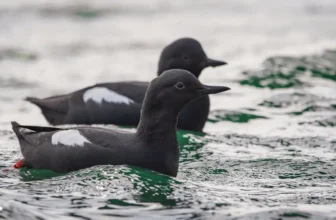
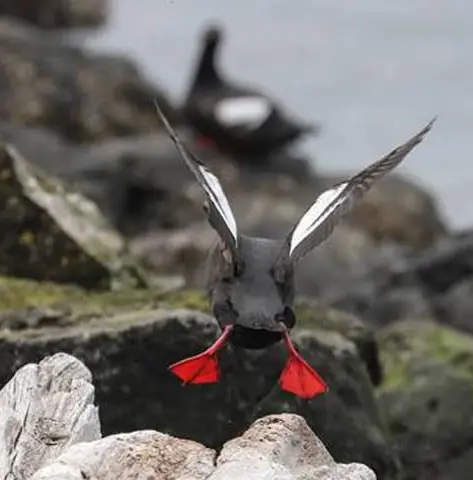
Striking coastal diver with stark white wing patches.
Read More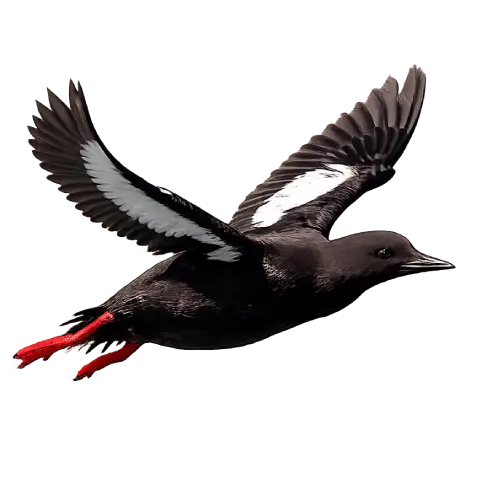
Pelagic bird sporting sweeping golden head plumes.
Read More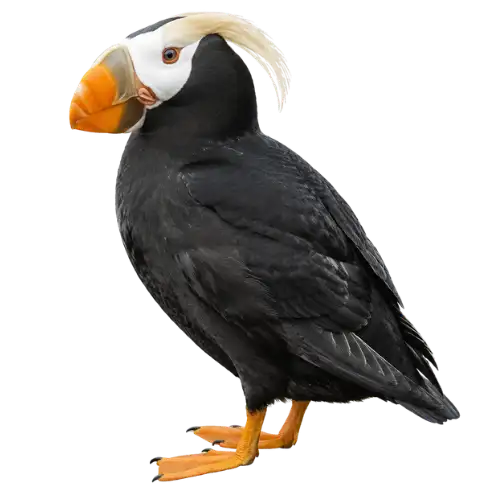
Nocturnal forager with a prominent pale bill horn.
Read More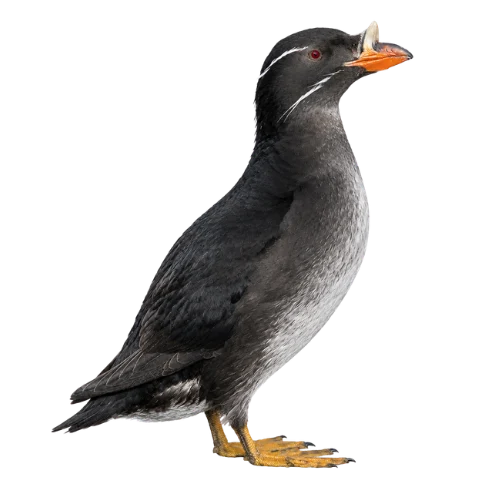
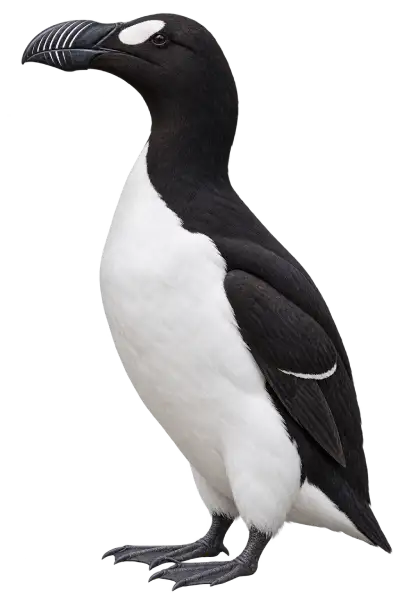
Massive, flightless seabird driven to extinction in the 1800s.
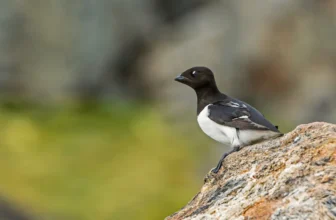
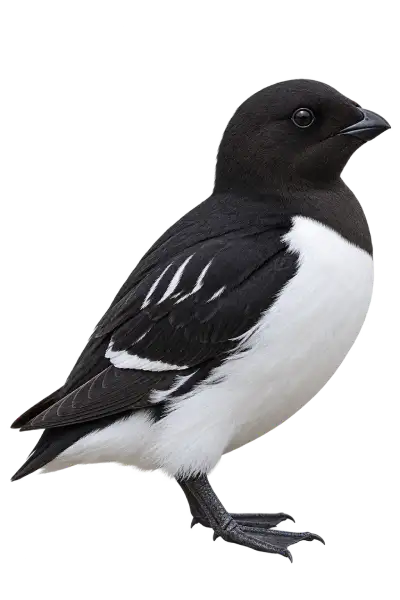
Tiny, plump Arctic seabird that gathers in massive flocks.
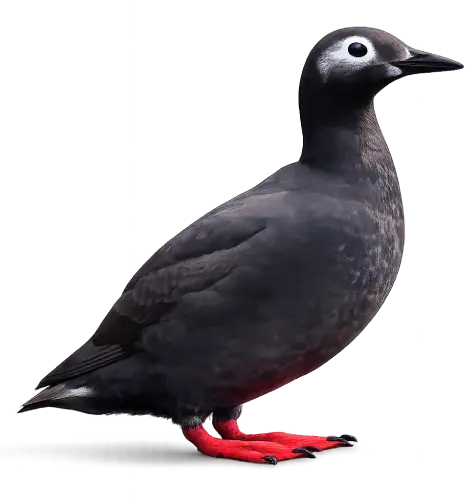
Pacific seabird known for distinct white eye-rings.

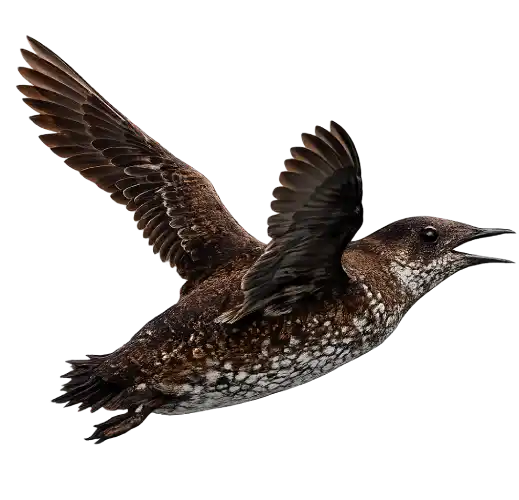
Small seabird that remarkably nests in old-growth forests.
Striking black seabird with large white wing patches.
Read More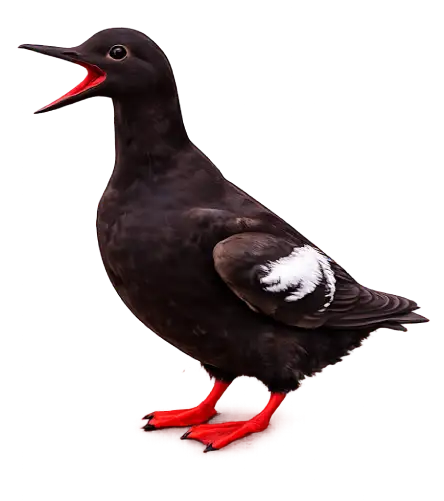
Distinctive seabird named for the fleshy horn above its eyes.
1. Naming & Taxonomy
Linnaeus described the genus Alca in 1758 in the tenth edition of Systema Naturae. The type locality is Stora Karlsö, a small island off the west coast of Gotland, Sweden, which still holds the largest Razorbill colony in the Baltic.
Both parts of the name are Scandinavian rather than classical. Alca comes from the Norwegian alke, and torda from törd, a Gotland Swedish dialect word. Both referred to this bird. The word Alca had already been used for the Razorbill by earlier writers, including Carolus Clusius in 1605 and Francis Willughby in 1676.
In English it has also been known simply as the auk, the razor-billed auk, and the lesser auk.
The Great Auk's Nearest Relative
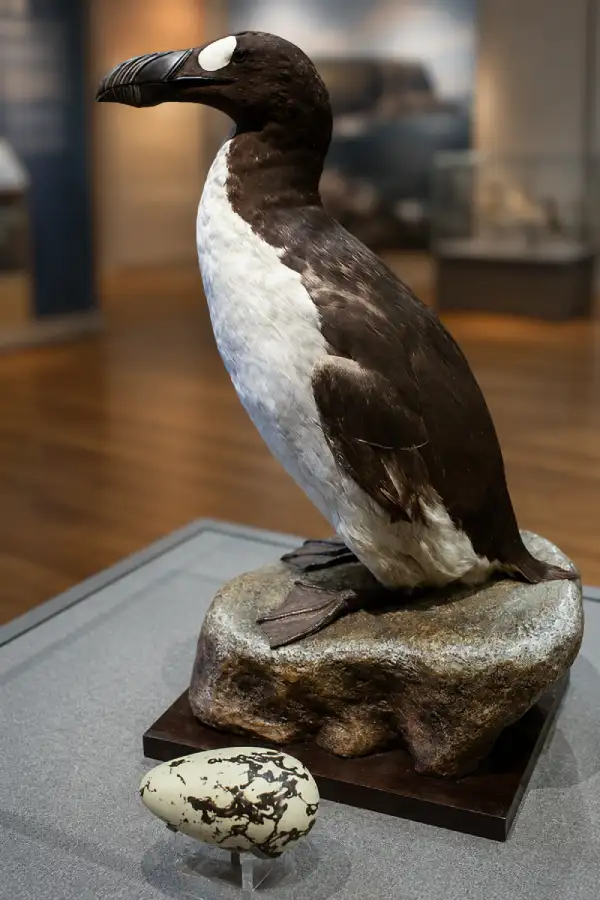
The Great Auk, Pinguinus impennis, gives the Razorbill some of its historical weight. It was flightless, stood about 75 cm tall, and went extinct by the mid-19th century.
Mitochondrial DNA research published in 2002 confirmed the Great Auk as the Razorbill’s closest living relative.
The Great Auk was once classified in Alca alongside the Razorbill, and some ornithologists still argue that it belongs there rather than in Pinguinus.
Both are members of the tribe Alcini, along with the Common Murre, Thick-billed Murre, and Little Auk.
A Genus in Decline
Alca was far more diverse in the Pliocene. Fossil species include A. grandis, A. stewarti and A. ausonia, found in Belgium, Italy, Spain and the Lee Creek Mine in the United States.
As far as is known the genus evolved in the western North Atlantic or the present-day Caribbean, like most of the Alcini, with its ancestors reaching those waters through the still-open Isthmus of Panama during the Miocene.
Subspecies
Two are accepted by the IOC.
- A. t. torda Linnaeus, 1758
- A. t. islandica C. L. Brehm, 1831, occurring in warmer waters and slightly smaller
A third, A. torda pica, is no longer accepted. It was distinguished by an additional furrow in the upper mandible, a feature now known to be age-related rather than geographic.
2. Identification & Appearance
Alca torda · Identification & Appearance
Least ConcernThe Bill Is the Name
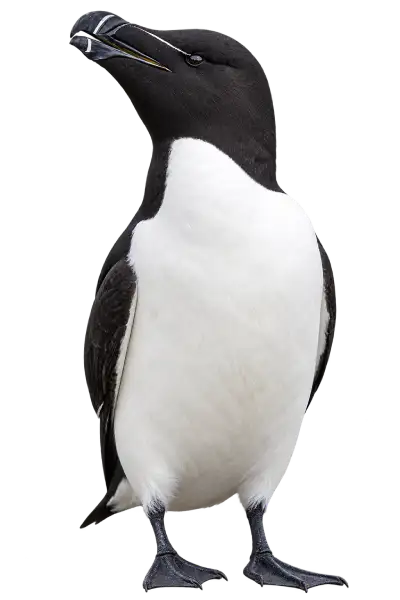
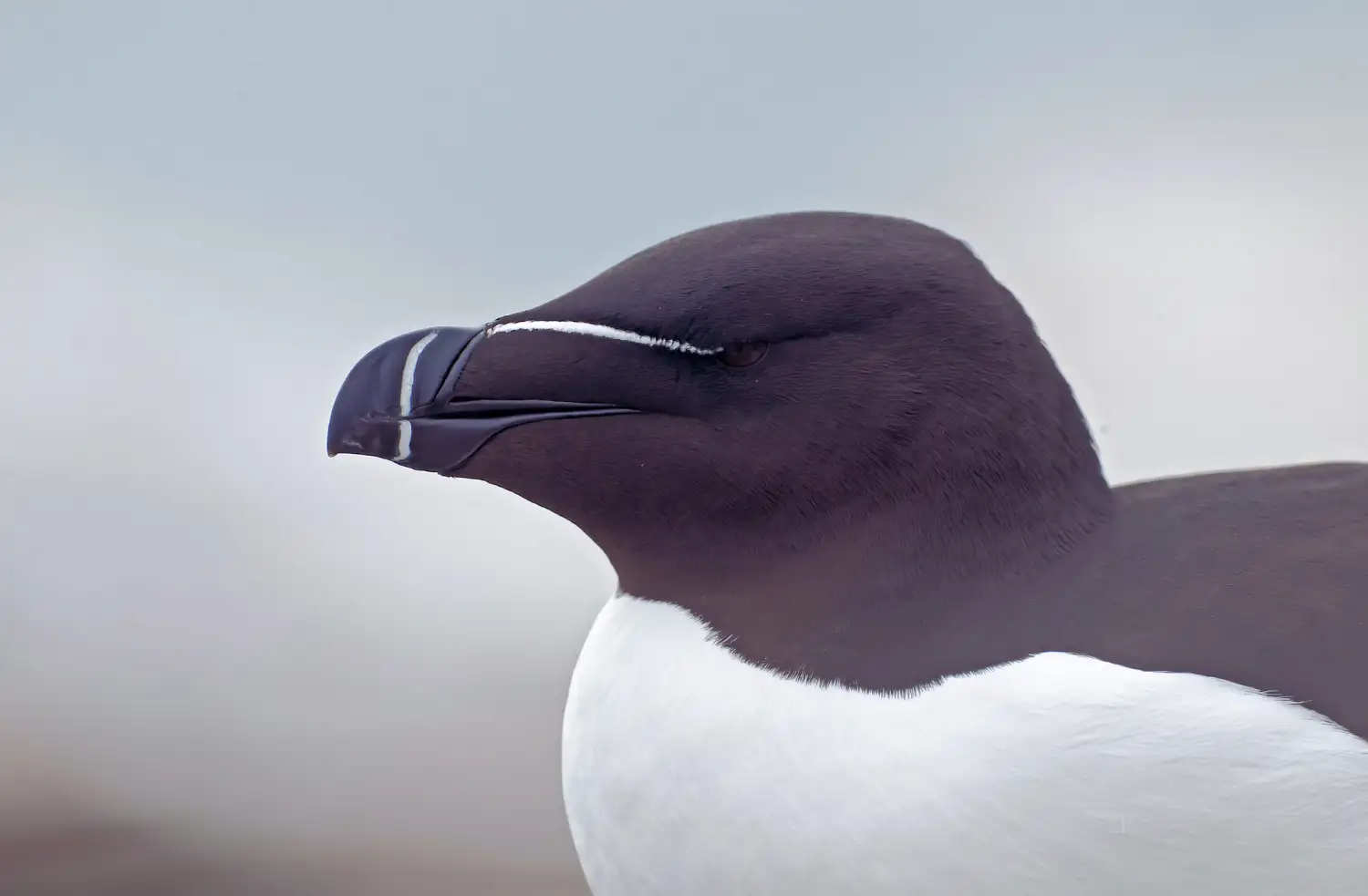
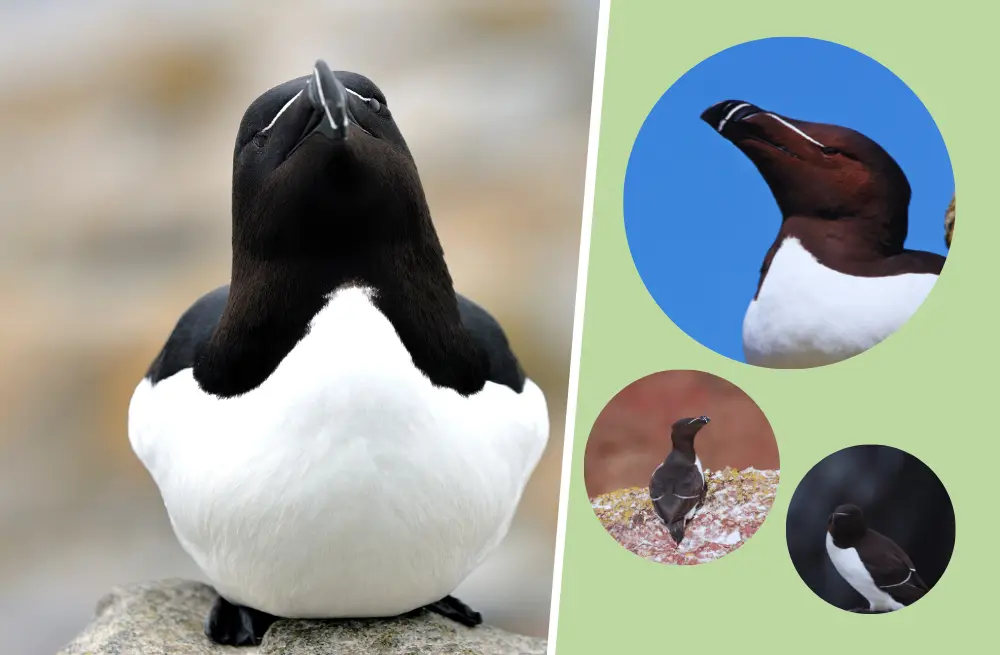
Black, deep and laterally compressed, ending bluntly rather than in a point. Near the curved tip are several vertical grooves, one of them marked with a broken white line. A thin white line also runs from the eye to the end of the bill.
Outside the breeding season the bill looks thinner and the grooves become less marked, and the facial line fades.
Plumage
In breeding condition the head, neck, back and feet are black and the belly is white. The head is darker than a Common Murre's, which is a useful mark where the two occur together. In winter the throat and the face behind the eye turn white.
Males and females are identical in plumage. Males are generally larger, though the difference is small and mostly a matter of wing length.
The Tail
Worth knowing, because it is unusual. The central tail feathers are slightly longer than the rest, giving the Razorbill a distinctly long tail for an auk. In flight the feet do not project beyond it. During incubation the bird adopts a horizontal stance rather than the upright posture typical of the family.
Longevity
The average lifespan is around 13 years. A bird ringed in the United Kingdom in 1967 was still alive at least 41 years later, a record for the species.
3. Range & Habitat
Alca torda · Detailed Distribution & Ecology
Pelagic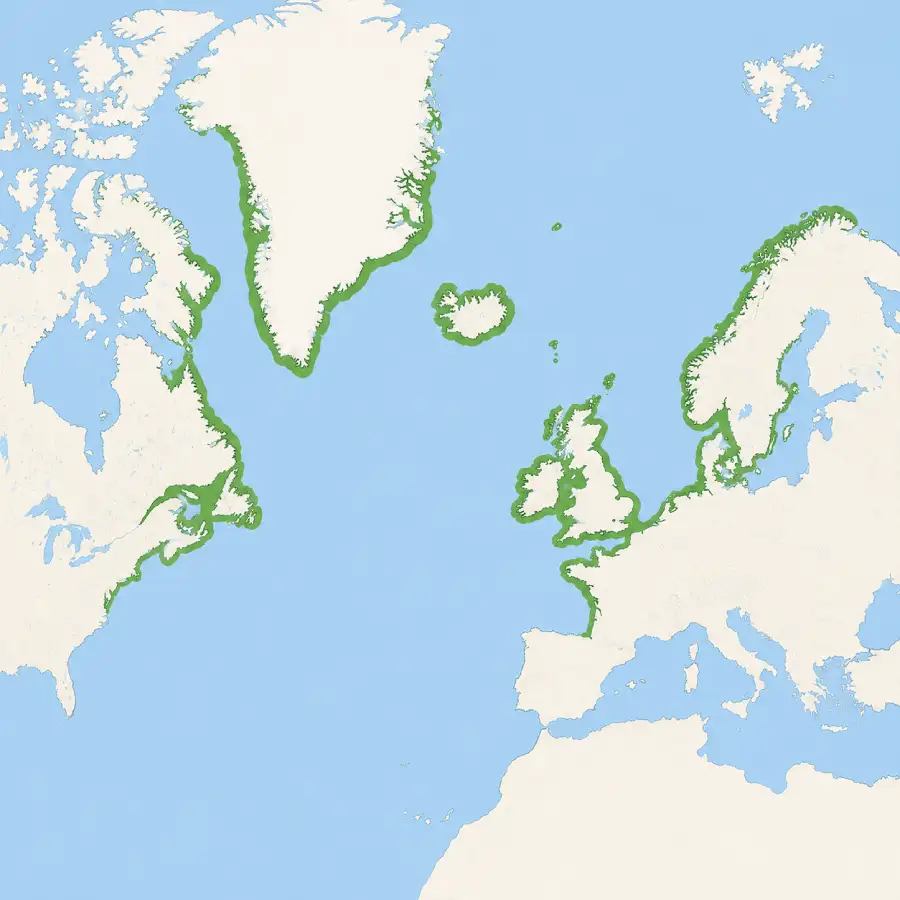
-
 Rocky Sea Cliffs
-
 Cold Coastal Waters
-
 Offshore Island Jumps
-
 Open North Atlantic
How Much of the Population Is in Iceland?
Sources give slightly different figures for Iceland’s share of the Razorbill population. Estimates range from about half to 60–70% of the world’s breeding population. Látrabjarg alone was estimated to hold around 230,000 pairs in the mid-1990s, roughly 40% of the global population.
The safest conclusion is that Iceland holds around half to two-thirds of the world’s Razorbills, with Látrabjarg supporting a particularly large share.
Selected Colonies
| Colony | Size |
|---|---|
| Látrabjarg, Iceland | About 230,000 pairs, mid-1990s |
| Bempton Cliffs, Yorkshire | 30,673 pairs, 2022 |
| Stora Karlsö, Sweden | 12,000 pairs, 2014–15, largest in the Baltic |
| Gannet Islands, Canada | 9,800 pairs |
| Runde, Norway | 3,000 pairs |
| Farne Islands, England | 523 pairs, 2022 |
| Île Rouzic, Brittany | 600 pairs in 1960, down to 30 by 2006 |
Île Rouzic marks the southernmost limit in Europe, and the collapse there from 600 pairs to 30 in under fifty years is the clearest single illustration of range contraction in the species.
4. Diet & Diving
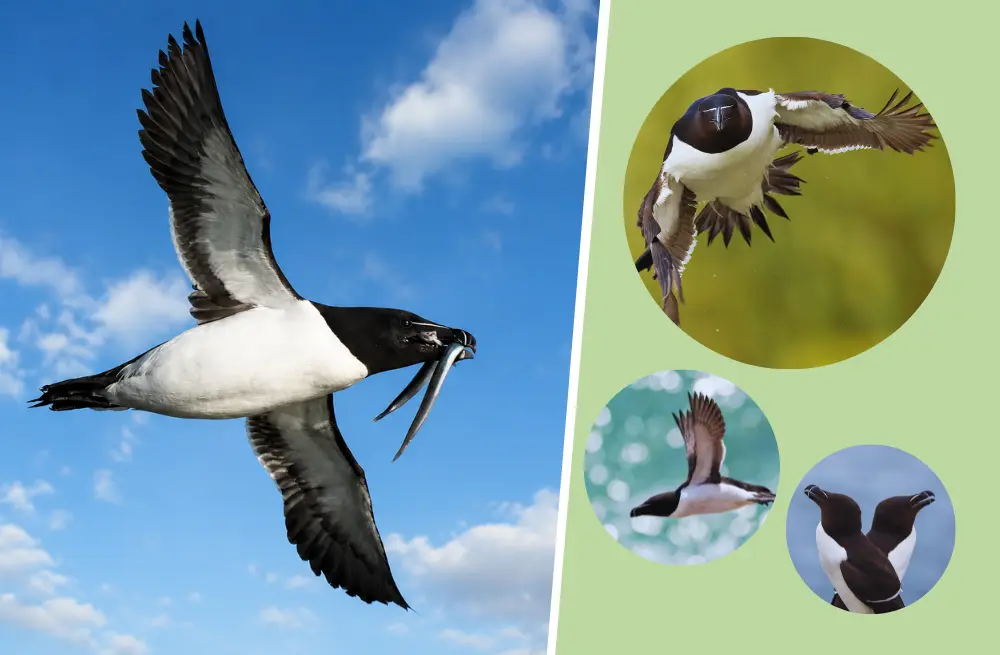
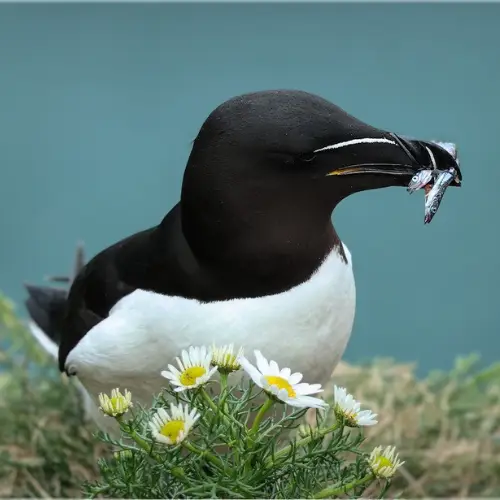
The Razorbill feeds mainly on mid-water schooling fish such as capelin, sandeels, juvenile cod, sprats, and herring, along with some crustaceans and polychaete worms. Its diet closely resembles that of the Common Murre.
Most feeding dives reach around 25 m, but Razorbills can dive as deep as 120 m. They dive with partly folded wings and spread feet, usually dispersing rather than feeding in groups. A single dive can bring up several fish.
Razorbills spend about 44% of their time at sea foraging. Their foraging range also changes during the breeding season. During incubation, they may travel more than 100 km from the colony. Once they have a chick, they usually forage much closer, around 12 km from the colony and often in shallower water.
Adults typically bring one fish per delivery, with feeding trips peaking around dawn and declining about four hours before dark. Females generally deliver food to chicks more often than males.ng off about four hours before dark. Females generally feed chicks more often than males.
5. Breeding & Nesting
Alca torda · Breeding & Nesting
Pairs For LifeFemales Choose
The mating system is unusual enough to deserve the detail.
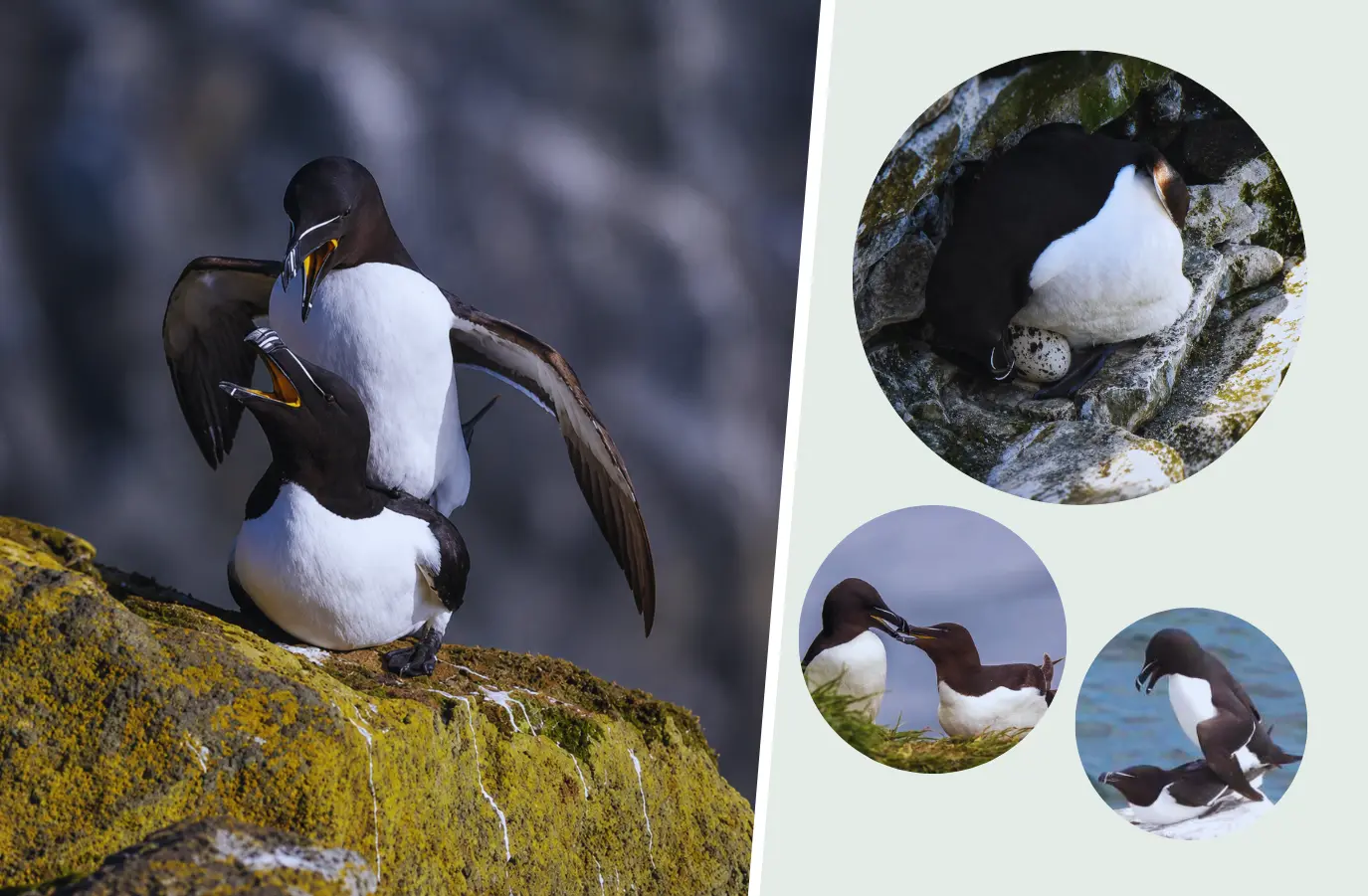
Females select their mate, and will often encourage competition between males before choosing. Once chosen, the pair stays together for life. Courtship involves touching bills and following one another in elaborate flight patterns.
During the pre-laying period, males guard their mates constantly, knocking rival males away with their bills. The pair may copulate up to 80 times in a 30-day period to ensure fertilisation. At the same time, females will sometimes encourage other males to copulate with them, and research published in 1991 concluded that female Razorbills control these extra-pair copulations rather than being subject to them.
Two Group Displays
Before laying, Razorbills gather in large numbers on the water and perform two distinct social behaviours. In the first, a large group dives and swims in circles together, then all rise to the surface head first with bills open. In the second, a large group swims in a line, weaving across one another in the same direction.
The Nest
Not immediately alongside the sea on open ledges as murres do, but set back at least 10 cm, in crevices on cliffs or among boulders. Crevice sites are more successful because they suffer less predation.
Razorbills generally build no nest, though some pairs drag a little material into place with their bills. They may take over a puffin or rabbit burrow. Nests sit metres apart rather than touching, which produces noticeably less aggression than in guillemot colonies, and pairs often reuse the same site year after year.
The Chick
Semi-precocial, spending most of the first two days under a parent's wing. One adult always remains at the nest while the other fishes. A complete feather sheath develops by ten days.
At 17 to 23 days the chick leaves by jumping from the cliff, long before it can fly. The male parent follows it down and accompanies it out to sea, diving more than the female during this period.
6. Predators
Adults are taken by Great Black-backed Gulls, Peregrine Falcons, ravens, crows and jackdaws. Eggs are taken mainly by gulls and ravens. In the north of the range, Arctic Foxes and Polar Bears can account for significant numbers of adults, eggs and chicks in some years.
An adult's best defence is simply to dive.
7. People & History
On St Kilda, off the Scottish coast, Razorbill eggs were collected until the late 1920s by men scaling the cliffs. The eggs were buried in peat ash to keep through the northern winter, and were reckoned to match duck eggs for taste and nourishment.
In the early twentieth century the species was harvested more broadly for eggs, meat and feathers, which substantially reduced the global population. Legal protection in the United States came with the Migratory Bird Treaty Act.
One small discrepancy worth noting. Wikipedia dates that protection to 1918 in its opening section and to 1917 elsewhere in the same article. The United States Migratory Bird Treaty Act was passed in 1918; the underlying convention with Great Britain, on behalf of Canada, was signed in 1916.
Sources
- Wikipedia, "Razorbill" (primary source for this entry)
- Gaston, A. J. & Jones, I. L. (1998), The Auks: Alcidae, Oxford University Press
- Moum, T., Arnason, U. & Árnason, E. (2002), "Mitochondrial DNA sequence evolution and phylogeny of the Atlantic Alcidae, including the extinct Great Auk", Molecular Biology and Evolution 19(9)
- Wagner, R. H. (1991), "Evidence that female Razorbills control extra pair copulations", Behaviour 118
- Piatt, J. F. & Nettleship, D. N. (1985), "Diving depths of four alcids", The Auk 102(2)
- Lavers, Hipfner & Chapdelaine (2009), "Razorbill", in Birds of the World, Cornell Lab of Ornithology
- del Hoyo, Elliott & Sargatal, eds. (1996), Handbook of the Birds of the World, Vol. 3
- Balestrieri et al. (2023), "Razorbills Alca torda in Italian Seas: A Massive Irruption of Historical Relevance", Animals 13(4)
- BirdLife International (2021, errata 2023), IUCN Red List: Alca torda
Last reviewed: July 2026.