Black Skimmer (Rynchops niger)
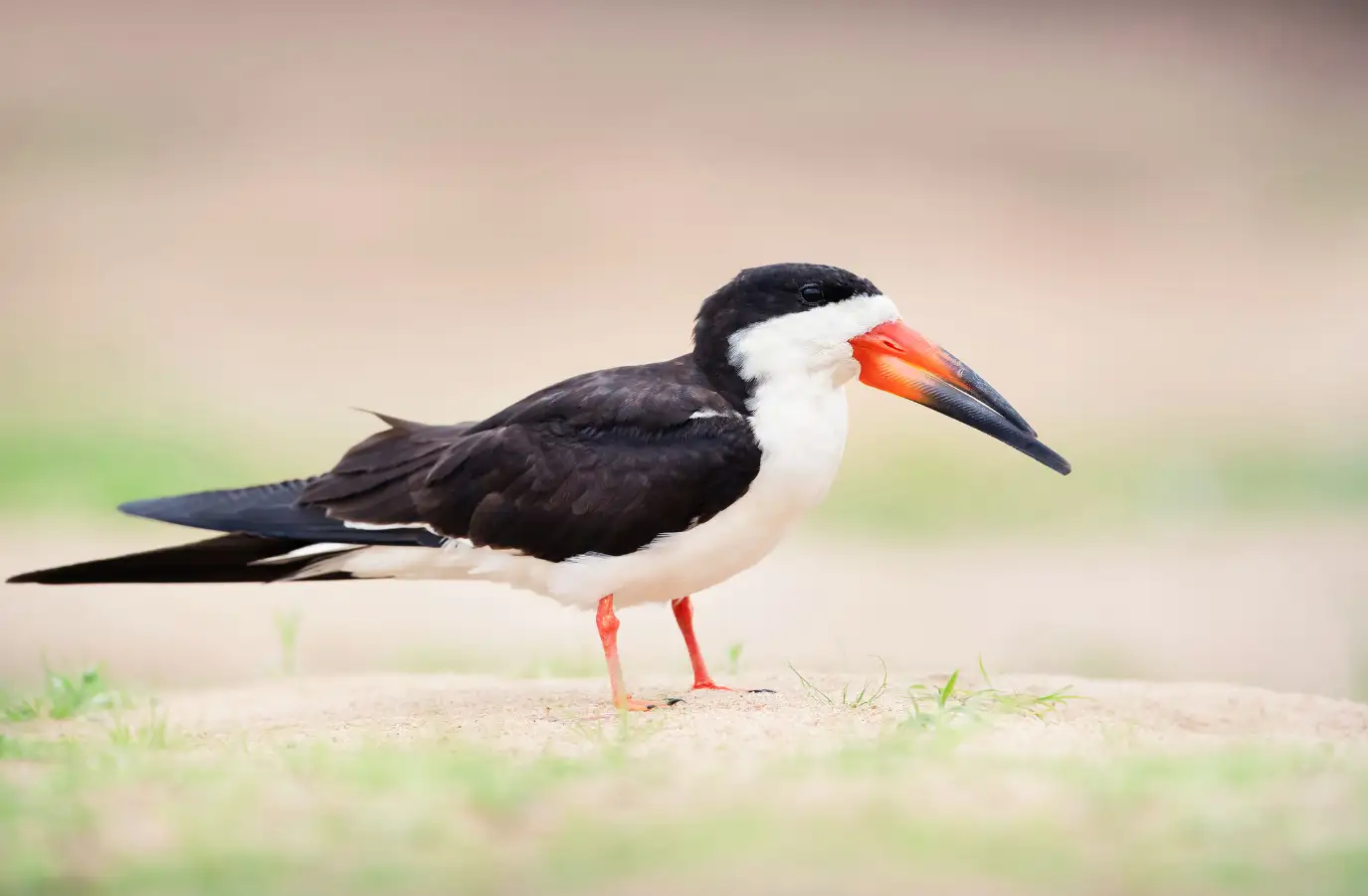
The Black Skimmer is one of the most unusual-looking birds found along the coasts of the Americas. Its striking black-and-white plumage is distinctive, but its extraordinary bill is what makes this bird instantly recognizable.
The lower mandible extends noticeably beyond the upper mandible, an adaptation that allows the Black Skimmer to hunt by slicing through the surface of the water while flying.
Unlike most birds that catch fish by diving or grabbing prey from above, Black Skimmers can forage with their bills partly submerged, making them one of the most specialized aerial feeders in the world.
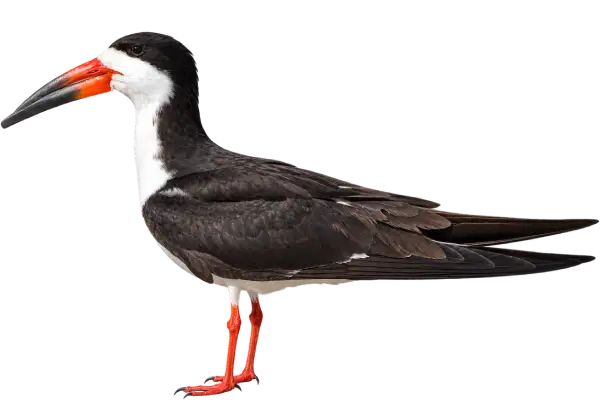
Species Profile
Scientific Classification
Cornell Lab gives the Black Skimmer a body length of about 40–50 cm and a wingspan of roughly 109–115 cm.
Birds that have adapted to life within the marine environment. While highly diverse in lifestyle and appearance, they all share a reliance on the ocean and coastal waters for survival.
A diverse order of small to medium-sized birds generally found near water, encompassing gulls, terns, sandpipers, waders, and skimmers.
A family of seabirds including gulls, terns, and skimmers, typically exhibiting webbed feet, strong flight, and a close association with coastal or pelagic habitats.
The skimmers. A unique genus of waterbirds easily identified by their uneven bills, where the lower mandible is significantly longer than the upper, adapted for specialized tactile feeding.
A specialized carnivorous diet consisting almost entirely of fish. These birds often employ unique hunting techniques, such as dragging their bills through the water or plunge-diving.
Dynamic environments where land meets the sea, including sandy beaches, estuaries, and mudflats, providing rich foraging grounds and vital nesting areas for marine birds.
A breeding strategy where large numbers of birds gather to build their nests in close proximity, offering safety in numbers and communal defense against predators.
An IUCN conservation category assigned to species that are widespread and abundant, facing no immediate threat of severe decline or global extinction.
How to identify a Black Skimmer
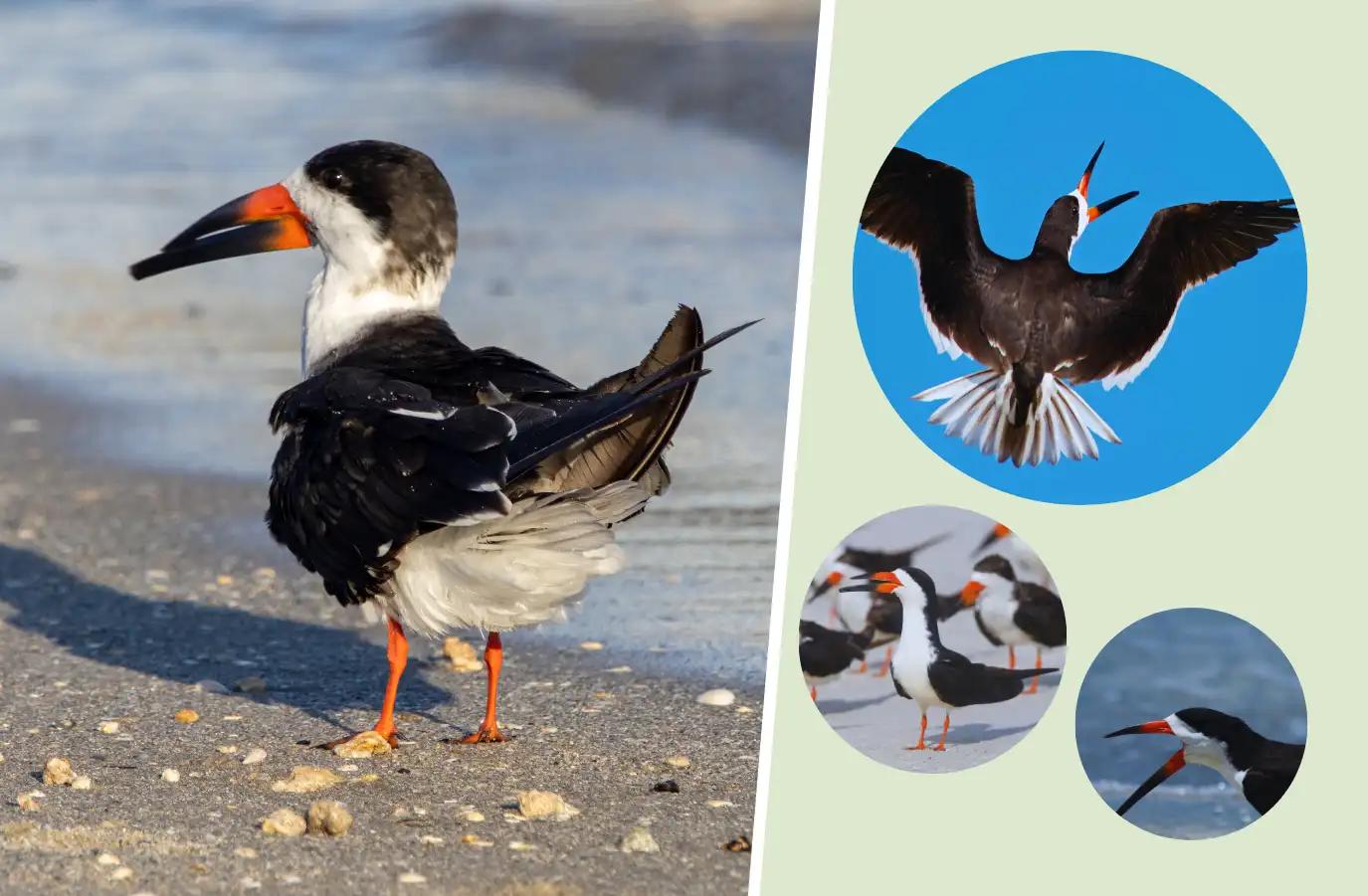
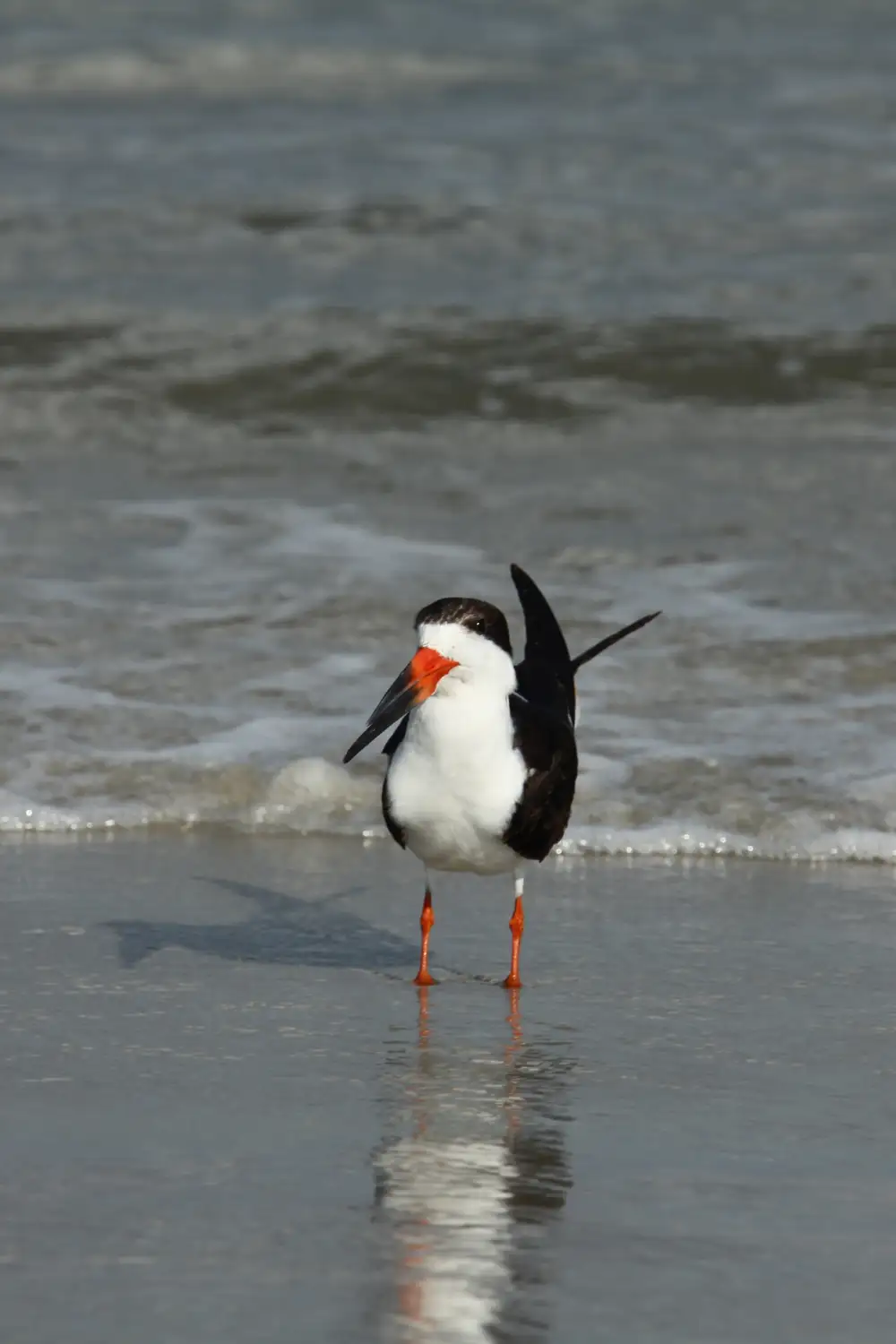
The easiest way to identify a Black Skimmer is to look at its bill. The lower mandible is considerably longer than the upper mandible, giving the bird an unusual, knife-like profile.
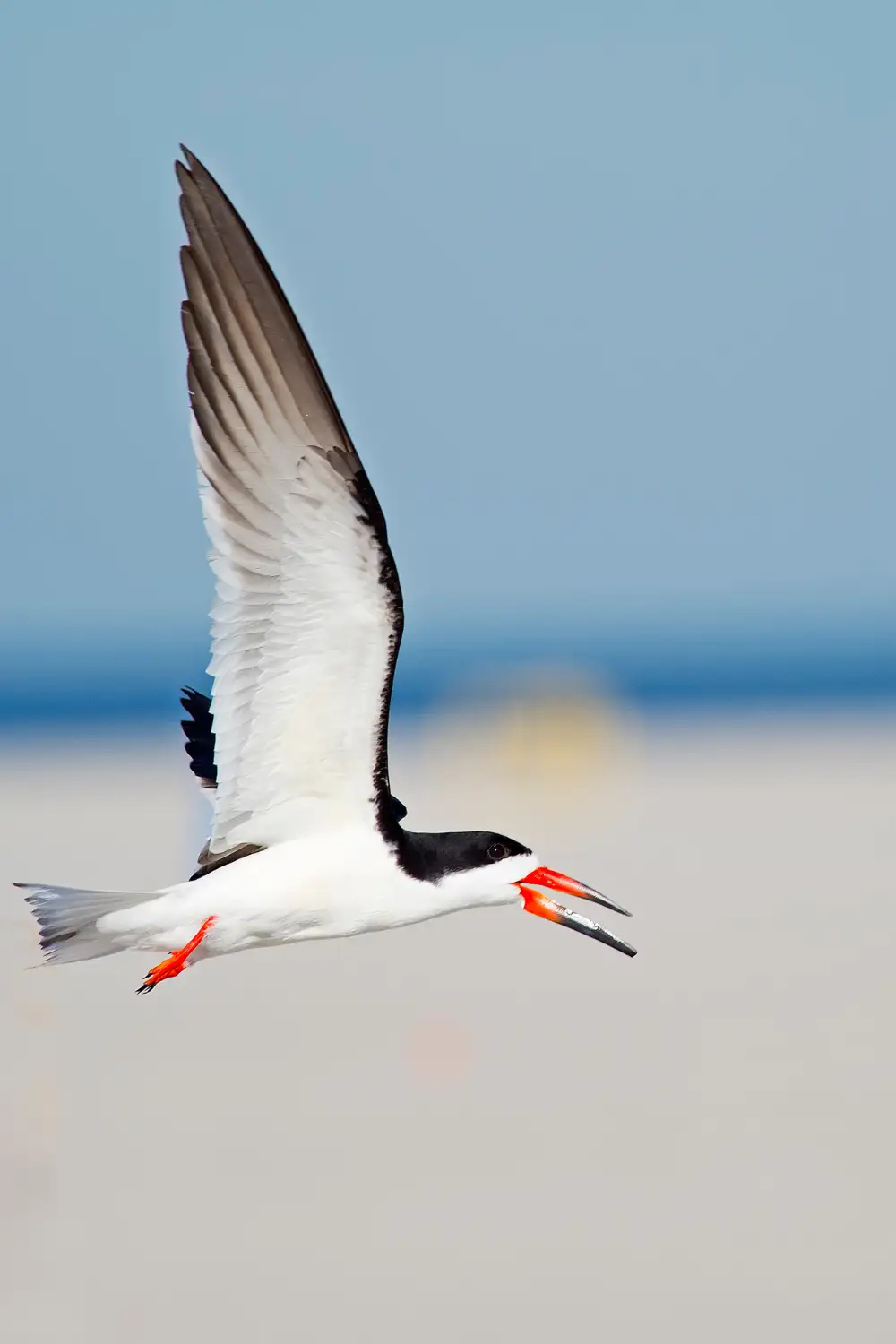
Adults have a sharply contrasting black-and-white appearance. The upperparts, including the crown and back, are predominantly black, while the underparts are white. The bill is red-orange near its base and black toward the tip, and the short legs are orange-red.
In flight, the species has long, pointed wings and usually flies remarkably close to the surface of the water. Its distinctive flight style, combined with the oversized bill, makes it easier to recognize than many superficially similar coastal birds.
Adult Black Skimmer
Breeding adults show the strongest black-and-white contrast. The bill has a bright reddish base and dark tip, while the legs are short and red-orange.
Juvenile Black Skimmer
Young birds are less dramatically patterned. Juveniles have browner, mottled upperparts with pale feather edges, making them look noticeably different from adults.
Why does the Black Skimmer have such a strange bill?
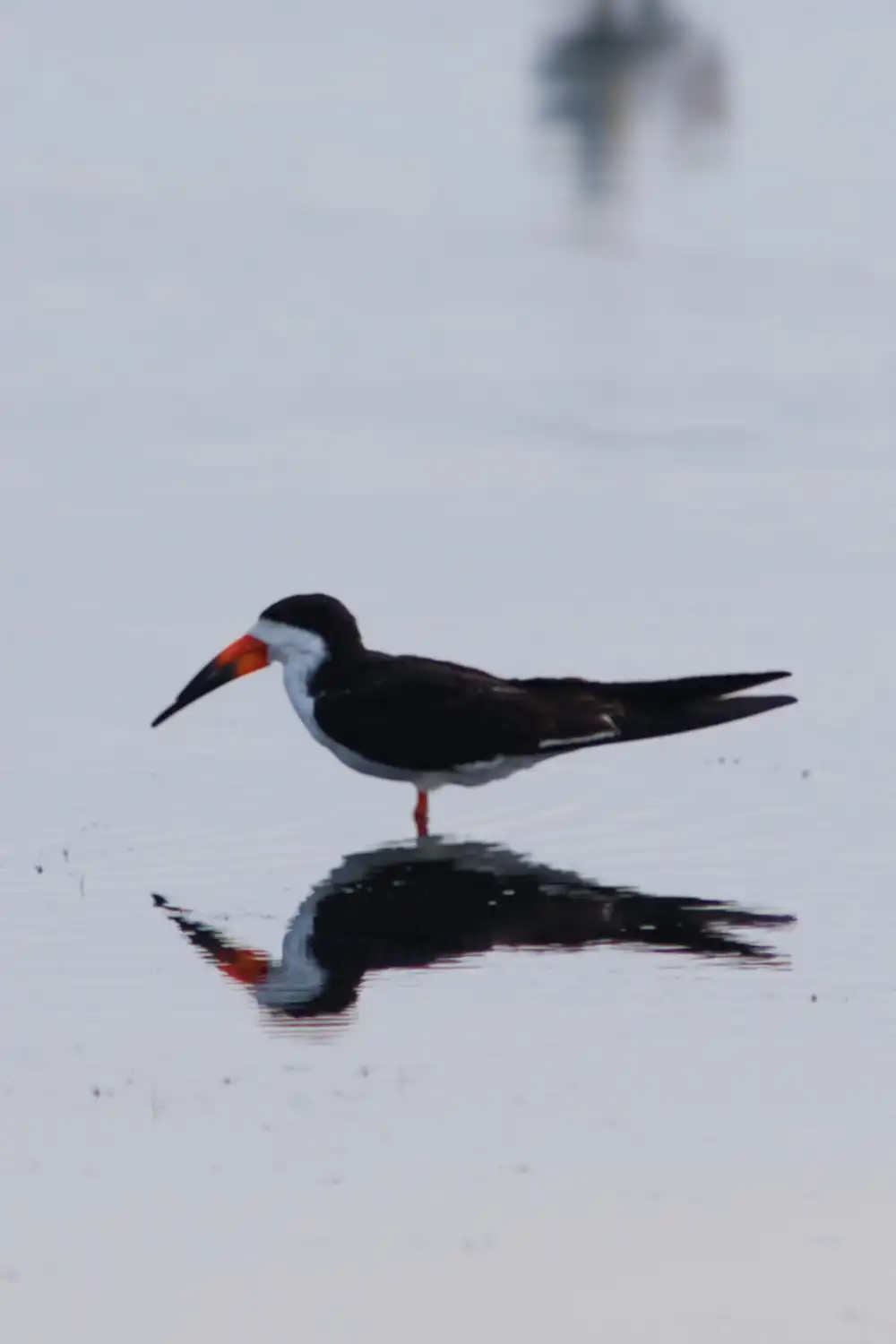
The Black Skimmer's bill is one of the most specialized feeding adaptations among birds.
The lower mandible is longer than the upper mandible. While flying low over calm water, the bird opens its bill and places the lower mandible into the water. As it moves forward, the lower mandible skims through the surface.
When it encounters a small fish or other prey, the bird rapidly closes its bill and captures it.
This method allows Black Skimmers to feed without diving. Because the technique relies heavily on touch, they can also forage in low-light conditions and at night.
Range & Habitat
The Black Skimmer is a coastal bird of the Americas, with populations found from the United States and Mexico through the Caribbean and into South America. In North America, it breeds mainly along the Atlantic, Gulf, and Pacific coasts. It is a short- to medium-distance migrant, with many birds moving south after the breeding season.
Where Black Skimmers Live
Black Skimmers are most often found around sandy beaches, barrier islands, sandbars, and other open shorelines. They favor places with little vegetation, especially when choosing a nesting site. Gravel and shell bars can also provide suitable habitat, as can open areas of saltmarsh covered with stranded vegetation.
When feeding, they move to shallow water where small fish are concentrated. Bays, estuaries, lagoons, tidal creeks, rivers, and saltmarsh pools can all be important feeding areas. Calm water is especially useful because it allows the skimmer to fly just above the surface with its lower bill cutting through the water.
Although strongly associated with the coast, the species is not restricted to ocean beaches. Small inland populations occur in places such as California's Salton Sea and parts of Florida.
Nesting Habitat
Breeding colonies need open ground close to feeding areas. Black Skimmers usually lay their eggs directly on sand, shell, or stones, creating only a shallow scrape rather than a conventional nest. Remote beaches and islands are particularly important because disturbance can quickly make otherwise suitable nesting sites unusable.
This dependence on open coastal habitat also leaves the species vulnerable. Beach development, vehicles, dogs, flooding, storms, and rising sea levels can all affect nesting colonies.
What do Black Skimmers eat?
Black Skimmers primarily eat small fish. They also take some crustaceans, including shrimp and occasionally blue crabs when the crabs are vulnerable during molting.
Documented fish prey include anchovies, menhaden, silversides, herring, mullet, flounder, killifish and several other coastal species.
Their feeding behavior is closely linked to water conditions and tides. Calm water and light winds are particularly favorable because they allow the lower mandible to move smoothly through the water's surface.
Black Skimmer feeding behavior
Watching a Black Skimmer feed is one of the best ways to recognize the species.
The bird usually flies just above the water with its lower mandible submerged. Its wings make long upward strokes followed by shorter downward strokes, producing a characteristic bounding flight.
When the bill touches prey, the upper mandible snaps downward to capture it.
This behavior is particularly effective in shallow coastal waters where small fish gather near the surface.
Black Skimmer behavior
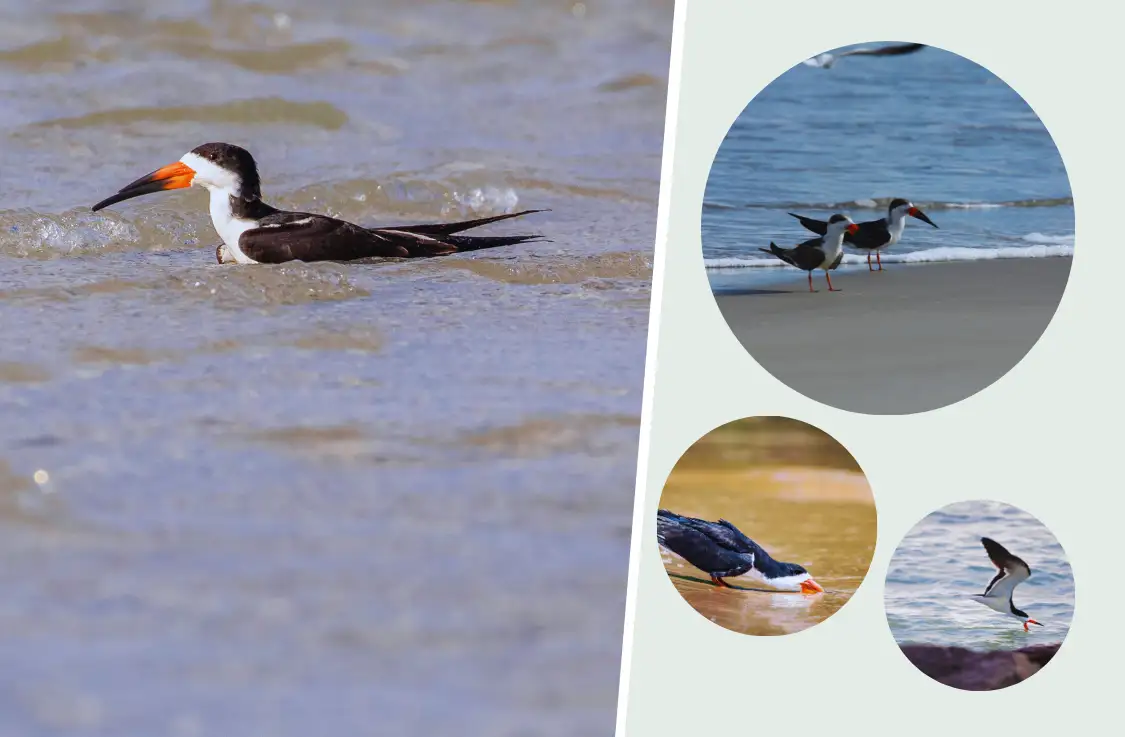
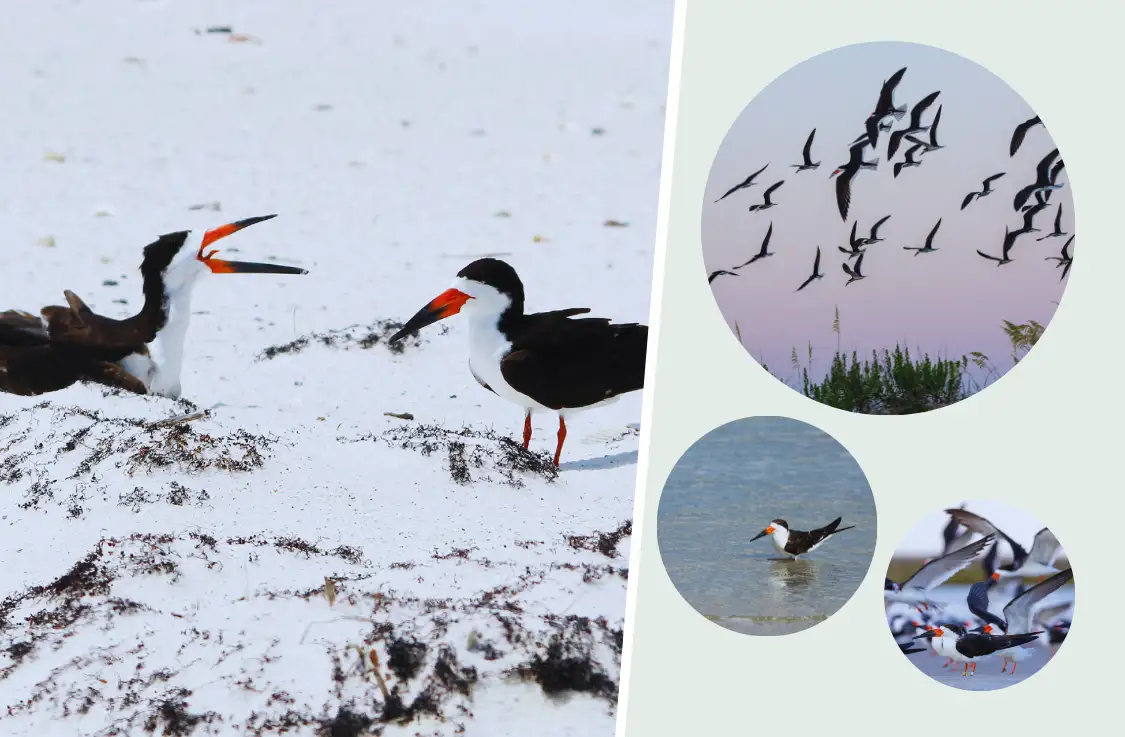
Outside the breeding season, Black Skimmers often gather in large flocks on beaches, sandbars and other open coastal areas.
Resting birds may lie almost completely flat against the sand, including their heads and bills. This unusual posture may help them stay cool and reduce the effort required to support their large bills.
During the breeding season, pairs become much more active. Courtship can include coordinated flights, displays and the presentation of fish by males to females.
Black Skimmer calls
Black Skimmers are not particularly famous for complex songs. Their calls are often described as barking or yelping sounds.
A flock in flight can sometimes be located by its distinctive vocalizations before the birds are visible. eBird notes that barking "yip" calls can be a useful clue when searching for a flock.
Black Skimmer conservation status
The global conservation picture requires some context.
The Black Skimmer is not simply a species that can be described as "rare." It has a broad distribution across the Americas, but several populations, particularly in North America, have experienced substantial declines.
Cornell Lab classifies it as a common bird in steep decline in its North American conservation assessment. The North American Breeding Bird Survey estimated an average decline of about 4% per year between 1966 and 2015, corresponding to an estimated cumulative population loss of approximately 87% during that period.
The main problem is the loss and disturbance of the open coastal habitats the species needs for nesting.
What threatens Black Skimmers?
Loss of nesting habitat
Coastal development can eliminate or reduce the sandy beaches, islands and shell banks that Black Skimmers need for nesting.
Human disturbance
People visiting nesting beaches can accidentally disturb adults or walk through nesting areas. Because the birds nest directly on the ground, their eggs and chicks can be particularly vulnerable.
Dogs and vehicles
Free-roaming dogs can disturb colonies or destroy nests, while vehicles driven across beaches can crush eggs and young birds.
Storms and high tides
Because Black Skimmers often nest close to the water, storms and unusually high tides can flood nesting areas and destroy eggs or chicks. Rising sea levels may increase this pressure in the future.
Pollution
Black Skimmers feed directly at the water's surface, making them vulnerable to pollution events affecting coastal waters. Their exposure was highlighted during the 2010 Deepwater Horizon oil spill in the Gulf of Mexico.
How can Black Skimmers be protected?
Protecting suitable nesting beaches is one of the most important conservation measures.
Effective actions include protecting breeding colonies from development, keeping vehicles away from nesting areas, managing dogs around sensitive beaches, limiting disturbance during the breeding season and protecting coastal feeding habitat.
Because Black Skimmers depend on a combination of safe nesting sites and productive shallow-water feeding areas, conservation works best when both habitats are protected.
Black Skimmer range and migration
Black Skimmers have a broad range extending through North, Central and South America.
Some North American populations are migratory, while many South American populations remain in the same general region throughout the year. Cornell describes the species as a short- to medium-distance migrant.
eBird's Status and Trends data also show strong seasonal differences in where Black Skimmers occur across their range.
Black Skimmer vs. similar birds
The Black Skimmer can resemble terns and gulls at a distance because of its long wings and streamlined body. However, its bill provides an immediate distinction.
The lower mandible extending well beyond the upper mandible is unique among the commonly encountered coastal birds in its range. Its combination of a black back, white underparts, red-and-black bill and short red-orange legs is also highly distinctive.
10 interesting facts about Black Skimmers
- The lower half of the Black Skimmer's bill is longer than the upper half.
- It catches fish by skimming its bill through the water while flying.
- Black Skimmers can forage in low light and at night.
- They usually fly very close to the water's surface.
- Their primary prey is small fish.
- They nest directly on the ground.
- Some nesting colonies occur on sandy islands and remote beaches.
- Juveniles are browner and less strongly patterned than adults.
- Black Skimmers often form large flocks outside the breeding season.
- North American populations have experienced major long-term declines.
Frequently Asked Questions