The Hairy Woodpecker is one of the most familiar black-and-white woodpeckers in North America, found across a wide range of forests and wooded habitats.
At first glance, it can look almost identical to the smaller Downy Woodpecker.
That resemblance is one of the most fascinating examples of convergent evolution in North American birds, with two species arriving at remarkably similar patterns despite not being close relatives.
Species Profile
Scientific Classification
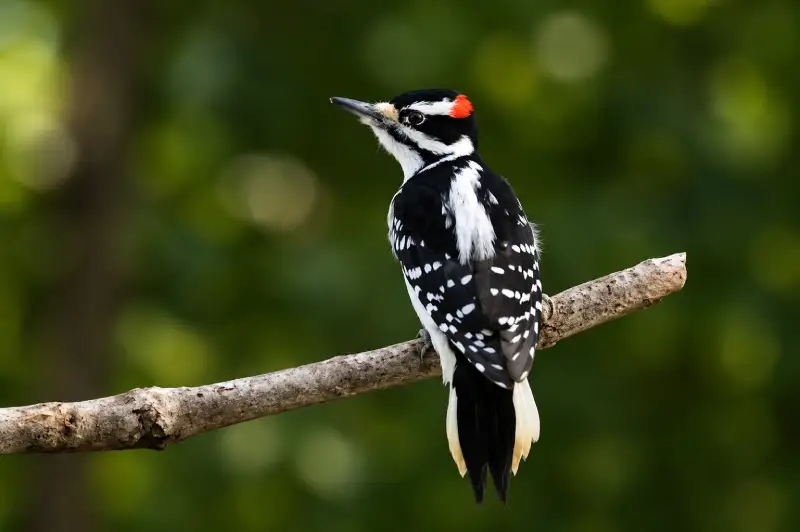
Birds known for strong bills used in drumming and foraging on trees, zygodactyl feet (two toes forward, two back), and stiff tail feathers used to prop themselves against trunks.
An order of largely arboreal birds that includes woodpeckers, toucans, and honeyguides. They typically have zygodactyl feet for grasping branches.
The true woodpeckers, piculets, and wrynecks. They are characterized by specialized shock-absorbing skulls and stiff tail feathers used as a prop when climbing.
A genus of small to medium-sized woodpeckers, typically featuring black-and-white patterned plumage. They are known for their rapid drumming and acrobatic foraging on tree trunks.
A diet consisting primarily of insects. The Hairy Woodpecker is an expert at excavating wood-boring beetle larvae, ants, and caterpillars from deep within tree bark.
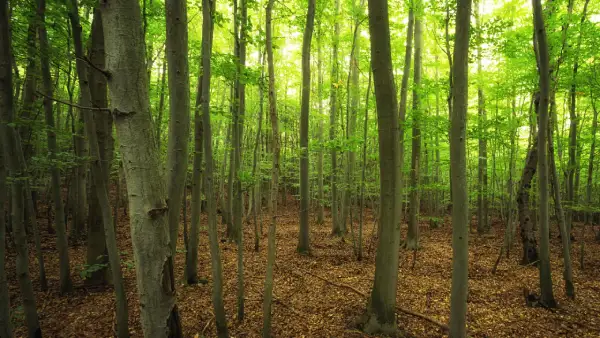
They favor larger, older tracts of deciduous and coniferous forests. They require large dead trees (snags) with heart rot for excavating their nesting cavities.
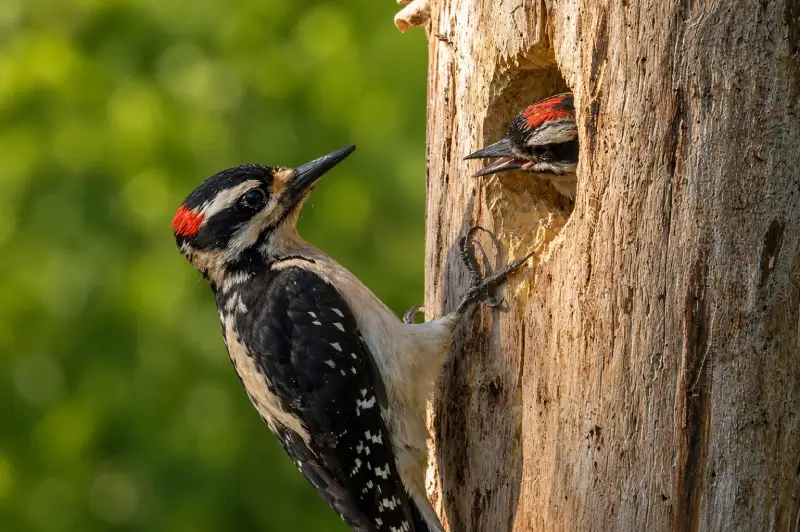
They excavate their own nesting holes in dead or dying trees. Both sexes help carve out the gourd-shaped cavity, which provides safe shelter for raising their young.
An IUCN classification for widespread and abundant species. The Hairy Woodpecker has a stable and robust population across a massive range in North and Central America.
1. Naming & Taxonomy
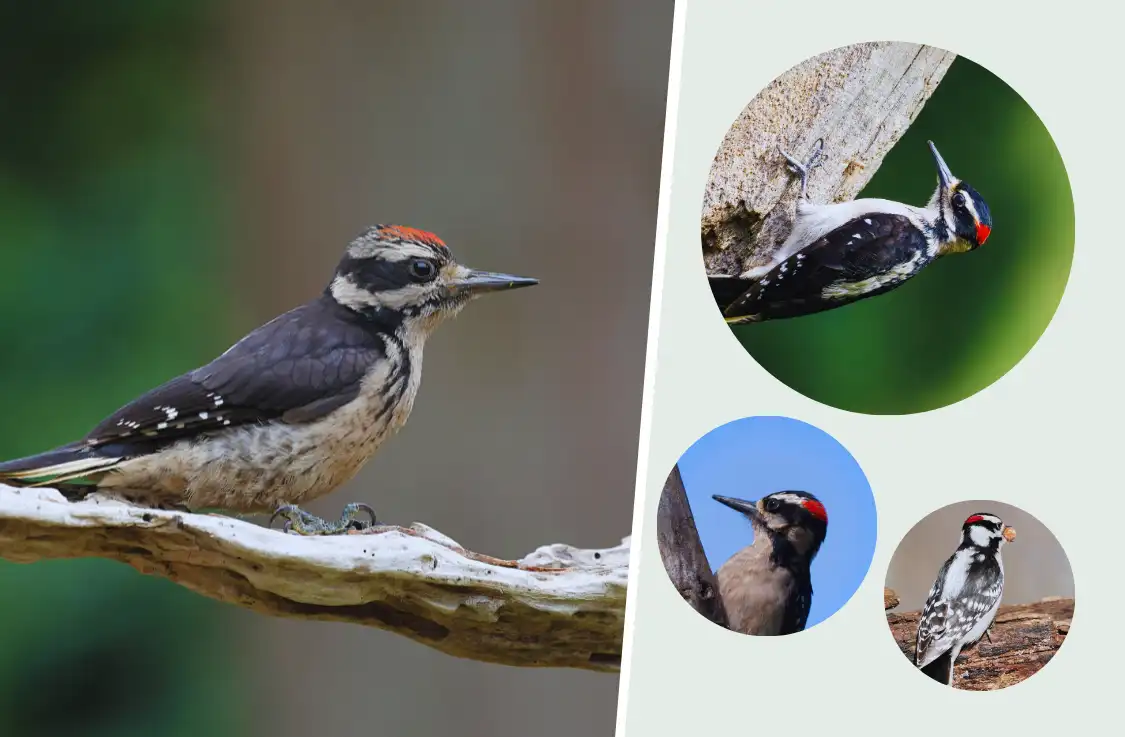
Mark Catesby described and illustrated the species between 1729 and 1732. Linnaeus formalised it in the twelfth edition of Systema Naturae in 1766, coining Picus villosus and citing Catesby’s plate. The epithet villosus is Latin for hairy.
The name refers to the back, not the general look of the bird. Cornell notes it comes from the long, filamentous white feathers running down the middle of the back.
Linnaeus gave the type locality as America septentrionali, North America, with specific mention of Raccoon, New Jersey.
The Genus Is Genuinely Disputed
If you look this bird up in three places you may get three different scientific names, and none of them is out of date. This is worth understanding rather than glossing over.
- Picoides villosus and Dendrocopos villosus are the historical placements. A 2015 molecular phylogenetic study by Fuchs and Pons found neither genus formed a monophyletic group, which triggered the reshuffle.
- Leuconotopicus villosus is the result of that revision, moving the species into a genus erected by Alfred Malherbe in 1845. This is what Wikipedia and the IOC World Bird List use.
- Dryobates villosus is used by other authorities, including the eBird/Clements checklist, the American Ornithological Society and Cornell’s Birds of the World. They favour an expanded Dryobates that absorbs both Leuconotopicus and Veniliornis.
2. Identification & Appearance
| Scientific name | Leuconotopicus villosus, also given as Dryobates villosus |
| Family | Picidae |
| Length | 7.1 to 10.2 in (18 to 26 cm), averaging about 9.8 in |
| Wingspan | 13 to 17 in (33 to 43 cm), averaging about 15 in |
| Weight | 1.4 to 3.4 oz (40 to 95 g) |
| Subspecies | Seventeen |
| IUCN status | Least Concern |
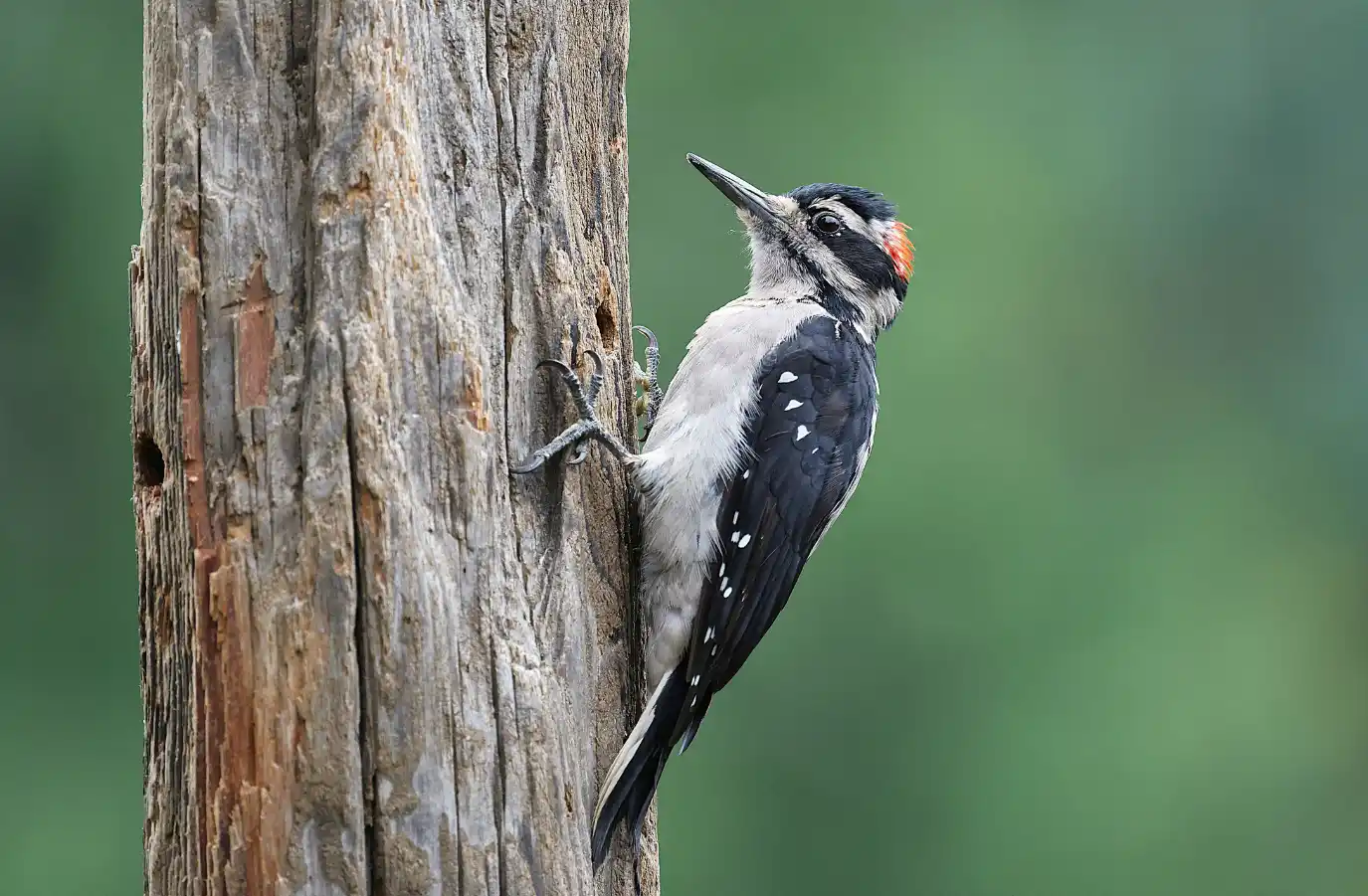
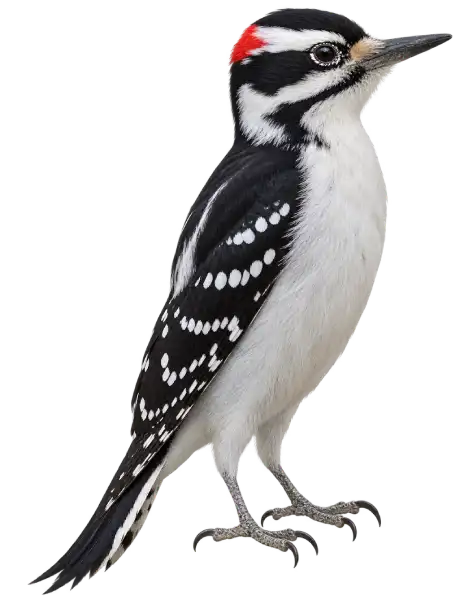
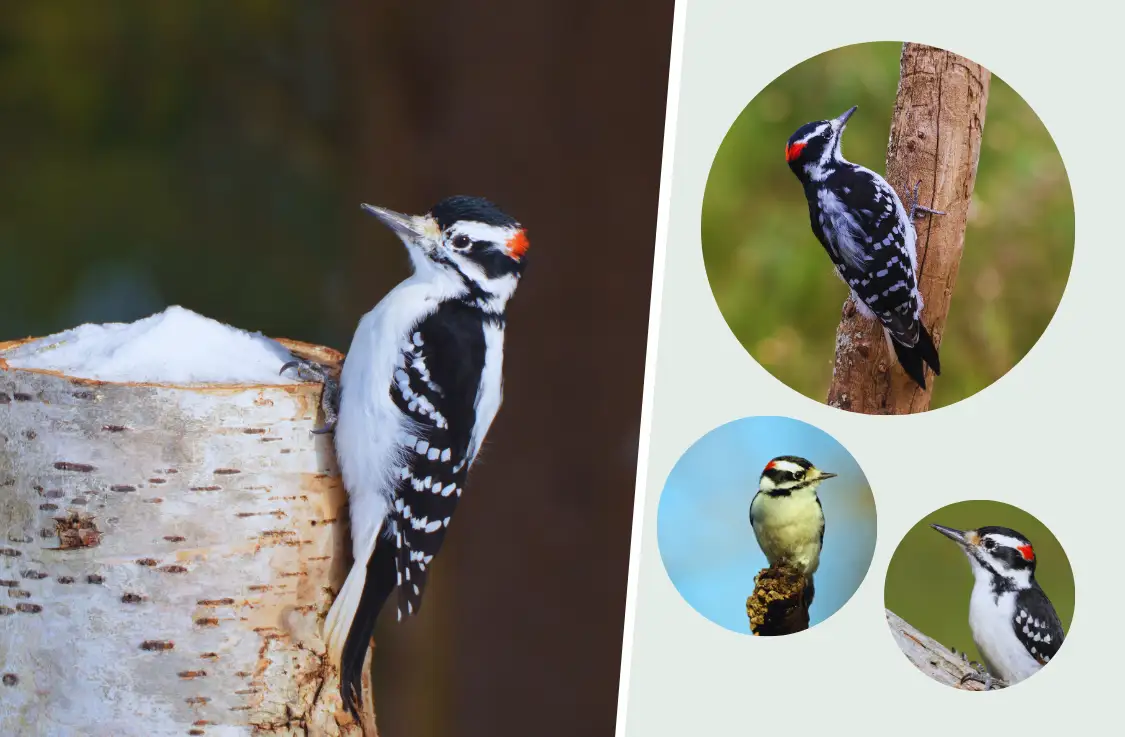
Adults are black above and on the wings, with a white or pale back and white spotting across the wings. There is a white bar above the eye and another below it. The tail is black with white outer feathers.
Underparts vary more than most people expect. The throat and belly run from clean white to sooty brown depending on which subspecies you are looking at.
Adult males carry a red patch, or two smaller side-by-side patches, on the back of the head. Juvenile males show red, or occasionally orange-red, on the crown instead.
3. Hairy or Downy?
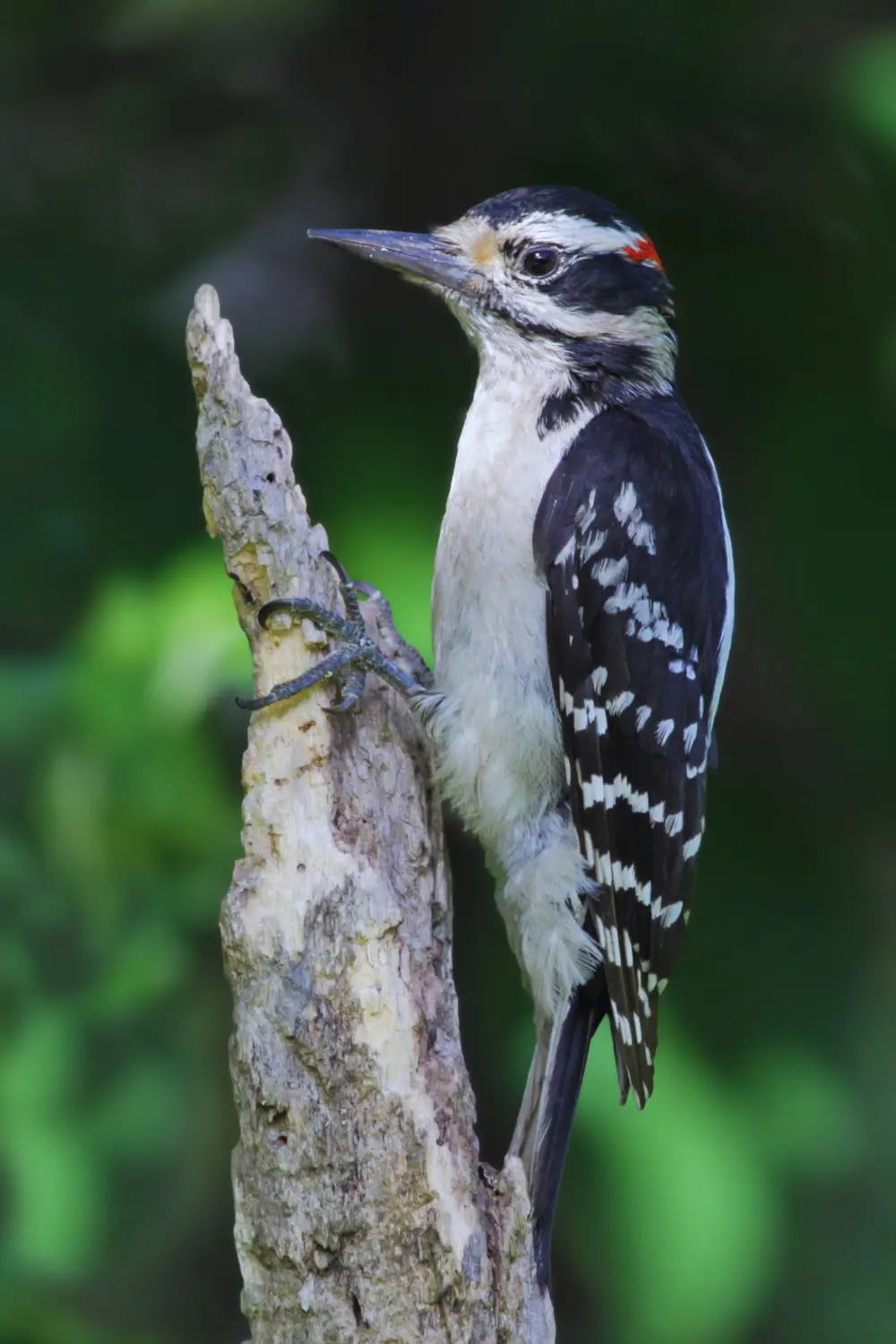
This is the question almost everyone actually arrives with, so it deserves a proper answer.
Bill length is the best mark. The Downy's bill is short relative to its head, roughly a third of the head length. The Hairy's is long and heavy, close to the full length of the head. Once you have seen it, it is hard to unsee.
Check the outer tail feathers. The Downy has black spots or bars on its white outer tail feathers. The Hairy usually has none.
Size works, but only with something to compare against. The Hairy is noticeably larger, though a lone bird at distance offers no scale.
Voice differs, and habits do too. Cornell notes the Hairy never feeds on weed stalks, cattails or reeds, which the Downy does readily. Audubon adds that the Hairy needs larger trees, is generally less common, and is less likely to turn up in suburbs and city parks.
Why They Look Alike
They are not closely related, and are likely to end up in different genera. The resemblance is convergent evolution, and it is striking enough that researchers have studied it directly. The reasons remain unsettled, with only tentative hypotheses advanced. What is clear is that the size gap between them means direct ecological competition is slight, so they coexist without much friction.
4. Subspecies & Variation
Seventeen subspecies are recognised, and Cornell describes the Hairy Woodpecker as one of the most geographically variable bird species in North America, with clinal variation in both size and colour across its range.
The spread includes distinct island and regional forms: picoideus on Haida Gwaii off British Columbia, terraenovae in Newfoundland, extimus from Costa Rica to western Panama, and piger and maynardi in the northern and southern Bahamas respectively. Central American populations run from Mexico south through Nicaragua.
5. Range & Habitat

| Range | Alaska and Canada south through the US, Mexico and Central America to Panama |
| Also found in | The Bahamas and Saint Pierre and Miquelon |
| Vagrant to | Puerto Rico and the Turks and Caicos Islands |
| Habitat | Mature deciduous forest, plus mixed and coniferous woodland |
| Movement | Mostly resident |
Despite the enormous latitudinal spread, this is largely a sedentary bird. Populations at the extreme northern edge may shift south, and birds in mountainous country may drop to lower elevations in winter, but there is no true migration.
6. Diet & Foraging
Mainly insects, with fruit, berries, nuts and occasionally tree sap making up the rest. Audubon notes it does more pounding and excavating than most smaller woodpeckers, taking large numbers of wood-boring insects in the process.
Typical foraging is a hitch up a trunk or along a large limb, braced back on the stiff tail feathers, springing upward with both feet at once. Cornell adds a specific habit: the bird will forage at the bases of trees, particularly ponderosa pines, which are attacked just above ground level by a bark beetle.
Like the Northern Flicker, it is a natural predator of the European corn borer, an invasive moth that costs US agriculture over a billion dollars a year.
7. Breeding & Nesting
Dryobates villosus · Breeding & Nesting
Primary Cavity NesterThe Nest
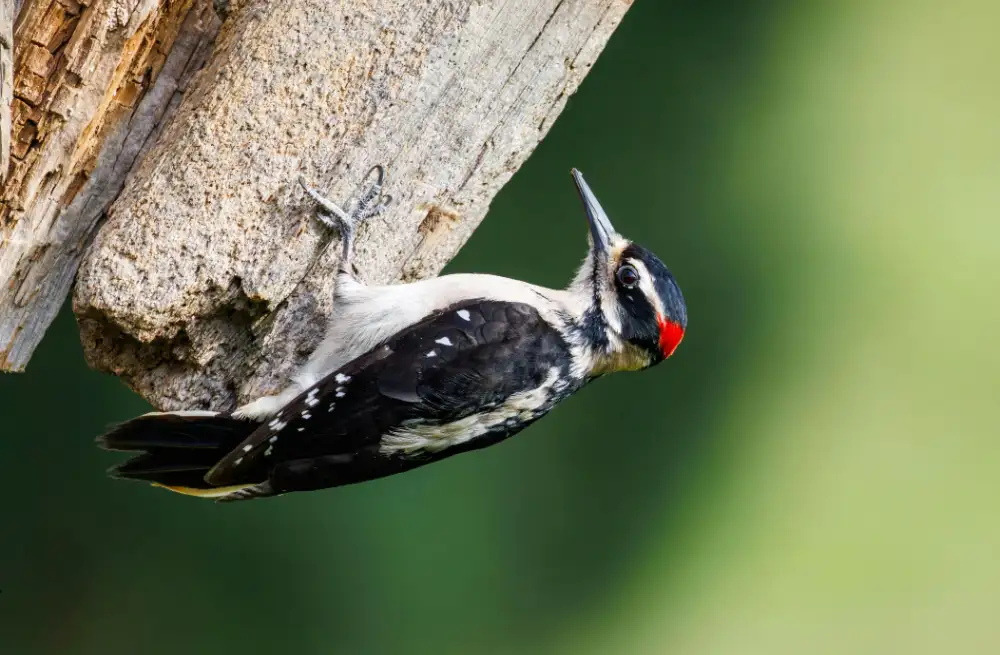
Both sexes excavate. The entrance is roughly 2 inches tall and 1.5 inches wide, opening into a cavity 8 to 12 inches deep that widens at the base to make room for the eggs and the sitting adult. There is no lining beyond a bed of wood chips on the floor.
Site choice varies by region. Audubon reports mainly deciduous trees in the east, and aspens or dead conifers in the west. Live trees are used where heart rot has softened the interior.
Pairing
Males and females may hold separate territories in early winter, then pair up in midwinter, often with the previous year's mate. The female's winter territory becomes the core of the nesting territory. Courtship includes both birds drumming in duet, and ritualised tapping by the female at symbolic nest sites.
Both parents incubate, with the male sitting overnight and the female taking most of the day, and both feed the nestlings. Audubon notes the male may forage further from the nest, making fewer trips with more food each time.
8. Conservation
The IUCN lists the Hairy Woodpecker as Least Concern, based on a 2020 estimate of almost nine million individuals across a very large range.
That said, some sources note the species is thought to have declined from historical levels in many areas. Two pressures are identified: the loss of nesting sites as dead snags are cleared from forests, and competition from European Starlings and House Sparrows, which will take over freshly excavated cavities.
9. Similar Species
- Downy Woodpecker: Same pattern, smaller, with a much shorter bill relative to the head and black spotting on the white outer tail feathers.
- Yellow-bellied Sapsucker: Similar size and also black and white, but with a red crown and throat, a long solid white wing stripe and a yellow-washed belly.
- Red-bellied Woodpecker: Barred rather than blocky black and white, with an orange-red crown and nape.
- Three-toed and Black-backed Woodpeckers: Northern forest species with barred flanks and, in males, a yellow crown patch rather than red.
Common Questions About the Hairy Woodpecker
Sources
- Wikipedia, "Hairy woodpecker" (primary source for this entry)
- Cornell Lab of Ornithology, All About Birds and Birds of the World species accounts
- National Audubon Society Field Guide, Hairy Woodpecker
- Animal Diversity Web, Picoides villosus
- Fuchs, J. & Pons, J. M. (2015), "A new classification of the pied woodpeckers assemblage," Molecular Phylogenetics and Evolution 88
- Weibel, A. C. & Moore, W. S. (2005), "Plumage convergence in Picoides woodpeckers," The Condor 107(4)
- Chesser et al. (2018), Fifty-ninth supplement to the AOS Check-list, The Auk 135(3)
- BirdLife International (2020), IUCN Red List: Leuconotopicus villosus
Last reviewed: July 2026. The genus assignment is contested and should be checked against whichever checklist you follow.